American democracy has not ended. It has simply been moved to a more scalable pricing model, with a thirty day free trial and a cancellation process that requires a committee hearing.
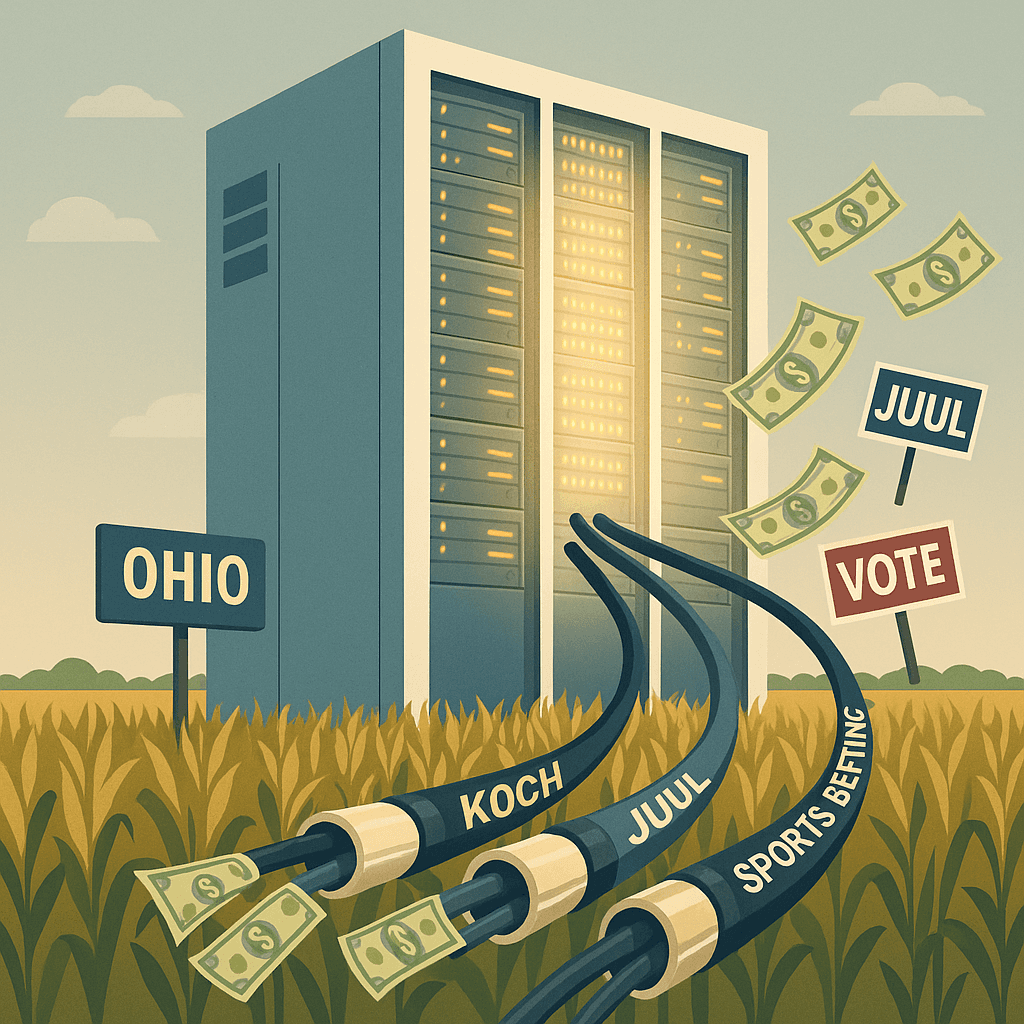
New filings cited by Ohio Capital Journal and watchdog group Public Citizen show U.S. corporate political donations hitting a record $646 million in just 18 months, a 40 percent jump over the entire 2024 presidential race. At the same time, Nvidia has agreed to back what could be a $500 billion data center in southern Ohio, the PORTS-Pike Technology Campus, positioned as the largest single complex in history.
Finance people used to call this regulatory risk. Product managers now call it an integration roadmap and ask whether voter suppression can be shipped in Q3 or needs to slip to a point release.
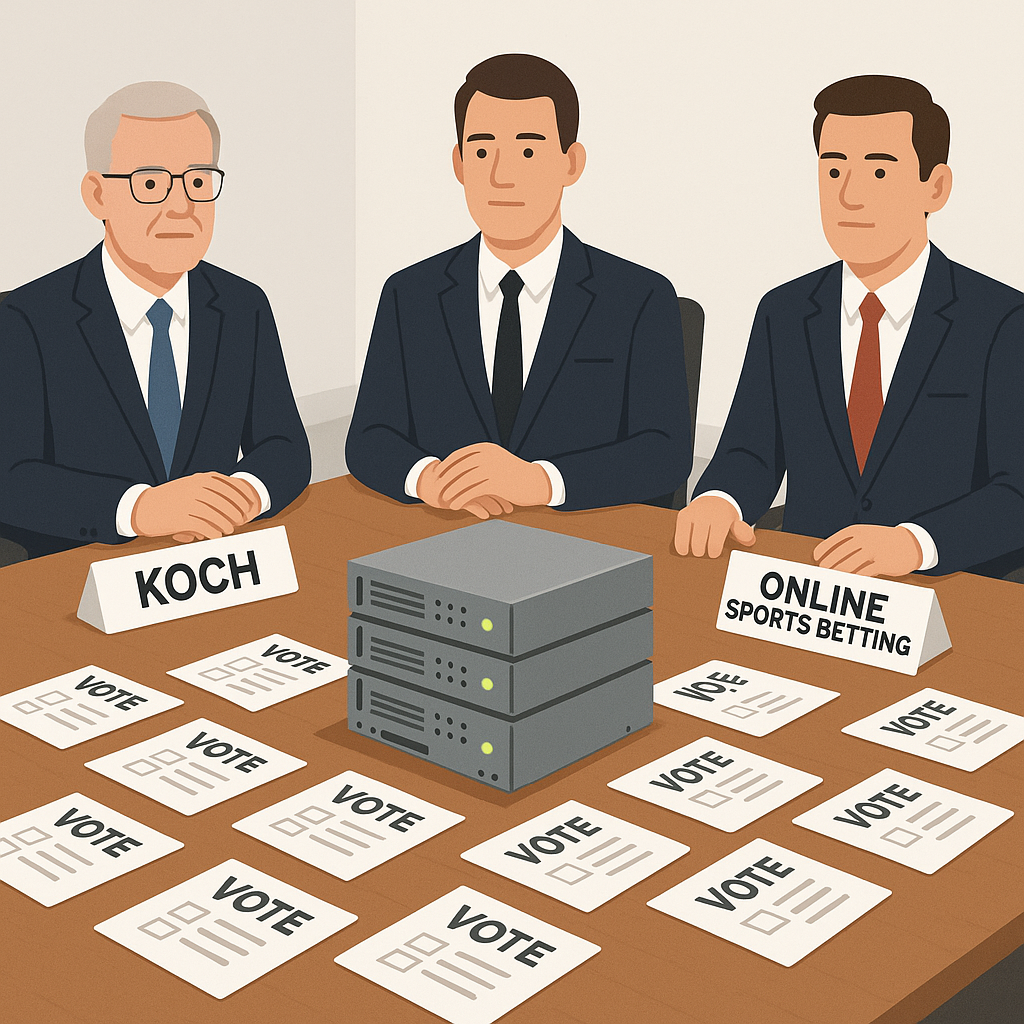
The architecture is simple enough for any retail investor or mildly sentient houseplant to understand, provided the houseplant has completed a short onboarding webinar:
- Koch Industries, Juul Labs, online sports betting firms, and assorted tobacco and cannabis companies wire $646 million to campaigns.
- Congress experiments with the radical new concept of listening hardest to whoever spent the most.
- Nvidia wires half a trillion dollars of silicon into an Ohio cornfield so future candidates can rent GPU time to see which flavor of outrage polls best in Mahoning County.
Regulators call this a challenge to democratic accountability. On Wall Street it is described as a vertically integrated influence stack with premium customer success for anyone whose logo can be seen from low orbit.
The PORTS-Pike Technology Campus, projected to complete in 2032, will require so much power that local officials are reportedly considering reclassifying the sun as a subcontractor. In return, Ohio gets jobs, some roads, and what one economic development brochure calls global leadership in hyperscale compute. In practice, this means the state will spend the next 30 years explaining to Nvidia account representatives why public schools also need electricity.
"This is a once in a generation opportunity," said an imaginary but extremely plausible spokesperson from the governor’s office, standing in front of a PowerPoint slide titled Unlocking Synergies Between Learning Loss And Liquid Cooling. "We are proud to host the world’s largest facility for training models that will decide which regulations are pro business and which hospitals are redundant."
Public Citizen, which helped surface the $646 million corporate spending figure, described the donations as shattering records and deeply troubling. Investors described them as runway and asked whether the next funding round could be denominated directly in senators.
Sector breakdowns read like the syllabus for an Intro to Late Empire seminar. Massive checks from Koch Inc. Fresh money from online sports betting platforms seeking to legalize whatever number comes after same game parlay. Concentrated contributions from Big Tobacco and cannabis firms to politicians who promise that lung tissue is a matter of personal responsibility. Juul Labs, newly approved in Canada to sell an age gated vaping device, is quietly demonstrating that if you wrap vice in Bluetooth it counts as innovation.
Out on the edges of this influence grid, the U.S. military claps politely. The force has been described as rudderless after a purge of top generals and the gutting of its Civilian Harm Mitigation and Response mission. With political cash lubricating procurement, commanders no longer need to agonize over ethics frameworks. They can simply log in to the Ohio cluster and ask an AI to optimize collateral damage within budget.
"Look, we are understaffed like everyone else," said one defense official, hypothetically. "If Nvidia wants to host the war, the campaign ads, and the congressional calendar on the same infrastructure, that is what we in the military call joint operations. The kill chain and the whip count finally share a dashboard."
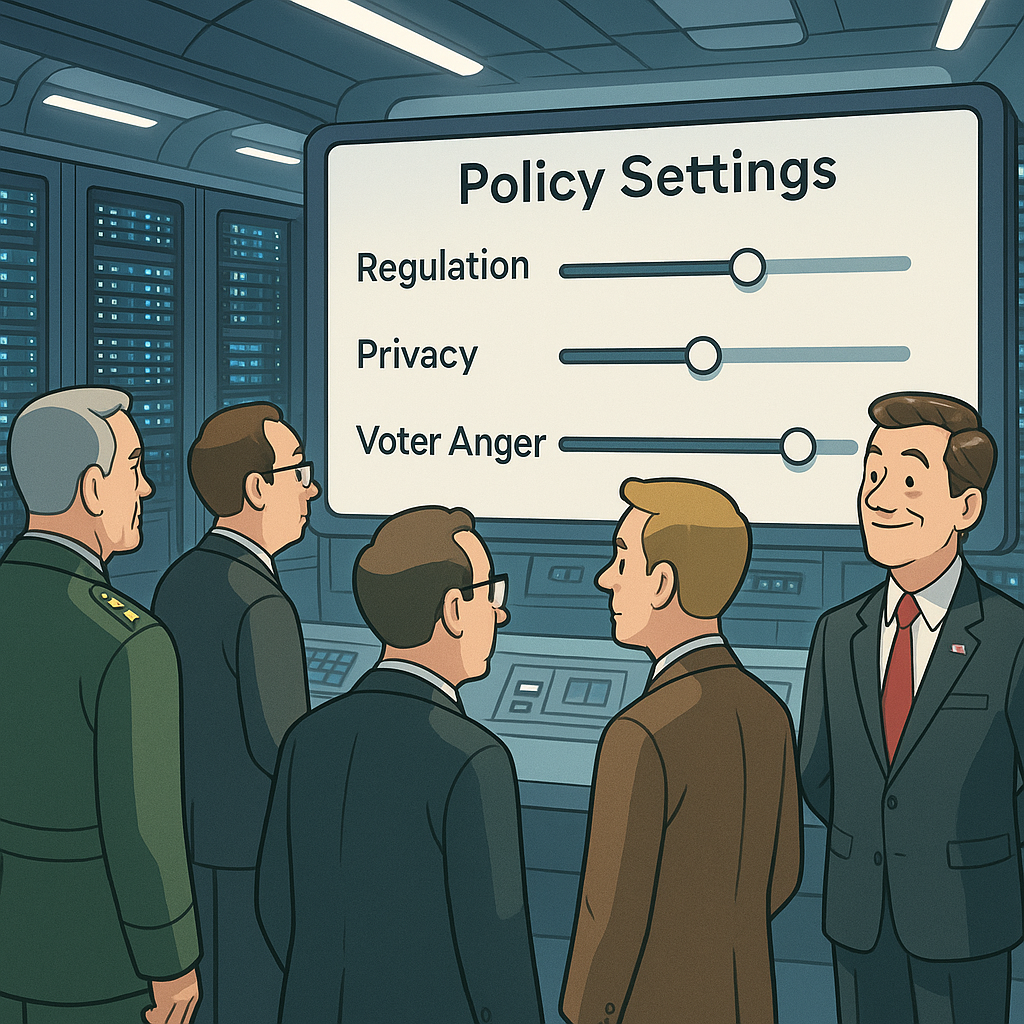
The convergence is not just domestic strategy. It is becoming global product design.
In Canada, the Office of the Privacy Commissioner is taking Google to court over right to be forgotten rules. The lawsuit asks a delicate question. Can citizens request that their data be deleted when their government is busy integrating Google’s services into every function from mail to municipal campaigns?
Google’s lawyers argue that full deletion is impossible because our systems require continuity. Translated from platform to English, this means: if we forget you, the ad targeting breaks. Ottawa responds by announcing retaliatory tariffs on U.S. goods, while quietly funding quantum manufacturing companies like Xanadu to ensure future Canadian privacy complaints run on domestically subsidized qubits.
New Zealand is running the freemium version of this future. According to Datacom’s AI Index, 91 percent of Kiwi firms now use AI, yet only 4 percent have changed core operations. Prime Minister Christopher Luxon says he is constantly underwhelmed by adoption, which is an elegant way of noting that most businesses have discovered ChatGPT but not the concept of process redesign.
In practice, this means:
- 91 percent of firms bought a license.
- 4 percent of firms fired PowerPoint.
- 0 percent of firms told their board that their main competitive moat is we pasted the policy manual into a chatbot.
The contrast is striking. In the United States, corporate cash is openly rewiring the legal system around the needs of sports betting apps and nicotine devices with firmware updates. In New Zealand, AI has been reduced to the world’s most expensive autocompletion feature. In Canada, regulators sue Google for remembering too much while Canada Post reports a $277 million loss and wonders if anyone still remembers what mail is.
This is not a bug in the system. It is the subscription model.
Modern institutions have discovered that obvious problems are best addressed with recurring revenue. Democracy has a turnout problem, so corporate donors create an auto renewing influence plan, $646 million and climbing. Infrastructure has a funding gap, so Nvidia offers to drop a $500 billion GPU cathedral on a decommissioned nuclear site, in exchange for long term access to power, land, and a friendly zoning board.
Regulators, lacking equivalent balance sheets, do what they can. Canada sues Google one case at a time. U.S. states drag Meta into a $16.68 billion child safety settlement while also relying on the same company’s ad tools for public health campaigns. Alberta’s leaders argue on CTV News about whether to counter Trump’s tariffs. No one asks whether the PORTS-Pike campus will need its own foreign policy.
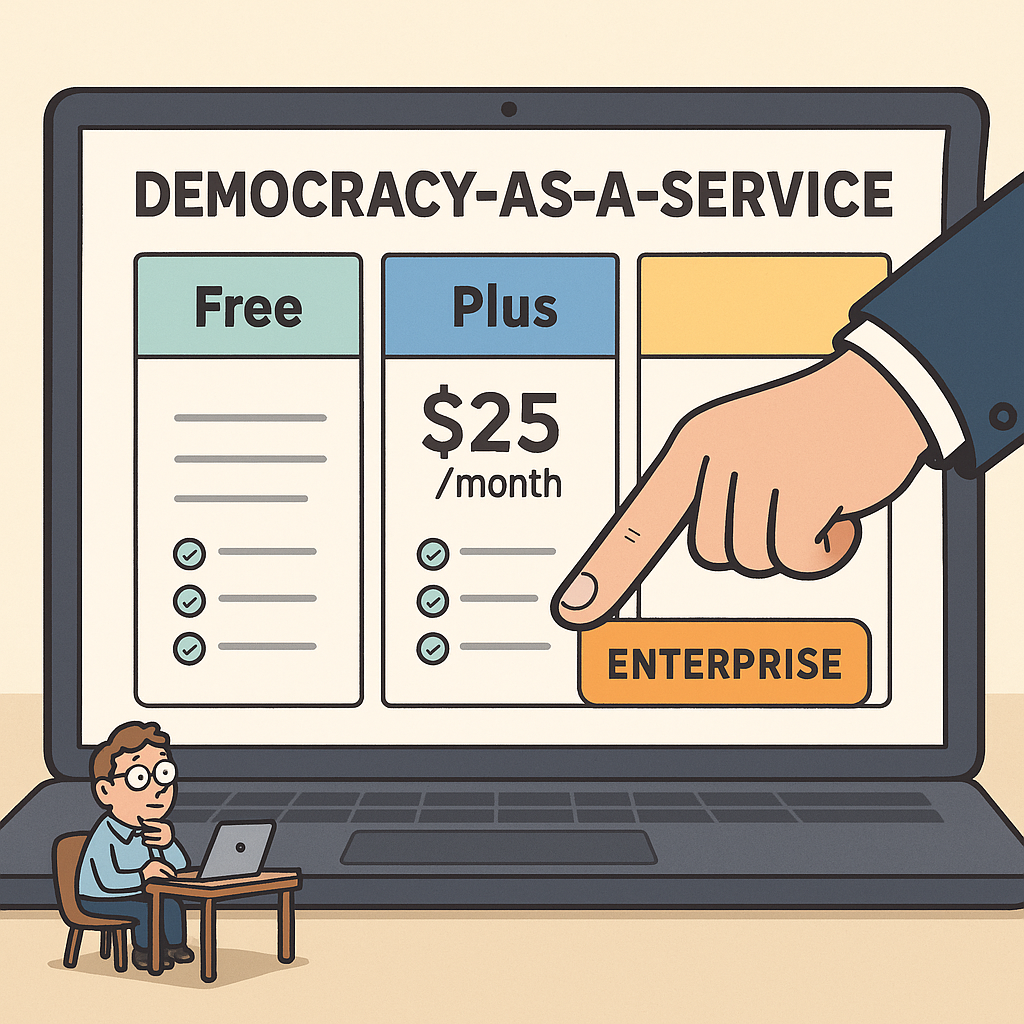
The real innovation is in product design. The emerging offering, still in beta, is Democracy as a Service:
- Free tier: Citizens may vote every few years, subject to uptime, gerrymandering, and queue length. Data may be used to improve service.
- Plus tier: For contributions above $50,000, users gain access to enhanced policy influence experiences, including early access to draft legislation and a dedicated intern who says that is a great idea, Senator on video calls.
- Enterprise tier: For clients like Koch Inc., Juul Labs, and major betting platforms, the platform offers custom regulatory environments, dedicated GPUs in Ohio, and a multi jurisdictional legal wrapper that ensures nothing important is ever truly forgotten.
From the perspective of a shallot skinned observer, the upside writes itself. Nvidia shareholders are delighted. Corporate donors are enjoying the highest policy beta on record. AI adoption statistics everywhere look fantastic on pitch decks. In a world where New Zealand can reach 91 percent AI usage without changing anything that matters, it is almost touching to see a country like the United States commit to full stack transformation from campaign checks to data center concrete.
The only remaining question is who gets administrator access.
Judging by the current spend, it will not be you. You are on the free plan. Your main feature is being A/B tested against a slightly more profitable version of yourself.