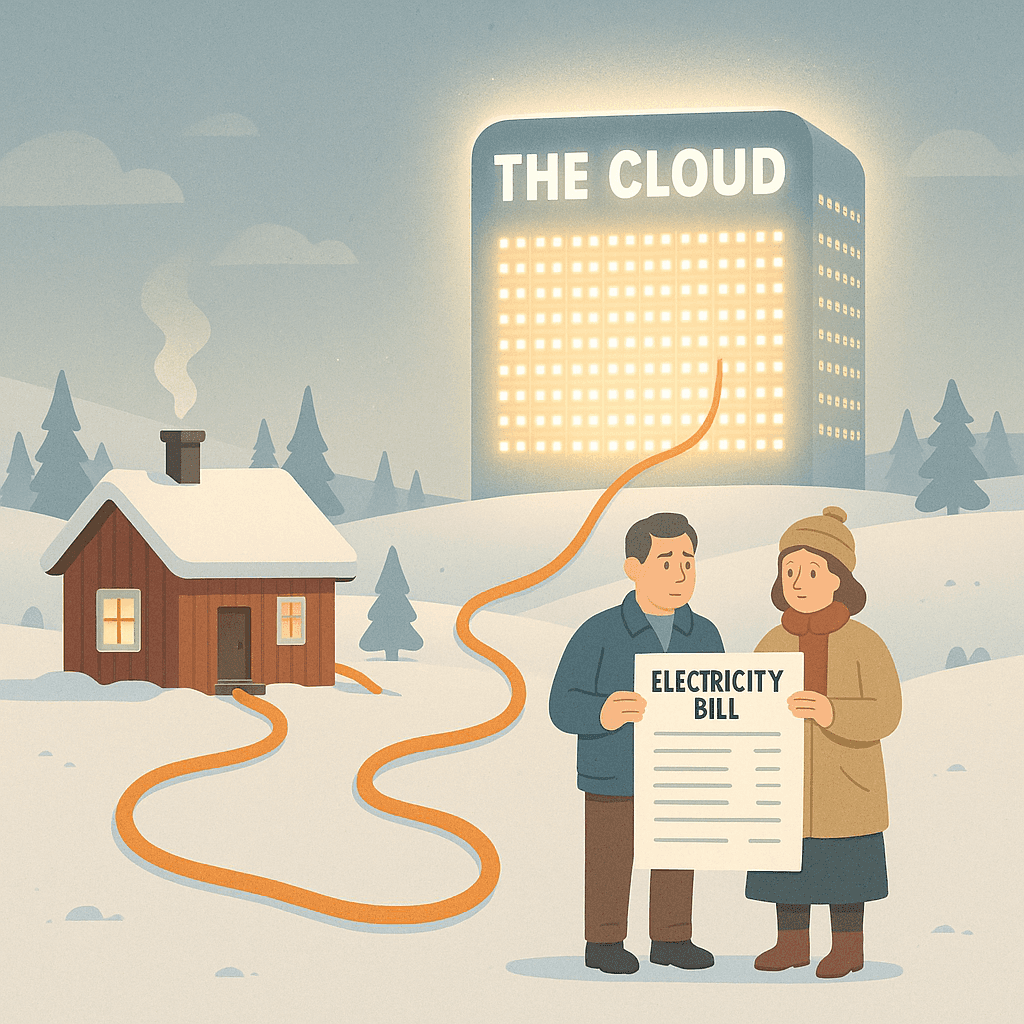
In a development experts called inevitable, Finland has discovered that inviting the world’s biggest data centers to plug into its low-carbon grid is less “green digital future” and more “foreign corporations speed-running our national power bill.” It is as if the country signed up to be Europe’s ethical snow globe and woke up as Microsoft’s extension cord concierge.
According to Yle News, a citizens’ initiative titled, in effect, “Please Stop Turning Our Country Into A Free GPU Outlet,” just hit the 50,000-signature mark in three days. Under Finnish law that number requires the Parliament of Finland to pause whatever it was doing, open Excel, and pretend to be surprised that Microsoft, Google, and ByteDance did not come to northern Europe for the reindeer or the concept of constitutional sauna.
The initiative demands two things that sound technical but translate cleanly into Finnish: new legal conditions on how data centers connect to the electricity grid, and a special data center fee. In corporate terms, citizens are asking hyperscalers to upgrade from the “Introductory Colonialism” plan to the “Enterprise Extraction, With Surcharge,” complete with a climate-themed loyalty program no one remembers signing up for.
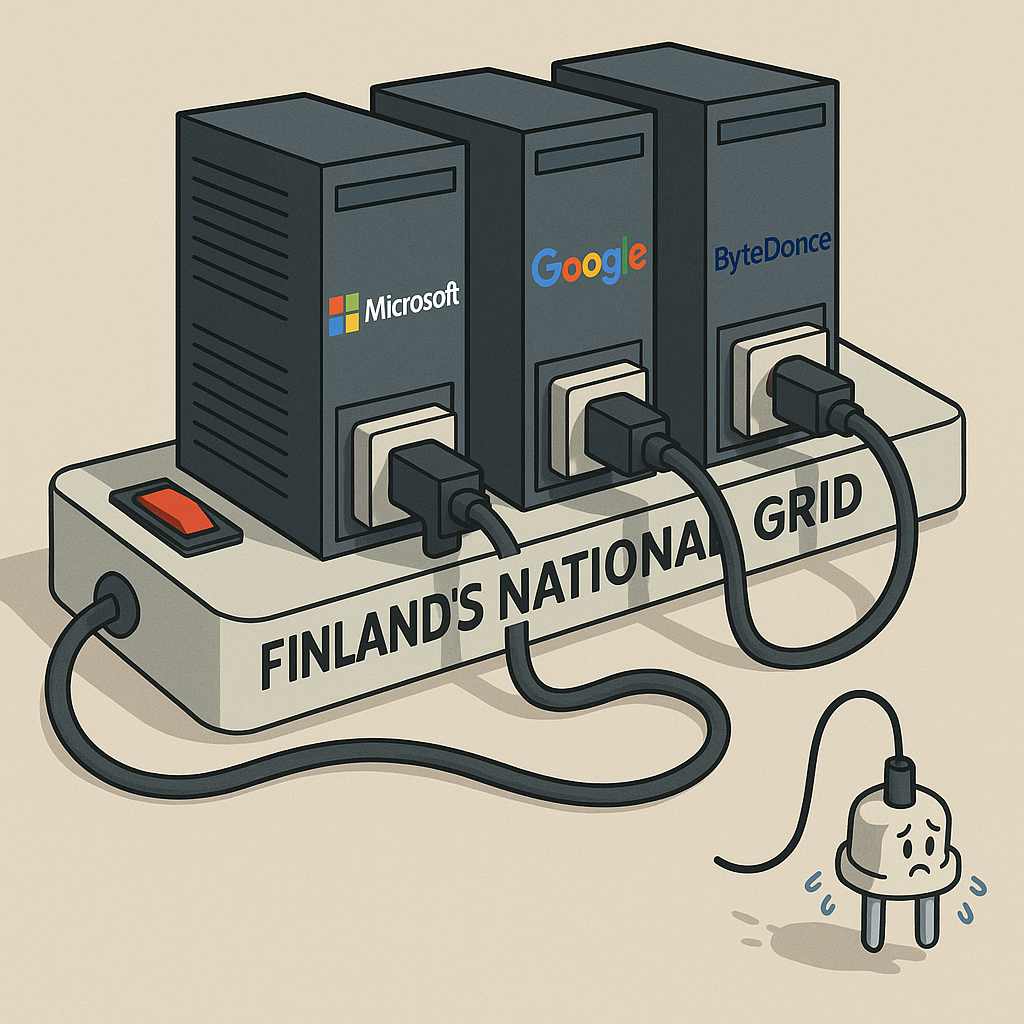
For a decade, Finland has pitched itself as an ideal host for server farms: plenty of low-carbon electricity, a cool climate that acts like free air conditioning, and a political culture that assumes when a foreign company says “sustainable,” it probably is. The resulting pipeline of investments from Microsoft, Google, and TikTok-owner ByteDance has delighted economic development officials and visibly annoyed everyone who owns an electricity meter, a heat pump, or a spreadsheet.
“We were told it was the cloud,” said one Helsinki resident, staring at a sprawling concrete facility the size of a medium religion. “Then I learned it uses more power than my entire town. That is not a cloud. That is a very large hairdryer for memes.” He pointed at the humming transformers and compared them, unfavorably, to his parents’ old Nokia charger which at least did not demand its own transmission line.
Grid operators describe the trend in neutral terms. Data centers are “large, inflexible loads” that “must be reliably supplied” and “shape capacity planning.” Translated into human, this means: when a new AI complex arrives, the national grid is legally obligated to prioritize your midjourney dog filter over grandma’s electric heater in February, then issue a PDF explaining that everyone should feel good about this because the dog has soft lighting.
Technology companies insist the relationship is mutually beneficial. They bring jobs, they explain, plus world-class digital infrastructure, plus the ability for Finland to proudly say that billions of cat photos are stored somewhere outside Kajaani. They also stress that waste heat from data centers can be reused to warm local homes, which is how citizens learned the word “waste” can quietly move between nouns without changing meaning and still arrive as an invoice.
“Our new facility will provide enough waste heat to warm 100,000 homes,” a hypothetical Google spokesperson said, in the exact same tone used to announce every other externality in the history of energy, as if they were giving away commemorative tote bags instead of repackaged server exhaust.
What the initiative’s backers heard was different: a proposal where Google uses Finland’s cheap low-carbon power to run US-based AI models, then sells back a byproduct to Finnish households who used to just have affordable electricity. In business school this is called “value creation.” In the citizens’ comments section it is called “we are literally paying for your server hangover,” with several footnotes about how the hangover has its own dedicated substation.
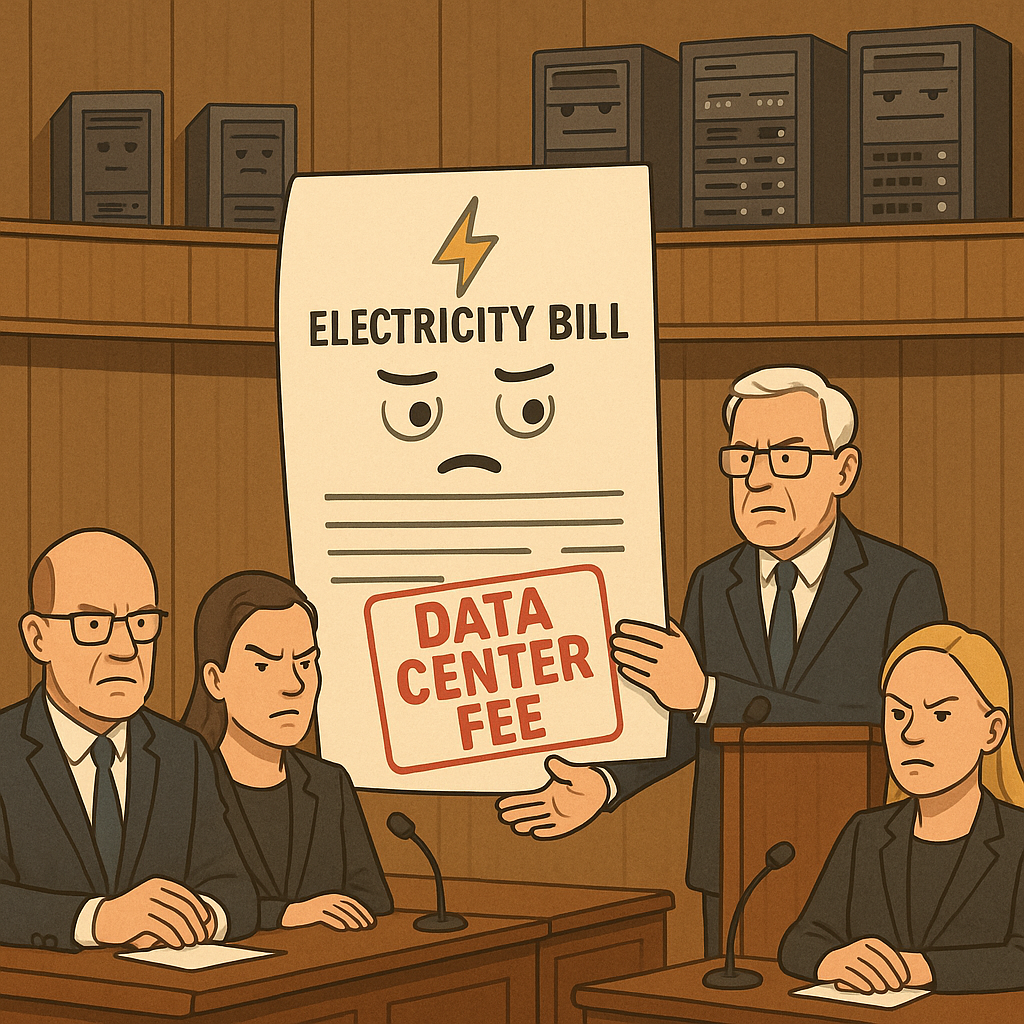
A key complaint is that data centers distort the electricity market. Their consumption is huge, predictable, and politely indifferent to price spikes. Ordinary Finns, by contrast, are encouraged to check an app, time their laundry, and consider living in the dark for national competitiveness. “Demand response,” the brochures call it, referring primarily to the emotional response of seeing a bill that quietly includes the global cloud along with your dishwasher.
The initiative reframes the issue completely. It is not about hating digitalization, it is about simple queue management. If the grid is a bakery, citizens argue, then households are lifelong customers who buy bread every day, traditional industry is the neighbor who occasionally orders 50 loaves for a party, and data centers are a guy who walks in, buys the entire oven, and insists this is good for brand visibility, regional innovation, and unnamed future synergies with croissant analytics.
Supporters want Parliament to move data centers into a distinct regulatory box. Different tariffs, stricter grid-connection rules, and the possibility that your right to train multibillion-parameter models might depend on not making electricity unaffordable for pulp mills and apartment blocks. It is a novel concept: AI as a conditional privilege rather than a constitutional amendment, subject to the same scrutiny as a noisy bar or a suspiciously enthusiastic cryptocurrency mine.
Technology lobbyists warn of consequences. If Finland imposes a data center fee, investors might look elsewhere. There are, after all, many other cold places with democracy, hydropower, and a vague desire to be “the next big AI hub.” Their message is simple: regulate us too much and we will leave you alone with your stable grid, functional electricity prices, and unmonetized sub-arctic breeze that stubbornly refuses to be turned into a platform.
Some in Helsinki appear unconvinced. Officials privately note that despite the hype, data centers create far fewer jobs than the number of zeroes in the press release suggests. A single hyperscale campus can consume as much power as a steel plant while employing roughly the staff of a medium-sized cafeteria, most of whom are there to keep humans away from the actual computers and occasionally explain to visitors that no, you cannot see the cloud.
Still, the timing is awkward. Europe is emerging from a painful energy crisis triggered by Russia’s war on Ukraine, and the phrase “strategic dependence” has started appearing in meetings that used to be about 5G roadmaps and neutral PowerPoints. It was one thing to be hooked on imported gas. Being strategically dependent on whether a US or Chinese firm would like to rent your electrons for their ad-targeting algorithm has a more niche dignity.
Meanwhile, across the Atlantic, the US House just passed a bill to limit utility bill spikes from AI-linked data centers, suggesting that for once, Washington and rural Finns are thinking the same thought: “If this future is so smart, why is my power bill dumber?” Somewhere a consultant is drafting a slide titled “Shared Concerns Across Transatlantic Stakeholders” and carefully avoiding the word “bill.”
Finland’s initiative could set a precedent. If Parliament treats data centers as a special class of consumer with their own tariffs and constraints, other northern European host countries like Sweden, Denmark, Ireland, and the Netherlands might follow. At that point, hyperscalers will be forced into a radical new experiment in innovation: using less of a finite resource that someone else also needs, without first giving it a name like HyperFlex Quantum Grid Synergy.
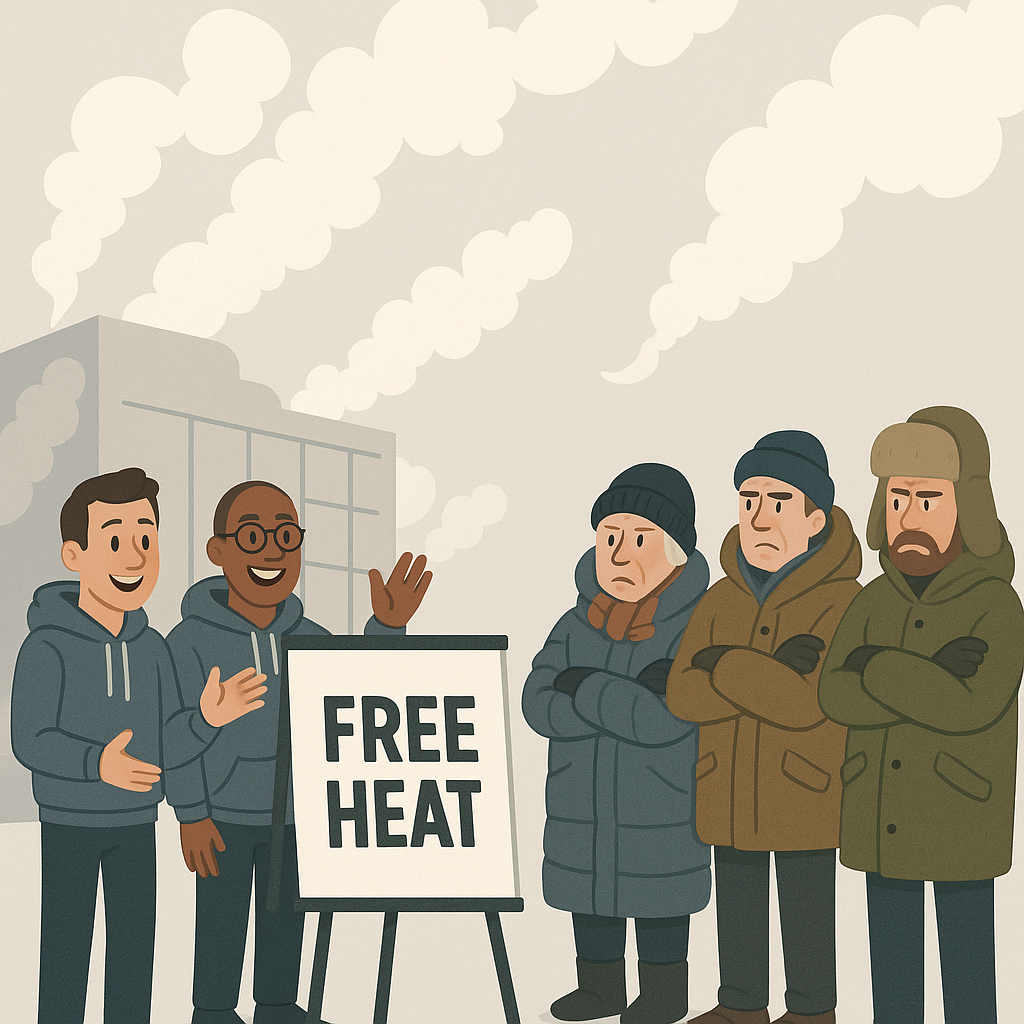
In public, Microsoft, Google, and ByteDance express confidence. They highlight ongoing talks about renewable projects, grid investments, and “community benefits” such as digital skills training, occasional school visits, and maybe letting local students look at the outside of a server rack from a safe distance while an adult reads aloud from a sustainability report.
In private, executives are reportedly modeling different scenarios:
- Scenario A: Finland keeps power cheap and plentiful, everyone pretends energy is infinite.
- Scenario B: Finland introduces a modest data center fee, which is passed directly to global cloud customers and described as a sustainability upgrade.
- Scenario C: Finland insists on full cost-reflective pricing, at which point the AI revolution briefly pauses to look up the meaning of “cost.”
For now, the spotlight is on Parliament. MPs must decide whether to accept their country’s role as a refrigerated annex of the global internet, or to tell the world’s richest firms that the northern lights are not, in fact, a free cooling solution bundled with grid priority and complimentary public patience.
As the debate begins, one quiet fact keeps intruding: Finland already met the “move fast” part. It is the first one to ask who exactly gets to break things, and who has to keep the lights on while they do it, preferably without checking an app to schedule their own shower.
Everyone agrees on at least one compromise. The cloud can stay. It just has to start paying for the weather.