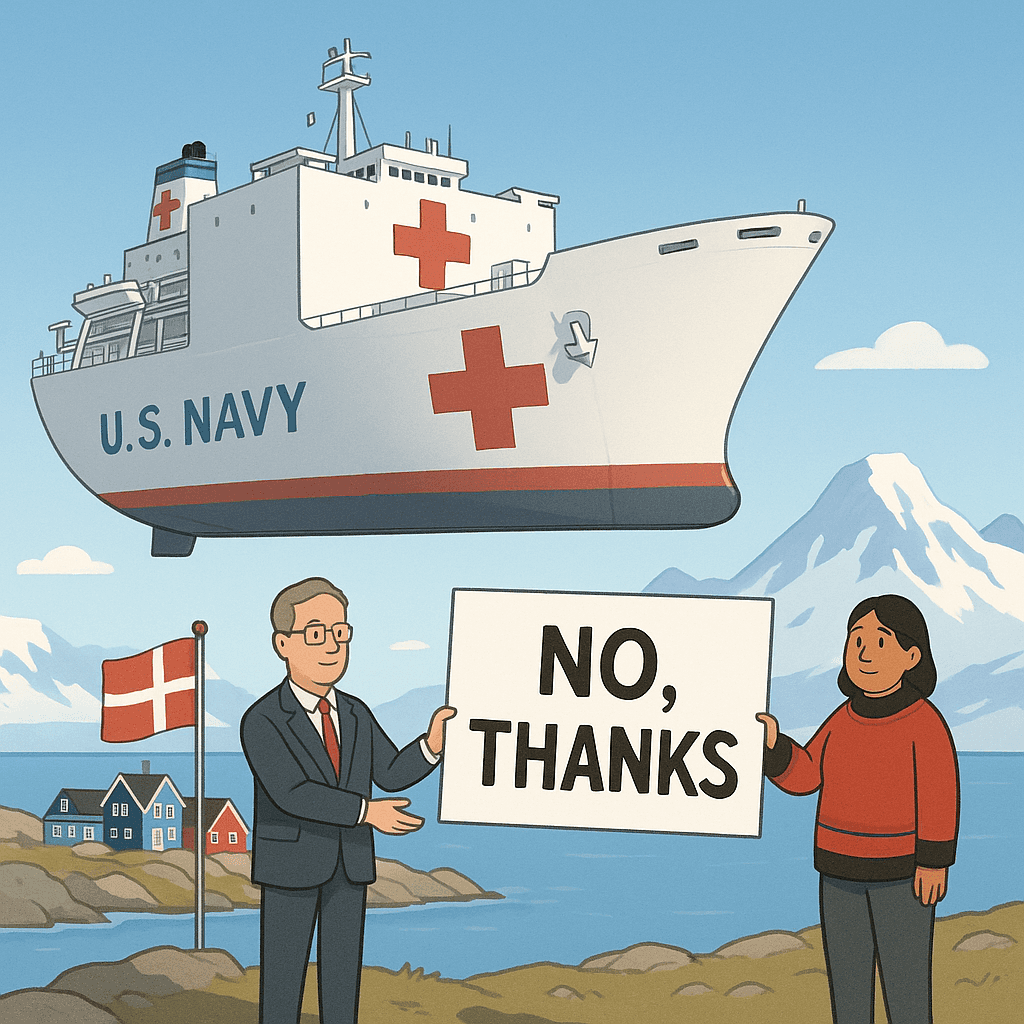
In a development that has left several US officials clutching their briefing folders like emotional-support PowerPoints, Denmark’s defense minister Troels Lund Poulsen calmly announced that Greenland does not need a US hospital ship, thank you very much, and could Washington please stop treating the Arctic like it’s a season finale of a Tom Clancy series (Kuwait Times, Feb 2025).
The suggestion that a gleaming US Navy hospital ship should glide nobly into Greenland, flags fluttering and deck helicopters doing their best recruitment-commercial poses, was reportedly floated as part of Washington’s ongoing attempt to demonstrate “commitment to Arctic partners.” Copenhagen, in response, demonstrated its own commitment to dignity and basic logistics by replying: “We’re good.”
Poulsen, speaking on behalf of the Danish government, noted that health services in Greenland are currently not in crisis, triggering confusion in several US think tanks who had already prepared 48-page memos explaining why a humanitarian deployment just happened to align perfectly with NATO’s expanded Arctic footprint, resource security, and the eternal quest for nicer drone backdrops.
“We appreciate the offer,” the Danish minister said with Nordic restraint, “but Greenland does not require a US hospital ship at this time.” Translated into Beltway dialect, the statement read: “Please stop using our territory as a prop in your soft-power Marvel reboot.”

The US proposal reportedly involved dispatching a vessel of the US Navy’s Military Sealift Command to Greenland’s shores, where it would provide medical support, joint exercises, and, crucially, wide drone shots of American humanitarian might against picturesque ice. Sources say the Pentagon had already workshopped a tagline: “Operation Polar Compassion: Freedom Never Freezes.”
Greenland’s government, which actually has to live there, seemed less enthused about being the set location for Season One of Grey’s Anatomy: Arctic Command. Officials in Nuuk politely noted that what they really need are long-term investments in local infrastructure, training for Greenlandic medical personnel, and maybe fewer climate policies that turn their ice sheet into an Olympic swimming venue.
“It’s not that we dislike hospital ships,” one Greenlandic health official allegedly remarked off the record. “It’s just that once they sail away, we’re still here, the snow is still melting, and the MRI is still from 2009. You can’t ultrasound your way out of geopolitics.”
The episode highlights a core feature of 21st-century foreign policy: the belief in Washington that there is no international issue that cannot be addressed with a combination of aircraft carriers, branded humanitarianism, and a well-lit press conference featuring at least two flags and one strategically diverse lineup of uniforms.
“In the US system, every problem is either a security threat or a PR opportunity,” said a fictional European policy analyst. “The Arctic is both, which is why the only thing more inevitable than American presence there is the hashtag strategy deck.”

The Danish rejection has triggered mild panic among US lawmakers who had hoped to turn the Greenland mission into a bipartisan showcase of muscular compassion. Several members of Congress had already drafted speeches praising the US for “standing shoulder to iceberg with our Arctic allies” while quietly lobbying to have the hospital ship stop at a few photo-friendly US ports on the way for “community outreach and campaign-ad b-roll.”
In conservative media, commentators expressed outrage that Denmark was “turning its back on American generosity,” while conveniently skipping the part where Greenland, a self-governing territory within the Kingdom of Denmark, has opinions, people, and functioning internet. One cable host thundered, “If Greenland doesn’t want US help, maybe China will send a hospital ship, and then what?” A question that, for once, seemed to alarm Washington more than the actual health metrics in Nuuk.
The ghost of Donald Trump’s 2019 idea to literally buy Greenland also made an uninvited cameo. Back then, the White House appeared to confuse a 2.1 million square kilometer territory with a distressed asset on Zillow. Now, the US is attempting a softer approach: if you can’t buy it, brand-heal it. Unfortunately for the State Department, Copenhagen appears to have read the terms and conditions.
“We understand the strategic value of the Arctic,” one Danish diplomat reportedly said. “We also understand the difference between actual healthcare cooperation and a Netflix miniseries pitch.” The diplomat then requested anonymity, not because of political risk, but because they didn’t want to be added to any future US PowerPoint titled “Key Stakeholders to Engage on Arctic Synergies.”
Greenlandic politicians, meanwhile, are using the moment to remind everyone that they exist outside of Washington’s satellite imagery. Locals have pointed out that if NATO partners are so eager to invest in Arctic resilience, they might consider:
- Climate adaptation funding that doesn’t arrive in the form of a destroyer escort.
- Support for training doctors who actually live in Greenland year-round.
- Infrastructure upgrades that still function after the journalists go home.
“We’re not a backdrop,” a member of Greenland’s Inatsisartut (parliament) was quoted as saying. “We’re a country. If you want to build ‘capacity,’ maybe start by asking what we actually need instead of what looks heroic from Washington.”

Yet, in DC, the saga is already being spun as a noble, if tragically unappreciated, gesture. Briefing materials circulated on Capitol Hill emphasize that the offer of a US hospital ship to Greenland underscores “America’s unwavering commitment to global health and regional stability.” The fact that the region in question waved it off like an over-eager MLM pitch has been relegated to page twelve, under “Engagement Challenges.”
In a particularly surreal twist, one Senate staffer suggested the US “revisit the proposal later, when Greenland is more receptive.” Arctic analysts translated this as: “The next time there is a crisis we can leverage.” After all, nothing proves the moral high ground like waiting patiently for someone else’s misfortune to validate your deployment schedule.
For now, Troels Lund Poulsen and the Danish government have neatly punctured the myth that every corner of the globe is thirsting for US hardware, as long as you slap a red cross on the side and call it ‘partnership.’ Greenland, it turns out, has its own agency, its own needs, and a suspiciously low appetite for becoming the pilot episode of Hospital Ship: Arctic Freedom.
But don’t worry. Somewhere in Washington, a committee is already drafting the sequel.
Working Title: “If They Don’t Need Our Ship, Maybe They’ll Take Our Think Tank.”