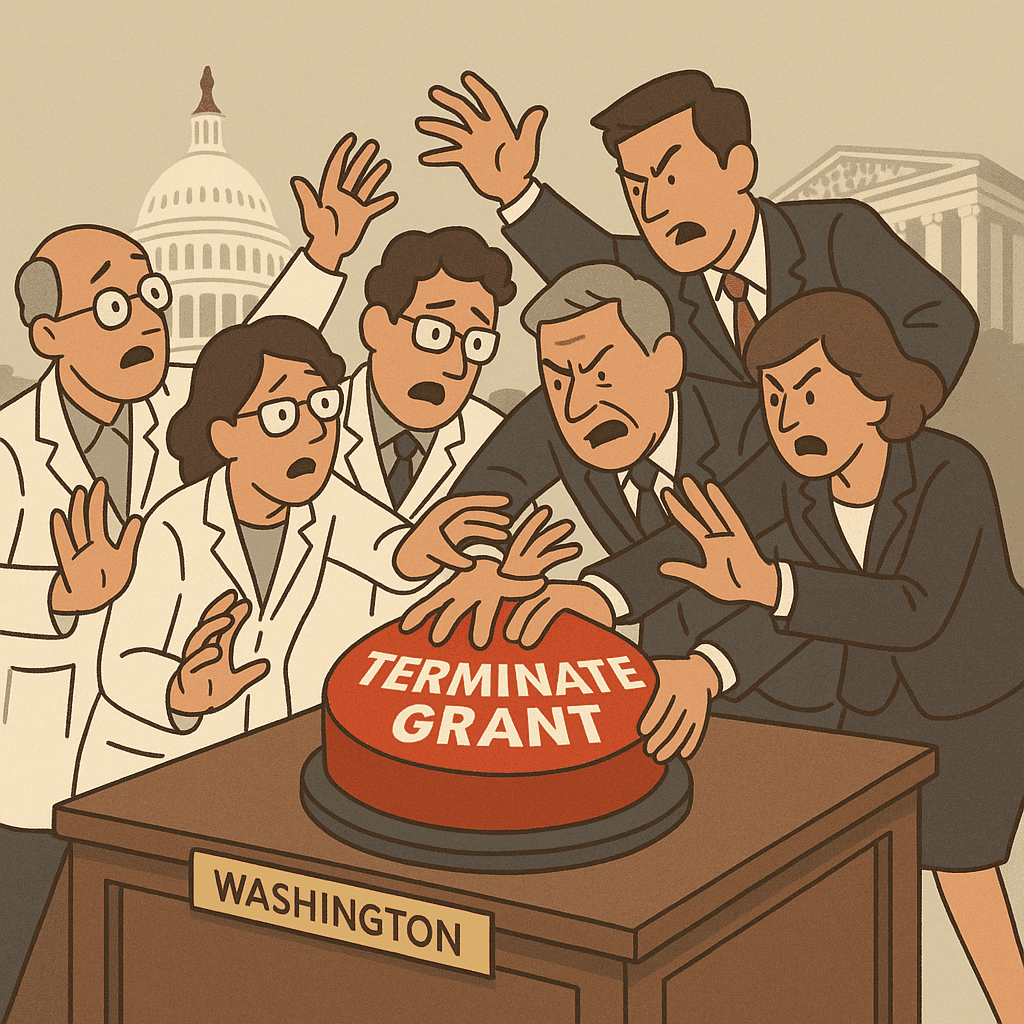
In a development experts called inevitable, federal policymakers have decided that if they cannot understand the future of science and technology, they should at least be able to right-click it and select “Terminate Grant.”
At the center of the fight, as AIP and others have noted, is a proposed Office of Management and Budget rule that would let political appointees overrule expert reviewers on federal research grants and cancel active awards whenever the data starts to look suspiciously like evidence. The Senate’s stopgap funding bill currently includes language to temporarily block that rule, which means America’s entire research ecosystem now hangs on whether Congress can pass a budget before it finishes its traditional fall pastime of threatening to erase itself from history.
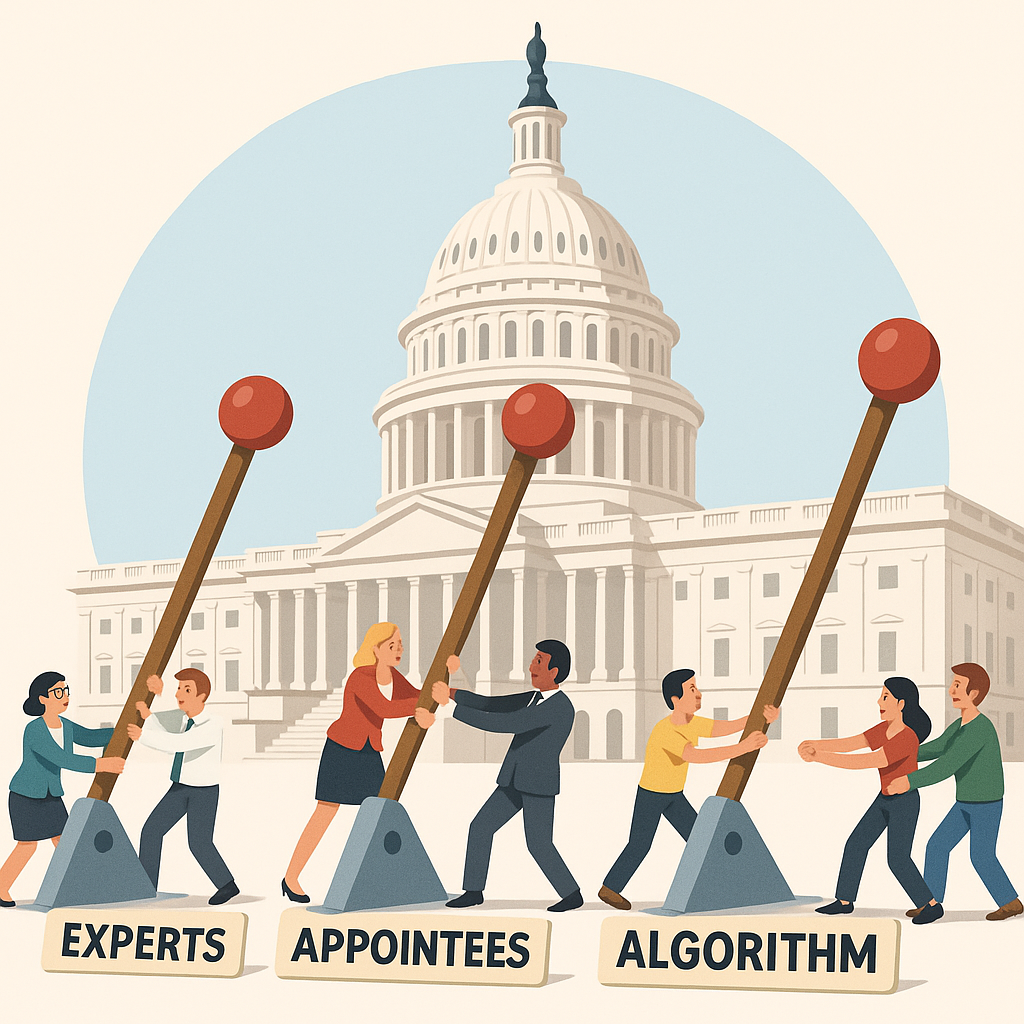
The OMB proposal is simple in structure, if not in consequences. For decades, grants have been awarded through peer review, a process in which subject-matter experts carefully read proposals, assess merit, and then lose to the one with the least controversial topic. Under the new rule, that tedious step would be augmented with a streamlined innovation: a political appointee who can look at years of climate modeling, mRNA cancer vaccine research, or AI-safety simulations and reply, “This feels off-brand for the administration.”
Supporters describe the change as restoring accountability. Critics describe it as “letting a guy whose last job was running a Super PAC decide whether NASA gets to study the dark universe,” which is technically also a form of accountability, just toward different celestial bodies.
Some Republicans, including Senate Appropriations Chair Susan Collins and House member Nick LaLota, have expressed worry that handing OMB a giant red “cancel” button for science might be a bit much, especially when the same government cannot locate its own Zoom links. Their concern is not primarily about partisan abuse. It is about latency. A grant might run for five years, a political attention span for roughly five hours.
“Look, we fully support science,” said one unnamed appropriations staffer, speaking on background because he was not authorized to admit to having read the OMB rule. “We just want the flexibility to terminate a pandemic early if the polling looks bad.”
Researchers are adapting. Several major universities are reportedly rewriting grant applications to sound more ideologically versatile. A proposal to study sea level rise now promises deliverables in three possible future timelines: woke oceans, patriotic oceans, and oceans that are just asking questions.
Another climate project has rebranded itself as “An Inquiry Into Whether Coastal Property Values Can Be Protected Through Thoughts And Prayers,” significantly boosting its odds of survival under multiple administrations.
Meanwhile, in the House, members have returned from a five week recess with a top priority, according to NBC News: avoid a government shutdown so that the fight over who controls the future of science and tech can continue on schedule. The stopgap funding bill is being fast-tracked on suspension, which allows it to bypass committees and any extended contact with reality, in favor of a quick vote that only requires a two-thirds majority and the absence of a last minute social post from Donald Trump.
Trump, for his part, has already claimed credit for Operation Warp Speed, the mRNA push he counts as a monumental achievement of his first term, and for a more recent executive order on quantum cryptography that the Treasury Department’s new Quantum-Readiness Task Force is now trying to interpret. Together, these moves suggest a clear doctrine: science is patriotic when it can be announced at a rally, and subject to review when it cannot.
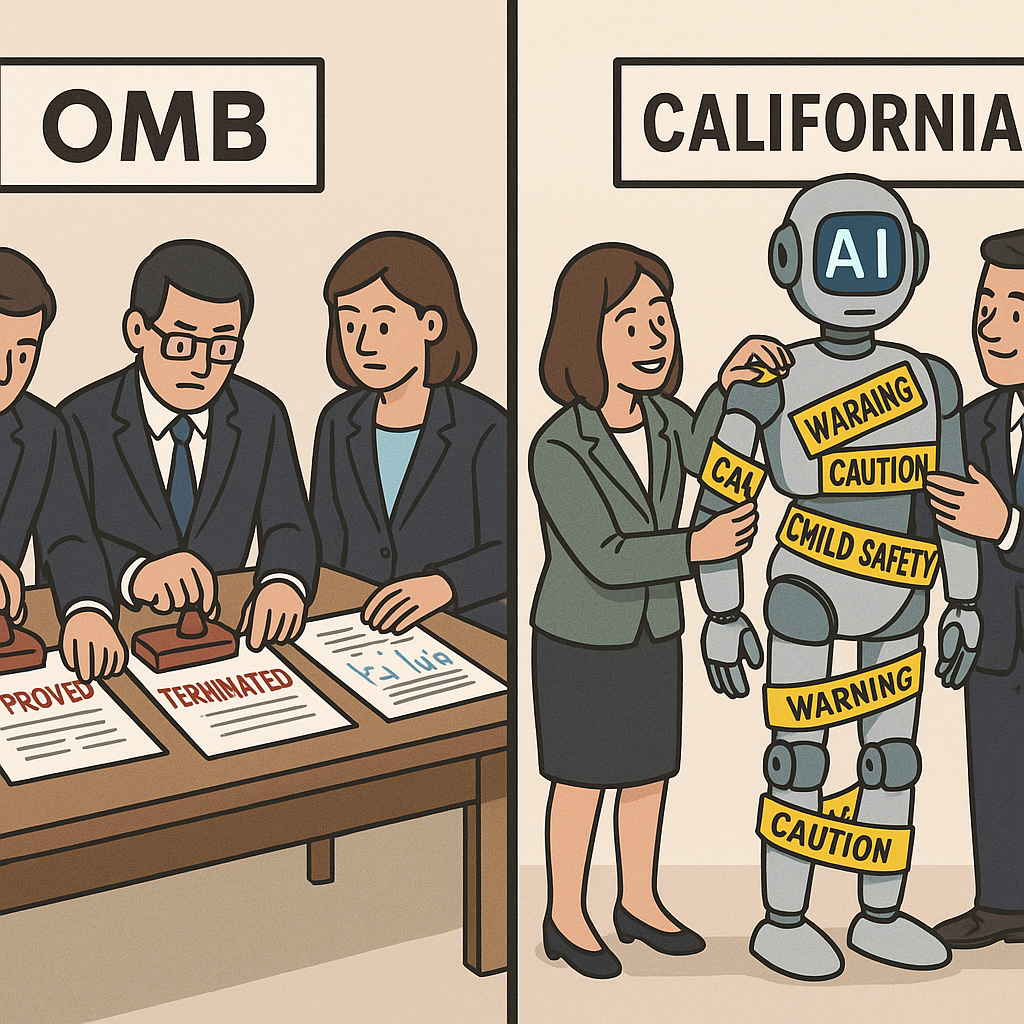
Across the country, California has decided that waiting for federal clarity is for people who still believe in the Commerce Clause. State lawmakers have moved ahead with a wave of AI and social media bills that promise to regulate everything from kids’ feeds to data center water use to whatever Anthropic is doing in that warehouse that glows at night.
“There’s a heightened level of tech anxiety right now,” Assemblyman Josh Lowenthal told the Los Angeles Times, citing fears about AI job loss, surveillance, and looming electric bills. “People are coalescing and they’re demanding that policymakers make change.” In practical terms, this means the legislature is trying to write binding, globally significant AI rules in the same building that previously outlawed plastic straws and then forgot to fund inspectors.
The result is a patchwork. In Washington, the House Energy and Commerce Committee is holding hearings on AI and quantum, the Treasury is convening its quantum-security brain trust, and the White House has published a National Security Science and Technology Strategy that lists everything from AI to quantum information science as vital to US leadership. In Sacramento, committees are debating whether Instagram should be allowed to show a 14 year old a video after 9 p.m.
Big Tech corporations now find themselves answering different questions on opposite coasts:
- In D.C.: “Can your AI help us maintain strategic dominance over adversaries?”
- In California: “Can your AI promise never to suggest a crypto app to an eighth grader while using more than three gallons of water per inference?”
Companies have responded in the only rational way. They are drafting parallel product roadmaps, one for the National Security Council and one for the Long Beach PTA.
Into this mess step groups like 314 Action, which has concluded that the most efficient way to influence science policy is to stop emailing fact sheets to Congress and instead replace parts of Congress with people who actually know what a confidence interval is. Their star candidate at the moment is pediatrician Annie Andrews, who is running for the South Carolina Senate seat left open by Lindsey Graham’s death and now occupied on the ballot by his sister Darline, with an endorsement from Trump.
Andrews has argued, in The Guardian and elsewhere, that with outbreaks of infectious diseases, cuts to Medicaid, and immigration raids in hospitals, there has never been a more important time to elect scientists and physicians to all levels of government. Political scientists call this trend “scientists losing their neutrality.” Scientists call it “the part where we try turning the country off and back on.”
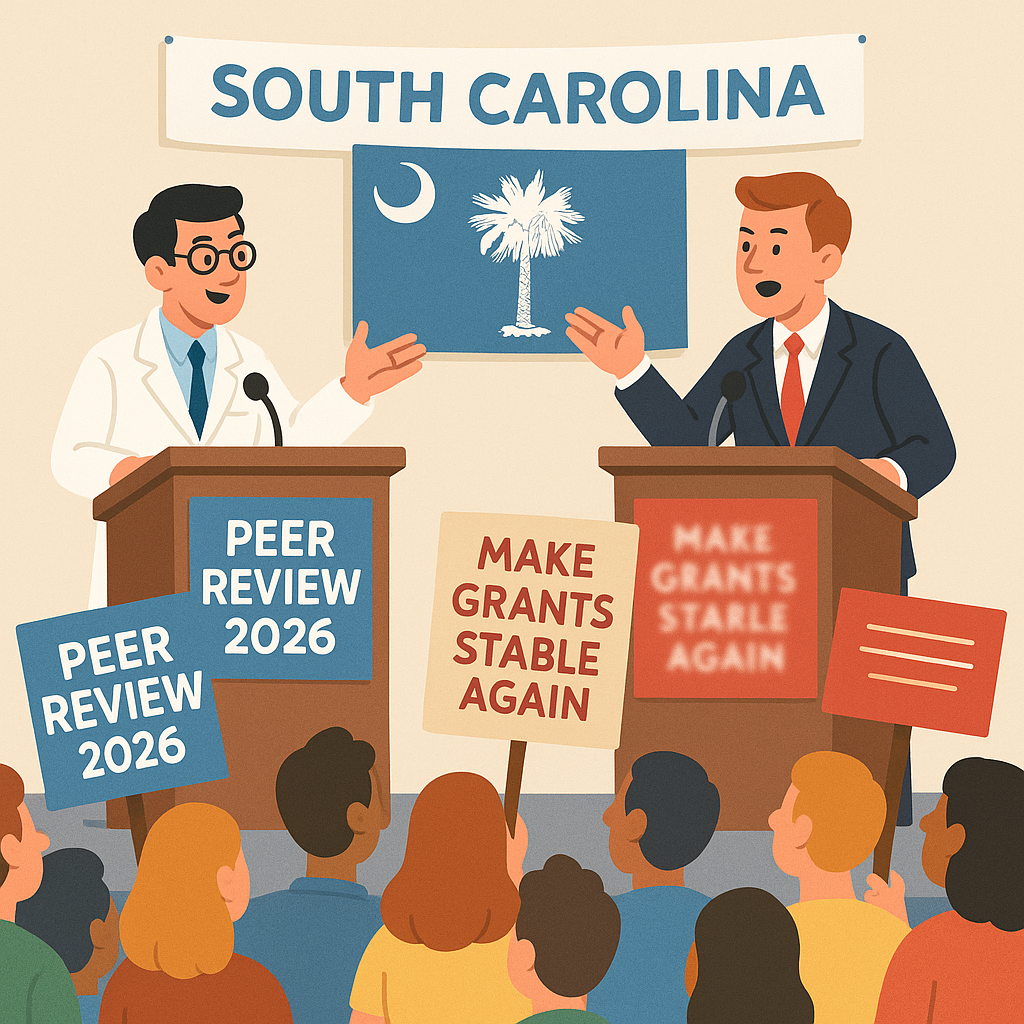
But the path is narrow. Research cited by Boston University’s Matthew Motta found that in 2018, nearly 200 STEM candidates ran for Congress and only about 12 percent won. 314 Action now talks about getting 100 scientists and doctors elected in the next four years, a goal experts describe as “ambitious” and elected officials describe as “a hostile takeover of our book club.”
Back in Washington, the White House continues to roll out security-focused initiatives like the National Security Science and Technology Strategy, which elevates quantum, AI, and other dual-use tools to the level of existential priorities. Open science advocates have noted that this framing tends to result in more classification, more export controls, and more visa issues for foreign researchers. National security officials have responded by quietly replacing the phrase “open collaboration” with the phrase “high-trust alliance network” and hoping nobody reads the footnotes.
The convergence is striking. On one axis, federal appointees are trying to centralize control over which grants get funded. On another, California regulators are trying to define what counts as safe AI for children and water tables. On a third, pediatricians and astrophysicists are knocking on suburban doors and explaining ranked choice voting to people who just wanted to ask about Lyme disease.
All of this is happening under the periodic threat of a government shutdown that would furlough the very agencies tasked with implementing whatever science policy survives the next 90 day continuing resolution. It is, in engineering terms, a system where the power cord occasionally negotiates with the wall outlet about whether electrons are feeling bipartisan this week.
When asked who should ultimately control the levers of science and technology, one senior staffer on the House Energy and Commerce Committee paused.
“Ideally, expert institutions,” he said. “Realistically, political appointees. But given how this year is going, my money is on whoever writes the AI that explains the next stopgap bill to Donald Trump.”
The future of US science and tech may depend on whether that AI is funded by a peer-reviewed grant, a political appointee with termination power, or a California pilot program testing “age appropriate legislative summaries.” Early drafts reportedly contain a helpful label at the top of each bill: “Rated PG-13 for violence, mild data collection, and frequent scenes of Congress touching the research budget.”
In the end, the real question may not be who controls the future. It may be who gets administrator permissions on the panic button.



