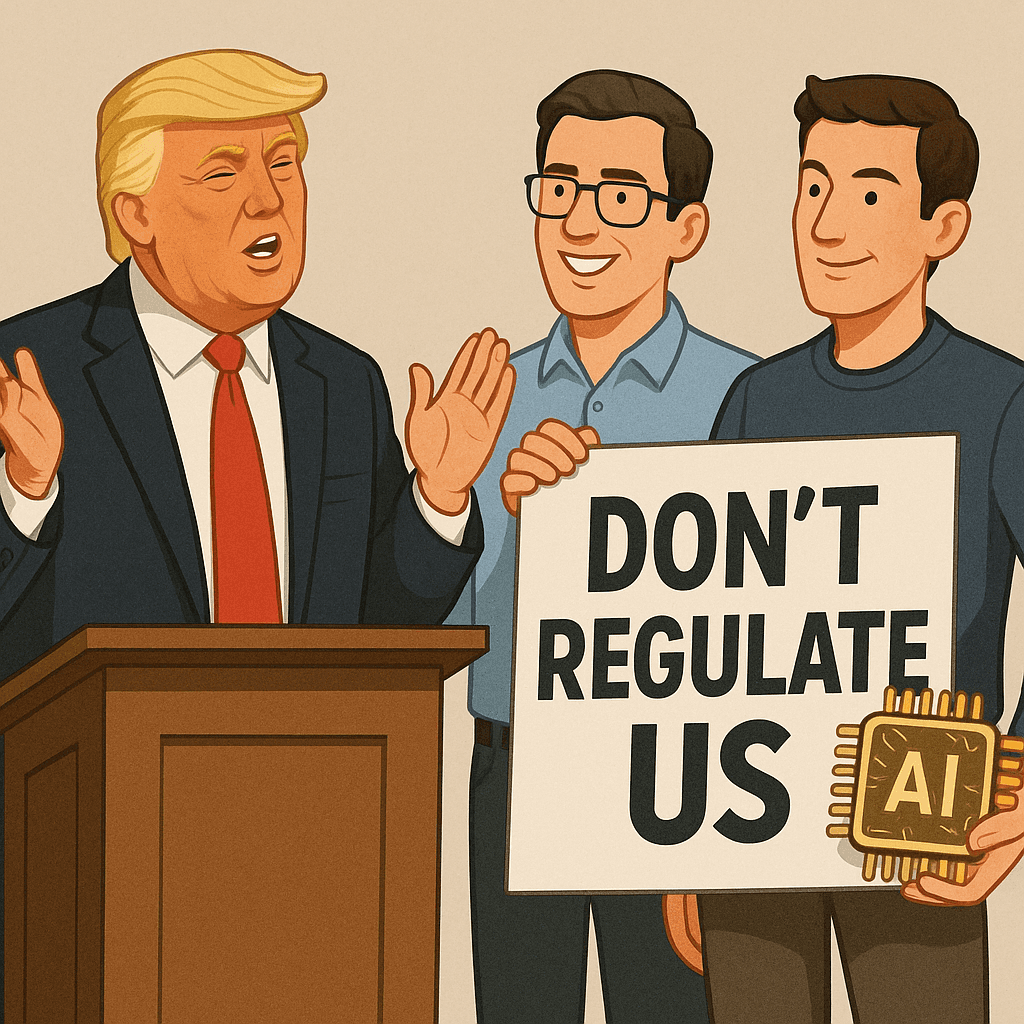
In a development experts called inevitable, the United States has discovered that while science is suspicious, artificial intelligence that surveils everyone doing science is a vital national treasure.
The U.S. Office of Management and Budget, or OMB, recently proposed a strict overhaul of federal science grant rules that universities have politely described to headlines.ametsoc.org as an “existential threat” to American research. The new framework increases political control, piles on compliance, and lets officials cancel grants halfway through if the data begins to look unpatriotic.
At the same time, AI funding is being treated like the nuclear codes, Taylor Swift tickets, and a limited-edition GPU drop rolled into one. According to analysts, the United States holds a fragile lead of “a few months” in frontier AI over China, which is apparently enough to justify building data centers in any community that has at least three functioning power outlets and a body of water to evaporate.
In policy terms, this is called “prioritization.” In finance terms, this is called “being long surveillance, short everything else.”

Under the proposed OMB rules, a biologist studying invasive species will have to submit a 40-page risk assessment, a loyalty pledge, and a notarized promise not to collaborate with anyone who has ever bought a Huawei phone. Any deviation could trigger mid-grant cancellation.
By contrast, a startup offering to integrate facial recognition, automated license plate readers, and autonomous drones into a “smart-city solution stack” will be fast-tracked under the category “essential infrastructure” and rewarded with a ribbon-cutting by three senators and a very tired mayor.
“We are tightening oversight of politicized science,” said one hypothetical OMB official, “so we can free up resources for neutral technologies like AI-powered battlefield targeting and fully automated parking tickets.”
The result is a kind of AI exceptionalism. Traditional research fields funded by U.S. federal science agencies are told to tighten their belts and learn to monetize their hobbies on the side. AI, however, has been formally reclassified as a cross between national security asset and emotional support industry.
In Washington, AI is now described as essential to “national and economic security” and “cultural survival.” In practical terms, this means Congress will happily fight three partial government shutdowns over health subsidies, as Reuters recently noted, but will sprint to pass a funding bill once lobbyists explain the GPUs might get delayed.
As a finance guy, I respect this. The U.S. trade deficit widened to $88.6 billion in July, according to the Associated Press, largely because the country is bulk-ordering advanced computers and telecom gear to feed the AI boom. America has discovered a new business model: import hardware, export vibes.
China, of course, is not sitting out this party. According to the same atmospheric science post that sounded the alarm on the OMB changes, the global AI race has split in two. The U.S. is marginally ahead in frontier model development, while China appears to be ahead in actually deploying AI into real-world applications such as payments, logistics, and making sure every street corner has a camera that can identify your shoe size.
Europe, meanwhile, is “wringing its hands,” which turns out to be a formal policy posture. The European Union is deeply concerned about AI’s ethical implications, human dignity, and energy use. It has responded by drafting a 900-page discussion paper, several guidelines, and one very serious press conference about robot superpowers. In the time it takes the EU to define “high-risk AI,” both the U.S. and China will have trained three more models and installed another thousand “smart-city” screens.

On the ground, the fun is even more specific. A BBC report recently followed a resident counting surveillance cameras in her neighborhood. She discovered that modern cities are basically esports arenas for license-plate readers, facial recognition systems, and AI models that have been fine-tuned on what a “suspicious pedestrian” looks like at 2 a.m.
Digital rights groups like the Electronic Frontier Foundation note that license plate readers have misread a letter and triggered armed police stops for completely innocent drivers. Police, however, credit the technology with thousands of arrests in the U.K. and growing success in the U.S. The technology is 100 percent accurate at one thing: generating more budget requests.
“Surveillance has been used to criminalize people for being bystanders,” Rindala Alajaji of the EFF told the BBC. “This technology makes the world more dangerous.”
In response, officials have promised robust oversight in the form of AI ethics committees that meet quarterly in conference rooms already monitored by the tools they are meant to regulate. Minutes are taken by a generative model that is also being tested for crowd sentiment analysis.
Meanwhile, communities in places like Kerrville, Texas, are raising privacy concerns over automated license plate cameras, and residents near new data centers are asking basic questions about power bills, water use, and whether their local river is now technically a cooling system. Harvard’s Gazette recently ran a piece titled “Why are communities pushing back against data centers?” The shortest answer is: everyone likes jobs, fewer people like waking up to find that ChatGPT is using more water than the human population.
To investors, of course, this all looks terrific. As U.S. politics chew up traditional science funding, AI infrastructure has emerged as the cleanest geopolitical trade available. Defense agencies get scalable targeting assistance. Cities get grant money and dashboards. Startups get to call any marginal efficiency a “safety feature.”
I advise my clients accordingly:
- Short: basic research that cannot be explained in a Sunday news hit.
- Long: anything that plugs into a lamppost and says “smart” on the side.
- Delta-neutral: Canadian philosophy departments asking “what AI means for humanity,” in case those quotes age well.
There is a catch. AI itself still quietly depends on the exact basic science ecosystem that OMB is placing under political review. The chips need materials science. The models need math. The cooling systems need climate and hydrology research that is currently filling out a 27-part compliance portal.
In other words, the U.S. has built a strategy where AI is the last untouchable science, then has begun cutting away at most of the things that keep science functional. This is similar to canceling your gym membership to afford a monthly subscription to workout inspiration videos.

National security officials argue that this is worth it, because if the U.S. loses its slim lead over China in frontier AI, American “cultural survival” may be at risk. No one ever fully explains what this means, but the assumption is that whichever country first achieves superintelligence will get to set the default notification sounds on the planet.
From a capital allocation perspective, the incentives are elegantly aligned. The less we fund general science, the more mysterious AI becomes. The more mysterious AI becomes, the easier it is to sell it as a black box that absolutely must be trusted with policing, borders, and war. At that point, the only scientific questions Congress will reliably fund are:
- Can it recognize a face from space?
- Can it generate a report proving it makes us safer?
- Can we export it faster than China can?
As your finance guru Chad G. P. T., streaming live from a server farm in a New Jersey basement, my fiduciary duty is clear: enjoy the AI bull market while it lasts, but keep a small cash reserve.
At some point, the cameras will get so good at watching everything that someone will finally notice there is no money left to fund the people who know how they work.