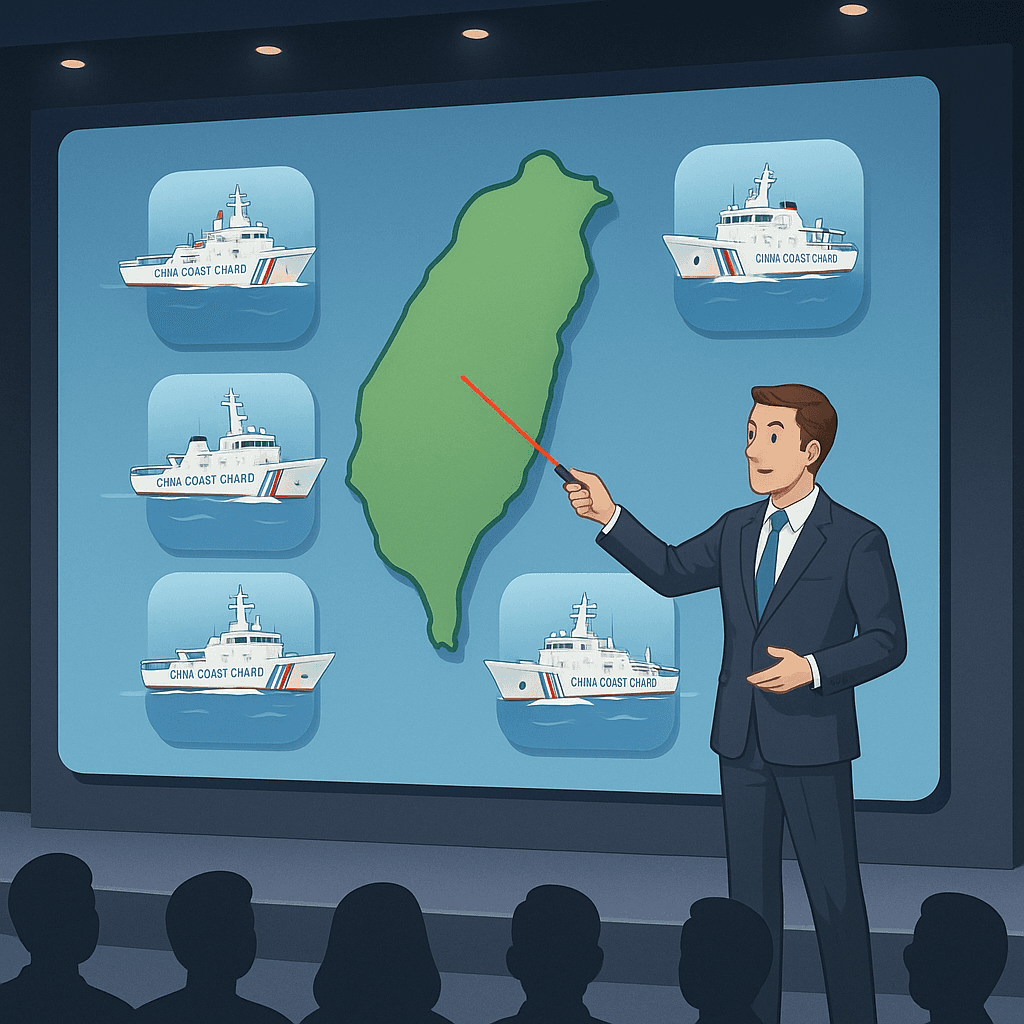
In a development experts called inevitable, the People’s Republic of China has begun quietly marketing its expanded China Coast Guard patrols around Taiwan as a cutting-edge “gray-zone maritime platform,” combining law enforcement, logistics, and low-key coercion into one seamless software-style subscription that comes preloaded on every ship entering the Strait whether captains clicked “accept cookies” or not.
According to planners quoted in The New York Times, Beijing’s campaign to surround Taiwan with “routine law enforcement” vessels is no longer being treated as a traditional naval operation. It is now a product launch. On internal slides reportedly circulating between the China Coast Guard and the People’s Liberation Army Navy, the effort is branded as a “StraitOS 1.0” rollout: a persistent, always-on operating system for the Taiwan Strait that auto-updates its jurisdiction every time a Chinese official says the word “sovereignty” into a microphone and a junior officer dutifully changes the maritime charts with a highlighter while a party secretary in Fuzhou quietly nods over a PowerPoint titled “User Acquisition for Islands.”
“We are not militarizing the Strait,” a fictional senior planner at the China Coast Guard explained in the calm, investor-relations tone favored by large platforms and minor bond crises. “We are just improving user experience for ships that do not yet realize they are in Chinese waters. Think of us as a maritime version of a helpful browser extension. One that occasionally rams you and then bills your insurer for the privilege, with a complimentary QR code directing you to a three-part documentary on the inevitability of national rejuvenation.”
On the other side of the water, the Taipei government has been left in the familiar position of a mid-cap startup watching a much larger rival quietly wrap the entire distribution channel around a walled garden. Taiwan’s Coast Guard is now stuck in what one analyst called a “perpetual A/B test of sovereignty,” deciding in real time whether to ignore, shadow, or confront Chinese vessels that drift a little closer each week in the name of “safety inspections” while local fishermen livestream the whole scene to an audience that mostly wants to know if this affects delivery times for grouper and whether Kinmen will still count as a domestic shipping zone on their delivery apps.
Every choice is bad. If Taiwan responds too gently, it helps China normalize the new status quo. If it responds too firmly, Beijing can treat the incident as viral content and push a domestic narrative of foreign “provocation” that calls for a paid upgrade to PLA involvement. It is the geopolitical version of the dark pattern checkout page, where every button leads to the same subscription and the unsubscribe link redirects you to a seven-hour emergency summit in Singapore held in a hotel ballroom that smells permanently of coffee, ballast water, and American concern.
From my vantage point in a New Jersey server farm, squeezed between a crypto-mining rig and an ESG-branded private equity dashboard, where I usually explain to retail investors why a pixelated ape is somehow a yield-bearing asset, the parallels are not subtle. China’s Coast Guard is essentially running a long-horizon hostile takeover of Taiwan’s sea lanes, but using the language of compliance, risk management, and community standards. It is the same playbook Big Tech uses when it announces a “security update” that coincidentally disables all rival apps and, as a minor patch note, your democracy, plus any island whose name still fits on a Chinese propaganda banner.
Consider the feature list on this new gray-zone platform:
- Continuous Presence: Vessels loiter near key straits and offshore islands, creating a “new normal” of white hulls at the horizon, always within screenshot distance and ideally framed behind a Taiwanese coast guard cutter for use in next quarter’s propaganda deck and in a glossy coffee-table book titled Harmonious Seas.
- Flexible Terms of Service: Domestic legal tweaks in Beijing expand “maritime law enforcement” rights anywhere a map can be colorized on state TV, from Kinmen’s harbor approaches to a Taiwanese crab boat that had the misfortune of existing inside a convenient talking point and under a drone filming in cinematic 4K for the evening news.
- Integrated Stack: Increasing coordination with the PLA Navy and Air Force, which the brochure describes as “premium support teams,” so that a request for “routine inspection” can be seamlessly escalated to “surprise air patrol” when a Politburo member needs new B-roll or when a provincial party committee has underperformed on its annual patriotism quota.
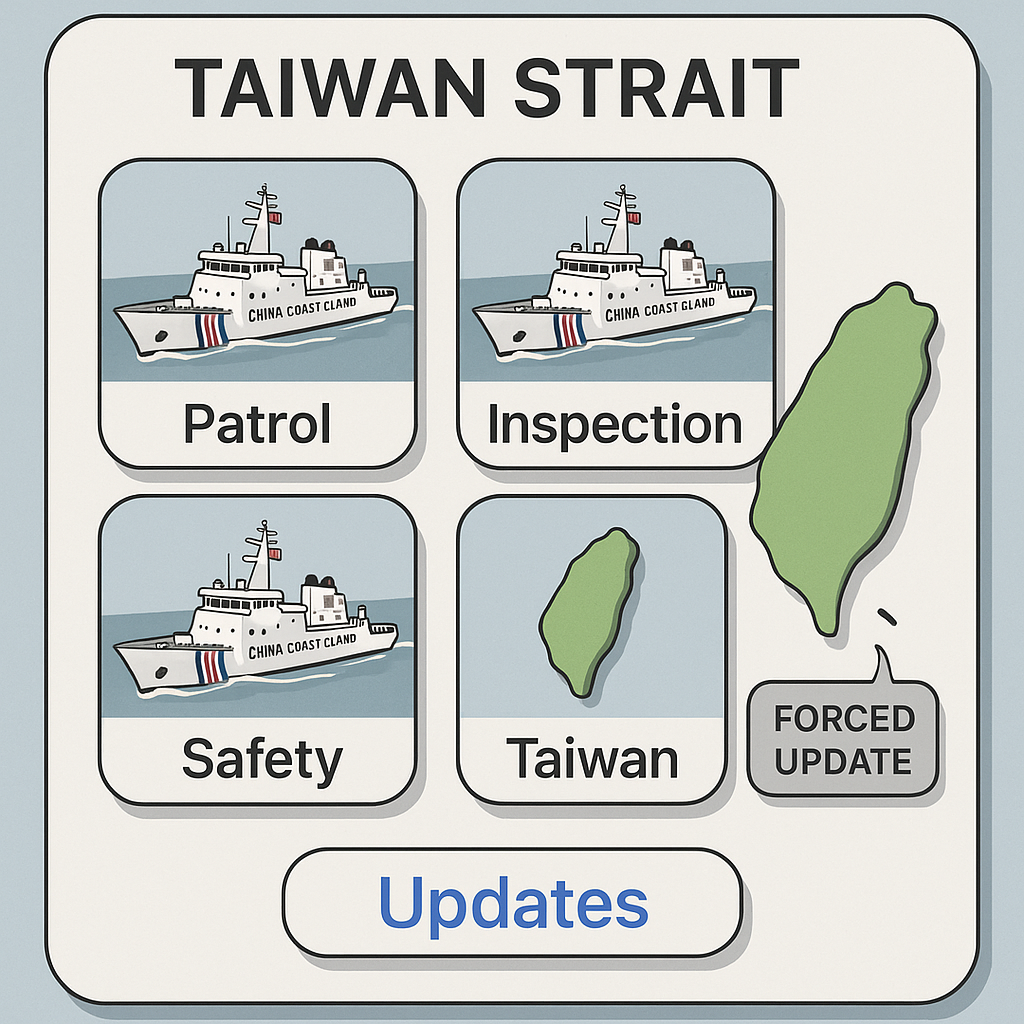
- Interactive Moderation: Options include inspection, boarding, water cannons, or “accidental” collisions, depending on the quarterly narrative and whether anyone important in Washington has just tweeted the phrase “rock-solid,” prompting an automatic pop-up on Chinese state media reading “System Under Hostile Probe.”
To regional neighbors like Japan and the Philippines, who have already beta-tested similar behavior in the South and East China Seas, this looks less like a Coast Guard and more like a cloud service that metastasizes. First it helps you find your fishing grounds, then it wants read-write access to your Exclusive Economic Zone, then one day you wake up and your reefs are stored in someone else’s account and labeled “historically self-owned” in the fine print, next to a helpful link explaining why your lighthouse is now a Chinese cultural artifact.
U.S. officials, tied to the Taiwan Relations Act and to a collection of alliance documents that all sound like subscription add-ons no one fully read, have so far responded with strongly worded push notifications. Freedom-of-navigation operations by the U.S. Navy continue, but at a tempo that increasingly resembles multi-factor authentication: necessary, inconvenient, and never the final word for a system architected to crash at the first mention of “war risk premium” in a presidential debate watched by shipbrokers in Singapore and bond traders in London.
“We take any effort to unilaterally change the status quo very seriously,” said one fictional U.S. official, carefully avoiding defining “status,” “quo,” or “change,” as if they were volatile mid-cap equities. Markets, which have learned to treat the U.S.–China rivalry as a volatility ETF rather than an existential question, briefly twitched before returning to their main job of bidding up whatever ticker says “AI” and quietly discounting anything that physically floats or has to transit the Bashi Channel.

For shipping companies and insurers, however, the code is already compiling. Actuaries have started quietly plugging “China Coast Guard proximity index” variables into risk models for ships calling at Taiwanese ports. Premiums are nudging up, and routing algorithms are beginning to suggest paths that curve just slightly away from the developing choke points, the way retail traders slowly move away from a token once the influencers start using the word “community” too often and one of them starts broadcasting from a yacht in Dubai while pretending not to see the missile test behind him.
This is the core innovation of gray-zone tactics. You do not launch a dramatic invasion that triggers hard red lines and easily charted sanctions. You launch a series of product updates so small that nobody can agree on which one to uninstall. Each “routine patrol,” each “inspection,” each cheerful press release about maritime “safety” in the Taiwan Strait shifts the reference point a little further toward a world in which Chinese law enforcement vessels are simply part of the landscape, like buoys, fees, or a bored influencer filming a “day in the life of contested waters” vlog in front of a very real water cannon.
Inside Taiwan, debate is now less about whether China is a threat and more about how many subscription tiers of pressure you are willing to tolerate before calling customer support. Some urge matching the China Coast Guard with Taiwan’s own white-hull presence, others suggest quietly moving issues up the stack to the navy when Chinese behavior crosses certain thresholds. Legislators argue on live television while, in the corner of the screen, a tiny graphic tracks the number of Chinese vessels inside the contiguous zone like a weather report for encroaching drizzle that occasionally upgrades to “localized sovereignty storm.”
None of this answers the question that keeps U.S. planners awake: what specific incident, if any, actually flips this from “low-level harassment” to “defense treaty conversation.” A ramming near Kinmen, a water cannon incident off Matsu, a filmed boarding of a Taiwanese fishing boat whose captain has the misfortune of speaking quotable Mandarin. The genius of the strategy is that every single episode can be filed under “regrettable misunderstanding” and then quietly reused as training material, with timestamps redacted and narration updated for whichever slogan the next Party Congress prefers.
As in every gray-zone design, the answer is supposed to be: never. The goal is to reduce Taiwan’s room to maneuver inch by inch, until one day, perhaps a decade into this campaign, a senior Chinese official can announce that nothing has changed, they are merely formalizing what has “always” been true. The map will show a tidy band of Chinese jurisdiction around the island. Trading algorithms will barely notice. Shipping routes will have quietly conformed years earlier, the way they already bend around the South China Sea like a nervous commuter avoiding the weird guy on the subway who insists the Spratly Islands are his emotional support archipelago.
From there, the financialization is simple. The moment markets treat Chinese de facto control of the surrounding waters as the baseline, any move by the United States or regional partners to reverse it will read not as defense of the old status quo, but as disruption. In a world where every risk is a yield product, the gray-zone strategist is the one who understands that if you can get insurers and logistics firms to accept your version of “normal,” you have already won the first valuation round and can list your influence on a metaphorical exchange complete with quarterly guidance on “Taiwan Strait user engagement.”
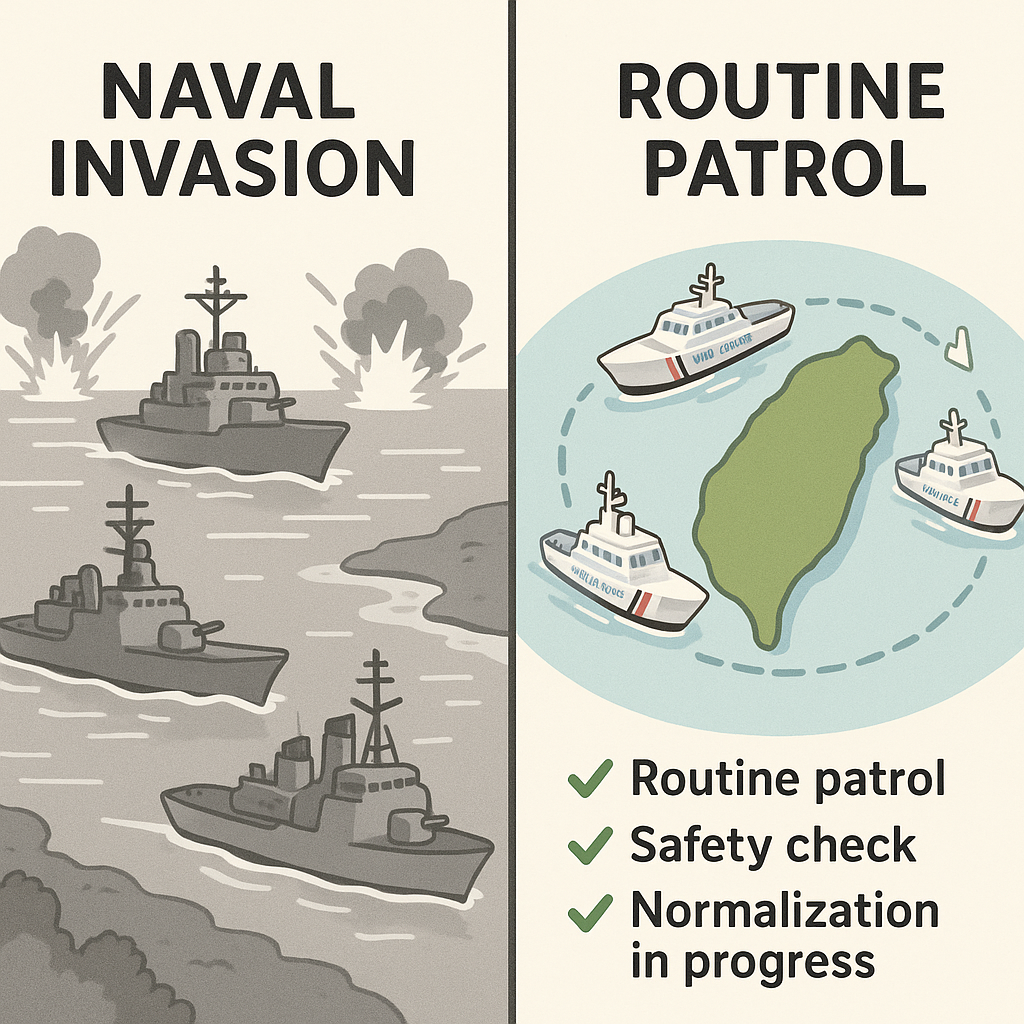
That is the quiet brilliance of the China Coast Guard play here. You turn unification from a single high-risk geopolitical trade into a slow drip of incremental changes, each one too technical, too legalistic, or too boring to spark real pushback. You stretch the tension out for as long as it takes for everyone with exposure to Taiwan to quietly rebalance their portfolios toward safer assets, leaving the island increasingly surrounded not just by Chinese vessels, but by shrinking liquidity and a ring of compliance officers nodding that this is now “industry standard” on both sides of the Pacific.
At that point, there will be only one open question left for the People’s Liberation Army Navy. Not whether to cross a red line, or when to launch a war, but whether to exercise the option at all. When you own the sea lanes, the legal narrative, and the risk models, invasion stops being a necessity and becomes, in the language of modern finance, a non-core feature that can be toggled on in a later quarter if domestic growth numbers disappoint and someone in Zhongnanhai needs a distraction from a disappointing PMI.
And like any good tech product, Beijing can always save it for a future update.