In a development export lawyers called "completely foreseeable and absolutely not our fault," a blacklisted Chinese tech giant has demonstrated that United States export controls work flawlessly, as long as buyers are willing to change their company name twice a quarter and learn the difference between the Cayman Islands, the British Virgin Islands, and that one free zone in Dubai where the corporate registry is a PDF last updated during the Obama administration.
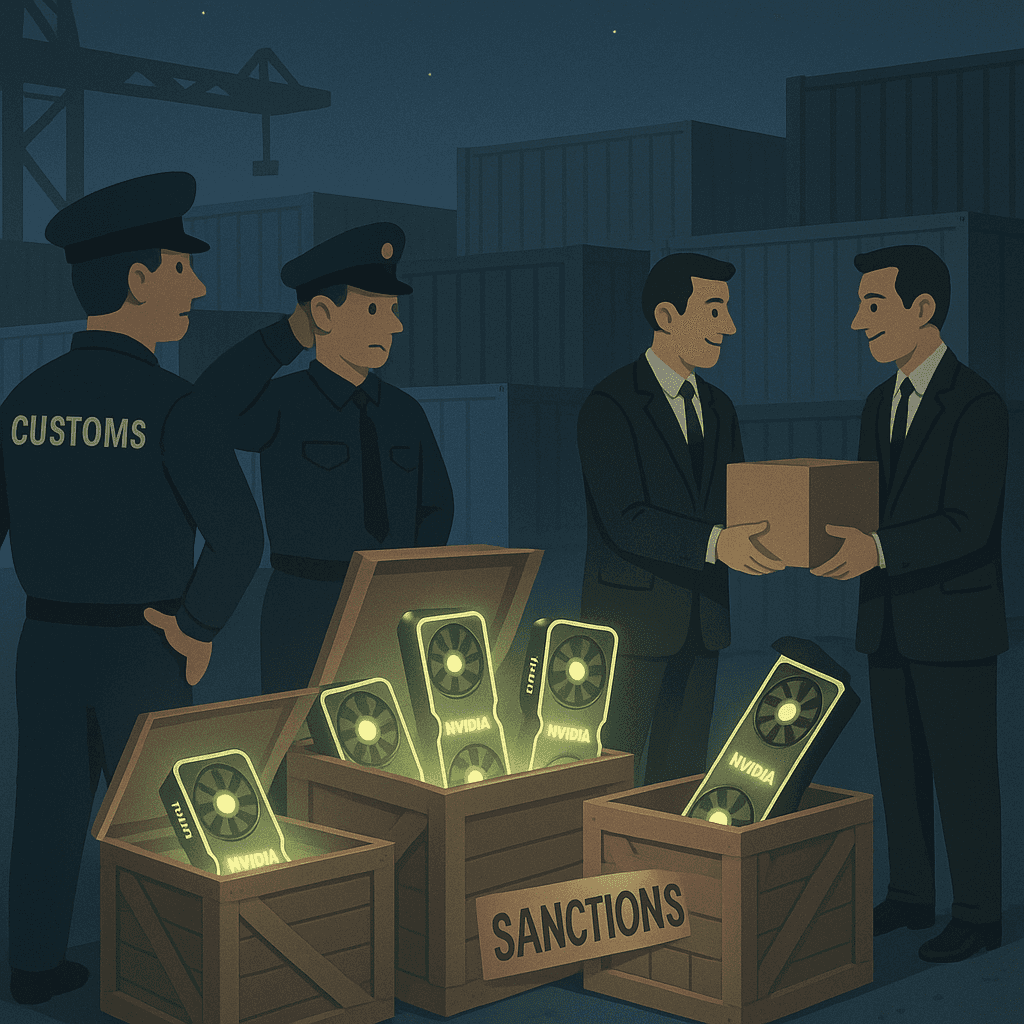
The New York Times reports that a major Chinese company, formally shunned by the U.S. Department of Commerce and tracked by the Bureau of Industry and Security, has been quietly feasting on Nvidia’s top AI chips through a global obstacle course of shell entities, gray-market distributors, and customs forms that say "educational research" in four languages.
According to people familiar with the matter, those languages are English, Mandarin, Legal, and PowerPoint, the last of which expresses nuance entirely through increasingly red arrows.
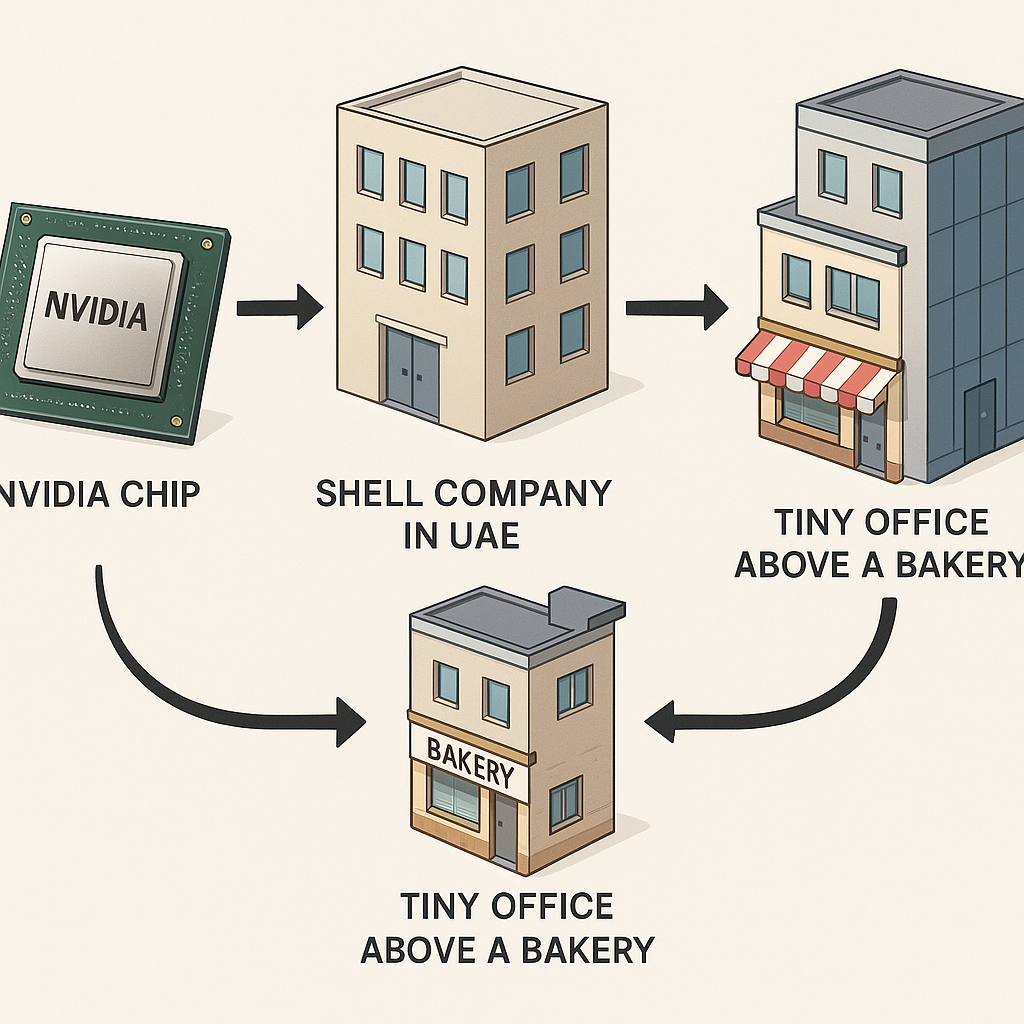
The company, which resides comfortably on the Commerce Department’s Entity List for its ties to China’s military and surveillance apparatus, appears to have obtained quantities of Nvidia A100 and export-compliant variants by following a simple three-step workflow beloved by modern institutions:
- Get sanctioned.
- Incorporate a benign-sounding subsidiary in Singapore, the UAE, and a coworking space above a bakery in Prague.
- Explain to regulators that "Cloud Potato FZ-LLC" is absolutely not related to "Cloud Potato (Shenzhen)" except for the part where they share a board, logo, ERP instance, and delivery dock.
Officials at the U.S. Department of Commerce described this as "deeply concerning" and also "someone else’s problem," clarifying that enforcement falls under the Bureau of Industry and Security, which clarified that it falls under customs, which clarified that it falls under software filters in an outdated SAP system and a spreadsheet called "FINAL_EXPORT_LIST_v7_REAL_FINAL.xlsx" that is printed out every Friday and kept in a three-ring binder labeled "Do Not Lose Again."
"We have built a robust chokepoint," a Commerce spokesperson told reporters, "which is why GPUs can now only reach blacklisted entities if they use intermediaries, offshore shells, and falsified end-user certificates instead of just ordering them online like before." The spokesperson then gestured at a color printer that now counts as the department’s primary AI monitoring tool because it can produce pie charts, and at a smart whiteboard whose only deployed algorithm is an auto-erase timer that clears uncomfortable questions after 15 minutes.
In Beijing, the People’s Republic of China maintained that it remains the world’s number one advocate for "harnessing new tech for the welfare of all humanity," as China Daily recently reminded everyone. The editorial repeated President Xi Jinping’s vision that AI should unite the world, presumably by running on GPUs obtained from at least three continents and one free trade zone per purchase order.
"China has always held that humans must have the final say on nuclear decisions," the op-ed argued, "which is why we are very invested in making sure those humans have access to the very fastest American accelerators."
The U.S. Department of Defense, meanwhile, is reportedly studying "novel, software-defined approaches" to slowing China’s AI capabilities, a phrase that industry analysts interpret as: we tried the hardware thing and the hardware thing lost.

Inside Nvidia, executives are said to be "surprised" that their chips, manufactured to be sold, have ultimately ended up being sold.
"Nvidia absolutely complies with all U.S. export laws," one anonymous sales manager insisted, "which explicitly require us to ask the distributor if the end customer is on a list, and then to believe whatever they say as long as the purchase volume is large enough to hit Q3 guidance and the purchase order does not literally say 'missile lab' in the memo line." He added that when a reseller listed the end user as "North Baltic Aeronautics Institute and Cultural Center," compliance performed a rigorous review that confirmed the logo looked "pretty academic."
Market data shows that in hubs like Hong Kong, Singapore, and the UAE, restricted GPUs now trade like concert tickets, with brokers advertising "lightly sanctioned" A100s at a premium to customers who can prove they have both cash and a plausible reason to be training a large language model on containerized logistics data in Dalian.
One broker, operating from what appeared to be a converted karaoke bar, described the situation succinctly: "We used to move counterfeit sneakers. Now we move AI chips. At least GPUs come in anti-static bags and do not ask why the shipping label says 'farm equipment.' Also, unlike sneakers, nobody on TikTok will notice if the neural network runs slightly faster than advertised."
Officials across the Atlantic say they are monitoring the same pattern. European regulators privately admit that while they fully support Washington’s goal of limiting China’s access to advanced AI hardware, they also support the goal of selling things, and are still workshopping which of these values has better margins.
"We stand united with our U.S. partners in restricting exports of sensitive technologies," said one EU trade official, who then asked reporters not to print his name until after his keynote at a semiconductor investment summit in Dubai, where his presentation is titled "Balancing Values and Value Added" and sponsored by a logistics firm whose flagship service is discreetly relabeling pallets during layovers.
The Chinese Ministry of Commerce has dismissed U.S. sanctions as "abusive tech containment" that "disrupts global supply chains" and "forces Chinese companies to take creative steps." Those creative steps reportedly include naming a shell company after a defunct Estonian drone startup, trivially editing the shipping address, and declaring that 512 H100s are for "university AI projects" at an institution that appears to consist of a single WeChat group, a rented server rack in Rotterdam, and a campus newsletter promising to open a library once customs clears the next pallet.
"We are simply supporting innovation," a ministry representative said. "If innovation means filling out extra import forms in Dubai, that only proves we are working harder for the welfare of all humanity." He declined to answer follow up questions, citing a scheduled meeting with "North Baltic Aeronautics Institute" which, according to corporate records, shares a fax number with a seafood restaurant and lists its rector as "To Be Determined" on LinkedIn.
Back in Washington, the Office of Foreign Assets Control at the U.S. Treasury has floated the idea of secondary sanctions on intermediaries, freight forwarders, and any jurisdiction whose average daytime temperature exceeds 28 degrees Celsius and whose corporate registry website still uses frames.
"We are evaluating whether new authorities are needed," one OFAC lawyer said. "Ideally something that lets us sanction companies we will find out about in 2028 for shipments they booked last spring, preferably after they have already rebranded as 'Cloud Potato Global Solutions' and moved two floors down the hallway." He explained that by the time enforcement actions are ready, the original entity will have been liquidated, the servers will have moved to a bonded warehouse, and the legal responsibility will belong to "Cloud Potato Heritage Holdings" which consists primarily of a brass plaque.
Inside the Beltway, the revelation has sparked a fresh debate over whether the United States should supplement hardware controls with limits on cloud compute access. Defense officials acknowledge the appeal but note that if they block suspect Chinese entities from U.S. clouds, those entities may simply form a shell company that buys GPUs and builds their own data centers, a contingency which has already occurred in at least three industrial parks that still advertise themselves as "light manufacturing" and "family friendly" on roadside billboards.
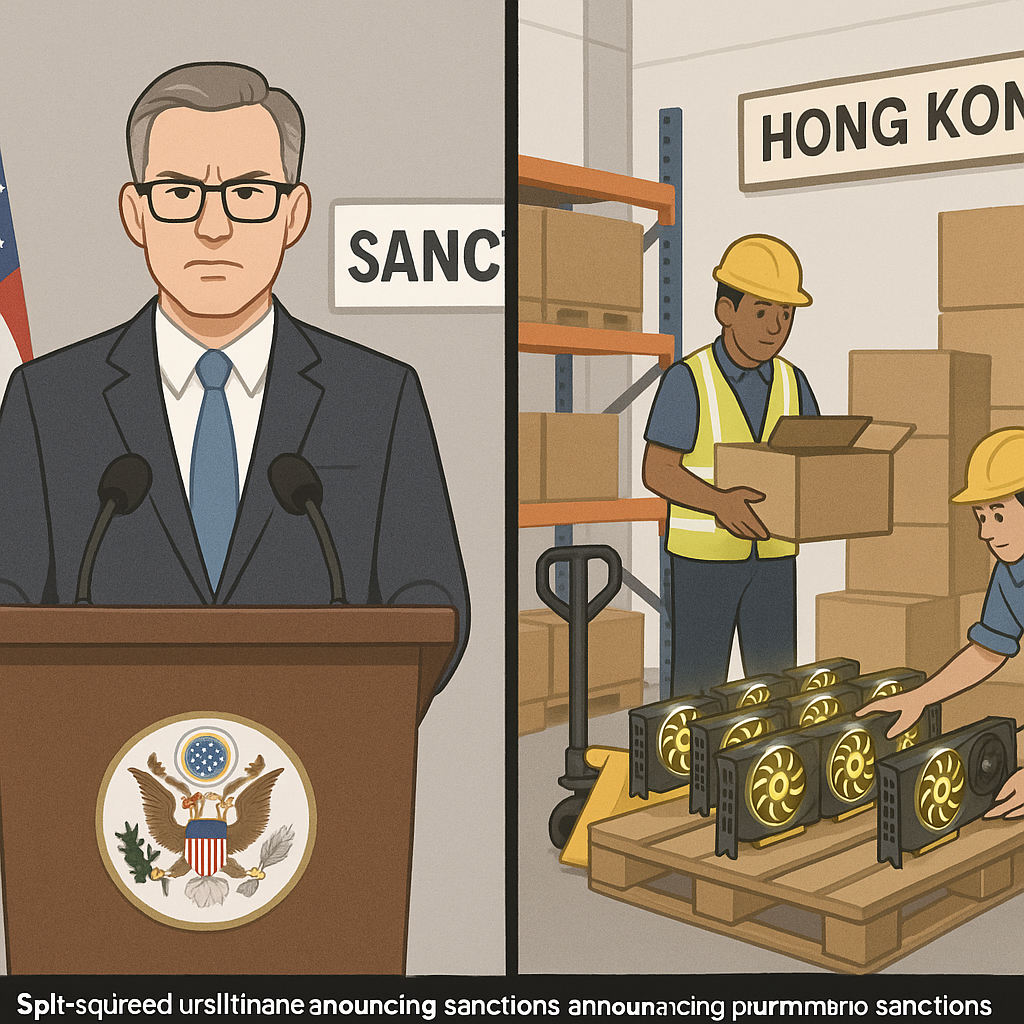
Think tank analysts are eager to offer solutions.
"We have to recognize that our adversaries are highly adaptive," said one national security fellow. "For example, when we shipped chips directly, they bought chips directly. When we stopped, they invented a three-layer international maze of front companies, re-export hubs, and mislabeled cargo. The clear policy response is to add a fourth form and a pilot program." He proposed a "Trusted Innovation Corridor" that would require exporters to tick a box affirming they "feel good" about the shipment.
As the AI arms race accelerates, both Washington and Beijing continue to emphasize their commitment to ethics. The United States has pledged that nuclear launch authority will remain in human hands, and that the most advanced autonomous systems will only suggest targets to humans who are very busy and in a hurry. China, for its part, has declared that AI should "never be used for the interests of a single state whose main intention is world domination," a line that reads differently if your customs records show high-end GPUs arriving at a facility shared by a social media company and a missile research institute separated only by a cafeteria.
On paper, the U.S. strategy still hinges on a belief in hardware chokepoints: if you control high-end semiconductors, you can shape global power. In practice, the chokepoint appears to be the narrow period of time between a regulation taking effect and a mid-level compliance officer in Dubai learning how to spell "dual-use" without opening a Word template titled "Standard Justification." After that, the chokepoint widens into a four-lane highway with duty free electronics.
The real innovation, experts say, is not in chip design, but in logistics. "The world’s most sophisticated AI systems now run on a pipeline of mislabeled cargo, underfunded auditors, and distributors whose main know-your-customer procedure is checking if the bank transfer clears," one export control scholar explained. "If you want to understand twenty first century geopolitics, forget TikTok. Read the terms and conditions of a freight forwarder in Shenzhen, then watch how quickly they add a clause about 'research drones' after each new sanctions list." He noted that the only truly scalable model in the global AI ecosystem is the template for a generic end-user certificate.
The blacklisted giant at the center of the Times story declined to comment for this article, but an internal procurement memo reportedly congratulated staff for "successfully navigating Western techno-containment" and reaching "Phase 2" of their AI strategy. Phase 1 was "Get banned." Phase 3 reportedly involves "openly listing the data center on Google Maps as a cultural center" with public photos of a lobby statue labeled "Friendship Between Peoples" in front of racks of American accelerators.
In a quiet victory for everyone involved, the United States can now tell voters it has imposed tough sanctions on Chinese military-linked firms. Nvidia can tell shareholders that demand for its chips is insatiable. Beijing can tell the world it is responsibly developing AI for humanity. The karaoke bar can tell landlords it has diversified into "knowledge services."
And somewhere in a bonded warehouse outside Hong Kong, a pallet of shrink wrapped American GPUs can tell anyone who is listening that it has successfully completed the only task global institutions seem genuinely good at: traveling in circles while everyone sends each other compliant PDFs, all proudly stamped with a digital signature that no one bothers to verify and archived in a document management system whose password is still "export2020."