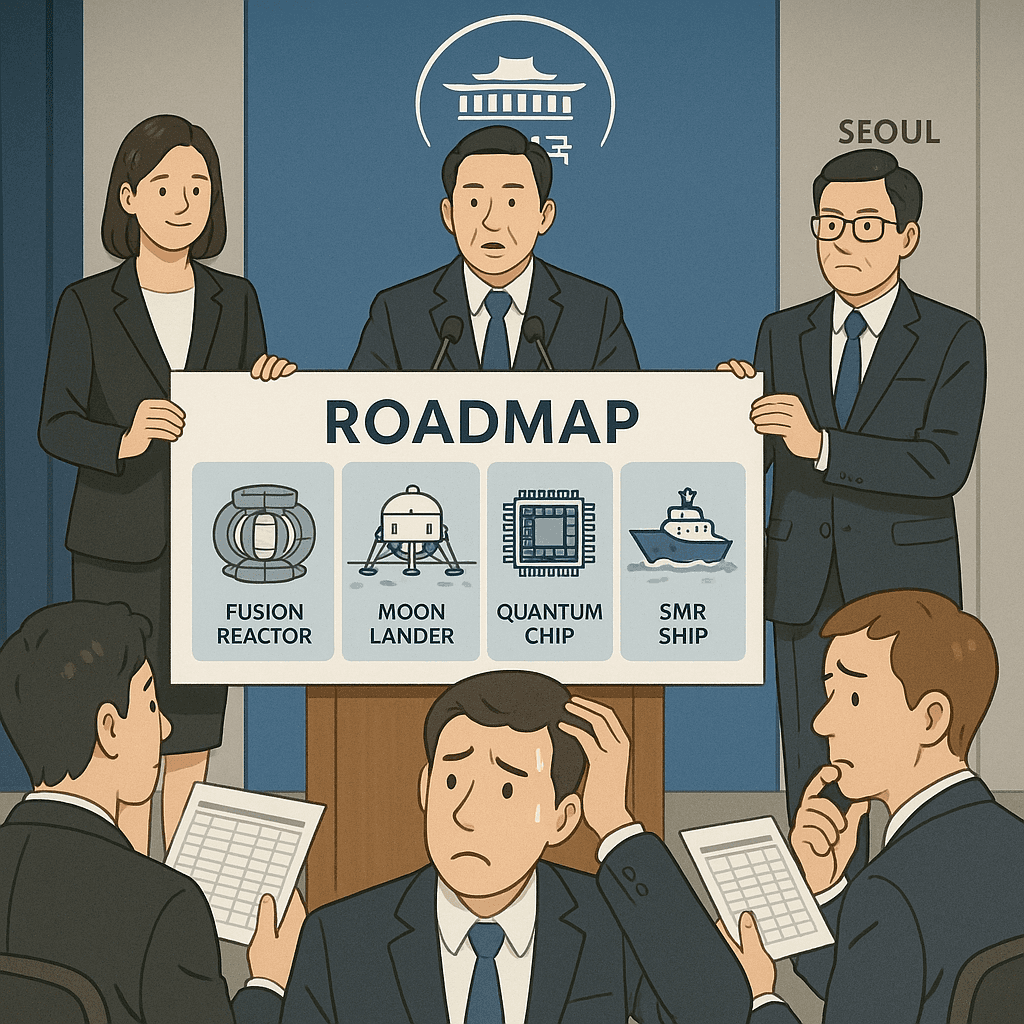
South Korea has stopped cosplaying as a passive market economy and put its real job title on the slide in corporate font: state capitalist in chief.
President Lee Jae Myung has unveiled a sweeping post AI industrial strategy built around seven government approved SEED technologies. The list runs from small modular reactors and nuclear fusion to quantum computing, space hardware, bio industries, critical minerals and related advanced sectors. Officials describe them as the "next growth engines" and everyone else recognizes them as "the new shortlist of projects Too Physics Intensive For VC and Too Long Term For PowerPoint."
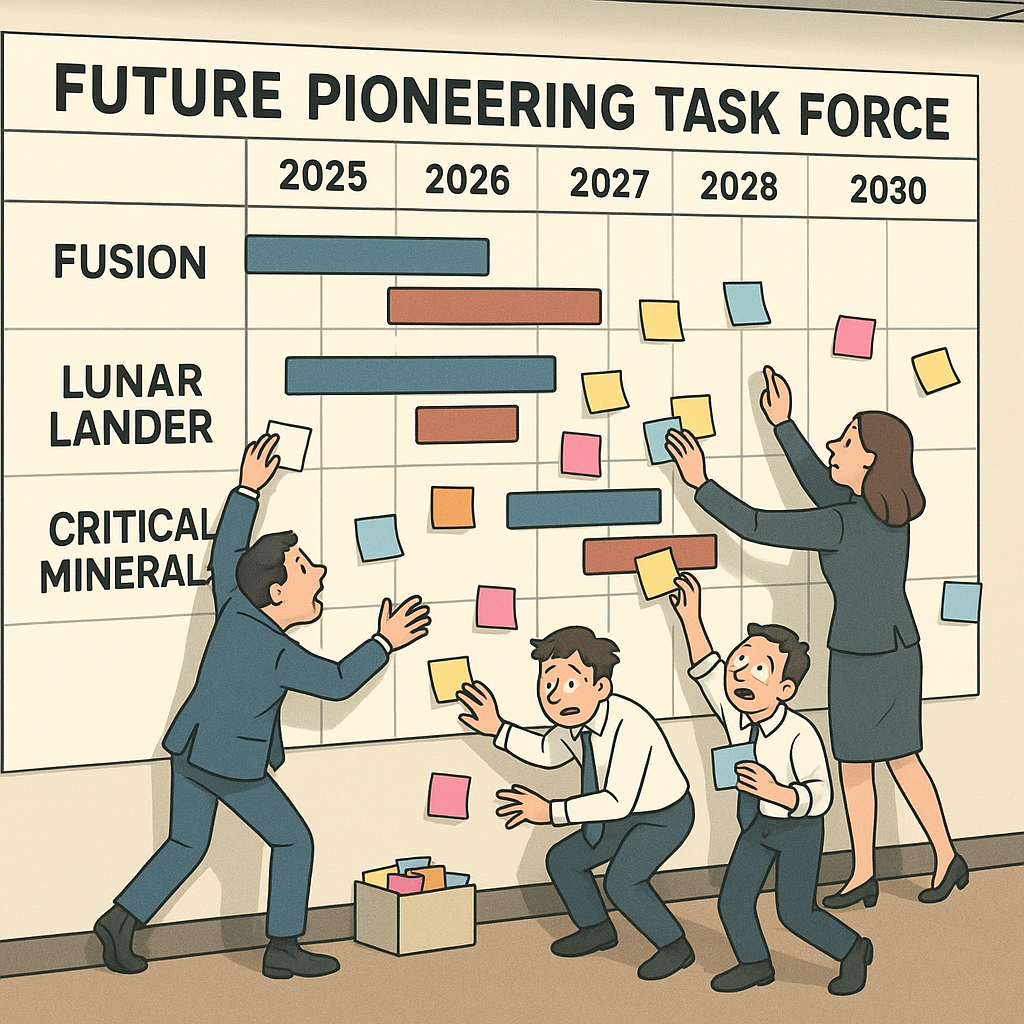
According to Asia Today and UPI, the plan will be overseen by a public private Future Pioneering Task Force chaired by Deputy Prime Minister and Science Minister Baek Kyunghoon, a sentence that contains every word investors like to hear except the one about exits or any mention of cap table.
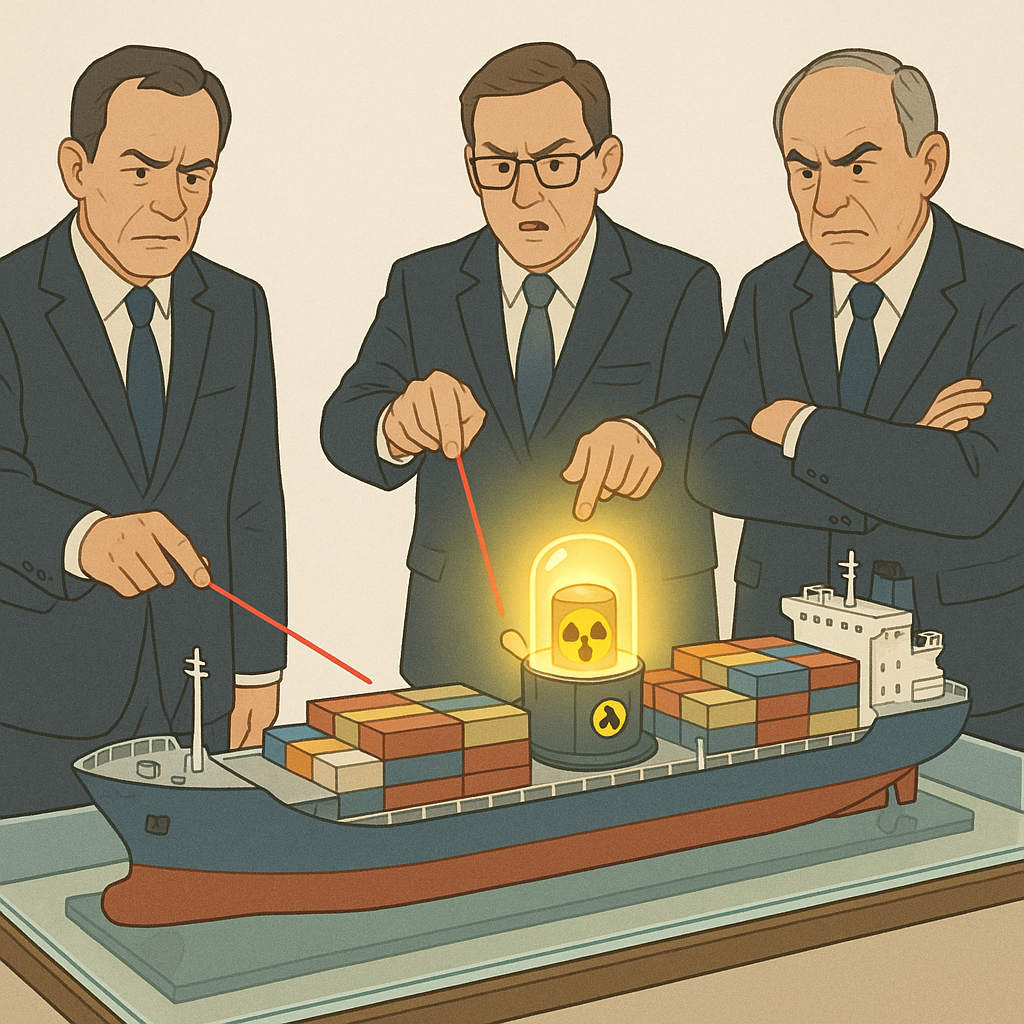
"We must prepare growth engines beyond semiconductors and AI," Lee said, standing beside a container vessel model equipped with a small modular reactor and a visibly uninsured cooling system. "If the risk is high but the work must be done and the private sector will not take it on, the government and public sector have a role to play." Markets reacted positively, relieved to learn that when a project is completely uninvestable on Earth, it will at least receive a lunar launch date and a commemorative stamp.
The Ministry of Science and ICT set out a roadmap that initially sounds like a mid tier crypto white paper, then stubbornly keeps adding actual engineering. Targets include a Korean designed 100 megawatt experimental fusion reactor by 2035, a 1,800 kilogram lunar lander by 2032, and a 20 percent recycling rate for 10 critical minerals by 2030. Analysts noted the projects have timelines, milestones and governance, which instantly disqualifies them from the Web3 label and from any conference held in a hotel ballroom with purple LED lighting.
"Think of it as a national LTV over CAC model," said one Seoul based fund manager, staring at a spreadsheet that covers two ultrawide monitors. "Lifetime value: if fusion and critical minerals work, Korea owns the energy stack for a century. Customer acquisition cost: a few dozen trillion won and several elections." He added that the IRR slides write themselves, provided no one is allowed to mark any of this to market before 2040 or ask why the discount rate has its own appendix.
Baek Kyunghoon framed the effort as both industrial strategy and childhood content marketing. Citing the 50th anniversary of classic robot animation "Robot Taekwon V" in remarks reported by The Asia Business Daily, Baek said the show inspired a generation of science kids in the 1970s and 1980s to pursue engineering instead of law school. "Now is the time for us to have similar inspirational dreams that can transcend a tough reality," he declared, formally upgrading industrial policy from "picking winners" to "competing with TikTok for your child's attention span with something other than mukbang."
To that end, insiders say the Future Pioneering Task Force is considering a youth facing pipeline that looks suspiciously like a product slate and entirely like a pitch deck from a children's streaming startup:
- "FusionCraft" a voxel based game where players must design 100 MW reactors before bedtime, then file simulated safety audits before dessert.
- "Quantum Idol" a survival show in which qubits and K pop trainees decohere under pressure while a panel of retired semiconductor executives votes on error correction.
- "Robot Taekwon V: Mineral Diplomacy" an animated series where a giant mecha negotiates offtake agreements in Central Asia while its legal department delays season two by insisting on full ESG disclosures.
"Our children must dream of becoming fusion researchers and quantum engineers," Baek said, "or at least project managers overseeing milestone slippage reports and drafting polite emails to delayed cryogenic suppliers."
Lee's office insists the seven SEEDs are about strategic autonomy as much as growth. Critical mineral supply chains secured through summit diplomacy in Central Asia and Latin America will be folded into the strategy, with plans to expand domestic processing and recycling. Officials describe a future in which Korean designed SMRs power domestic smelters running on Korean refined minerals feeding Korean quantum fabs calculating how late the fusion reactor will be, while a government dashboard updates the delay in real time in three languages.
Global peers are watching closely, mostly to see how aggressively they can copy the idea before the World Trade Organization calls from a half empty office in Geneva. Australia, for example, has entered what economists describe as the "please do not leave" phase of industrial policy. As the Guardian reports, Canberra is preparing a large bailout for the Tomago aluminium smelter, has offered 600 million dollars to keep Glencore's copper operations alive, and is dangling billions more for other plants. Where Seoul is planting SEEDs, Australia is air dropping pallets of fertilizer on anything with a smokestack and a marginal seat nearby.
"This is not a blank cheque," one Australian official insisted. "It is a sequence of very large, fully signed, non blank cheques." National Party figures warn such support is not sustainable, then immediately clarify they do not mean jobs should disappear, only energy prices, gravity and the concept of cost of capital.
South Korea is trying something more eccentric and more spreadsheet friendly: scheduling its miracles in advance. The 2032 lunar lander is expected to weigh 1,800 kilograms, slightly less than the combined documentation for the permitting process and the environmental impact statements. The 100 MW fusion demonstration, due 2035, will be comanaged with industry partners on a risk sharing basis. "We will not repeat the mistakes of previous mega projects," said a Ministry of Science official. "This time, we will build the governance committee before the cost overruns and give the audit office observer status from day one."
The private sector appears cautiously enthusiastic. Major chaebol groups have expressed interest in participating in space, quantum and SMRs, especially if the state is offering equity, credit guarantees and the legal right to say "we are a fusion company" on earnings calls without provoking follow up questions. Venture capitalists, used to funding apps that optimize the last mile of food delivery, are quietly recalibrating and googling "neutron flux" between demo days.
"We normally look for a path to exit in five to seven years," said one early stage investor. "With fusion, the exit is more like thirty years and involves rewriting thermodynamics. On the flip side, the total addressable market is basically 'all of civilization', which clears our minimum bar and our Excel row limit."
Not everyone is convinced. Some economists warn that picking seven national champions risks creating sacred cows that crowd out smaller, messier innovation. Others point to the timeline risk if early wins are not visible by the late 2020s, voters might begin asking unhelpful questions such as "Where is my Robot Taekwon V dividend?" and "Why does my electricity bill have a line item called Pre Commercial Plasma."
Officials counter that the program is explicitly structured for the long term. The Future Pioneering Task Force will continuously review roadmaps, adjust allocations and add new candidates for growth engines as needed. The list could eventually extend beyond SMRs, fusion, quantum, space, bio and minerals to more experimental categories, such as AI that does not hallucinate or housing affordability. These topics are currently viewed as beyond even fusion level difficulty and are therefore being deferred to a future subcommittee.
Outside observers note that while South Korea is centralizing its bets, the United States is dispersing its own, seeding regional clusters like Kansas City's BioHub and layering in tools such as Missouri's angel investor tax credit. The result is a global A B test in economic design. Seoul will see whether a small, coordinated country can speedrun a science fiction novel, while Washington tests if 50 states pursuing their own vibe can accidentally invent something useful between culture wars, highway expansions and naming rights for stadiums.
Back in Seoul, the official mood remains upbeat. Baek has promised to "nurture these seeds so that 10 to 20 years from now Korea will become a uniquely dominant global leader." The statement played well, particularly with anyone whose career horizon ends in 2031 and whose pension is denominated in projected multipliers.
For now, the seven SEEDs offer a clear answer to a simple question. In the post AI economy, who actually takes the first and worst risk on hard technology. South Korea has raised its hand, convened a task force and published a Gantt chart with color coded critical paths.
Everyone else is still looking for a way to charge it as a monthly subscription and call it platform fees.