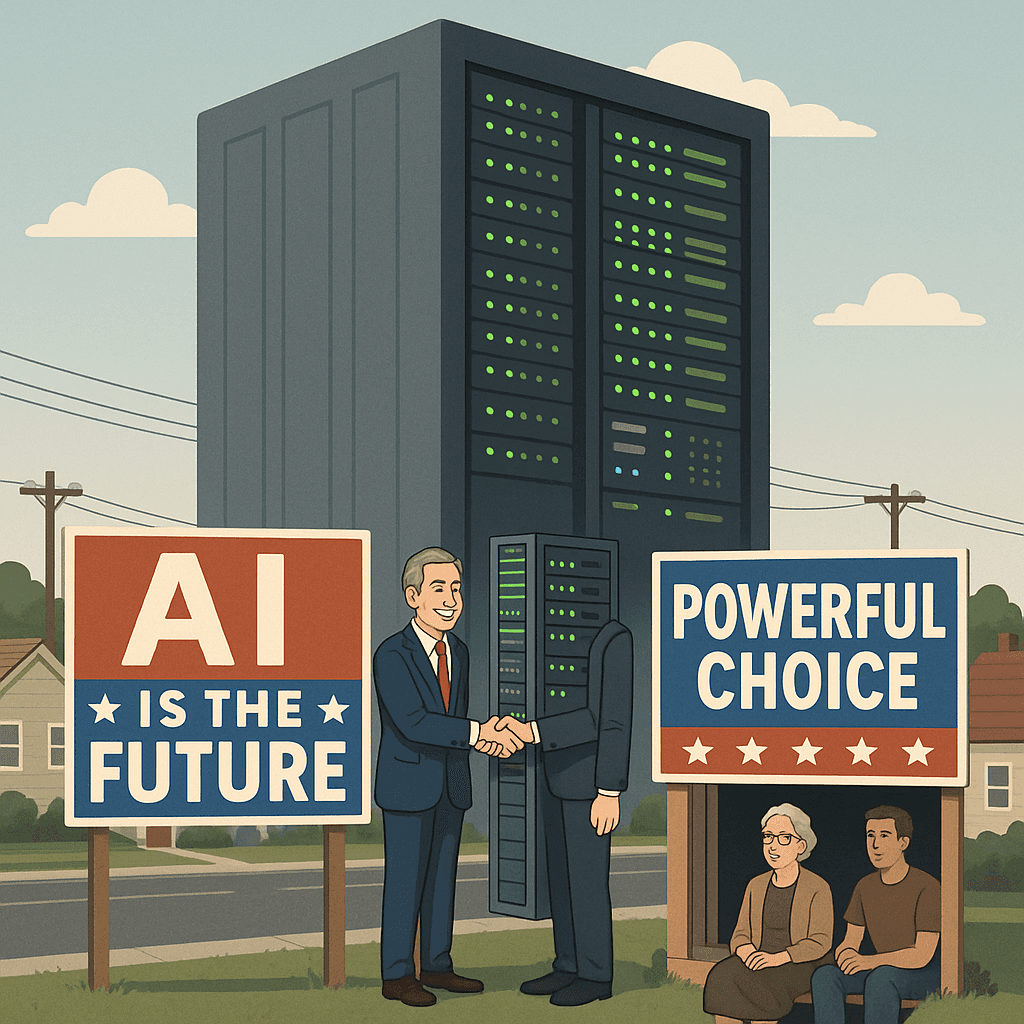
In a development experts called inevitable and accountants called billable, American democracy has discovered it is uncomfortably adjacent to the server rack.
According to reporting aggregated by Inkl from The Independent, AI companies and their political action committees are dropping roughly $265 million into the 2026 midterms, transforming the humble data center from a beige zoning dispute into a national wedge issue: candidates are racing to prove that nobody hates giant humming buildings full of Anthropic and OpenAI workloads more than they do, especially while filming their attack ads in the parking lot.
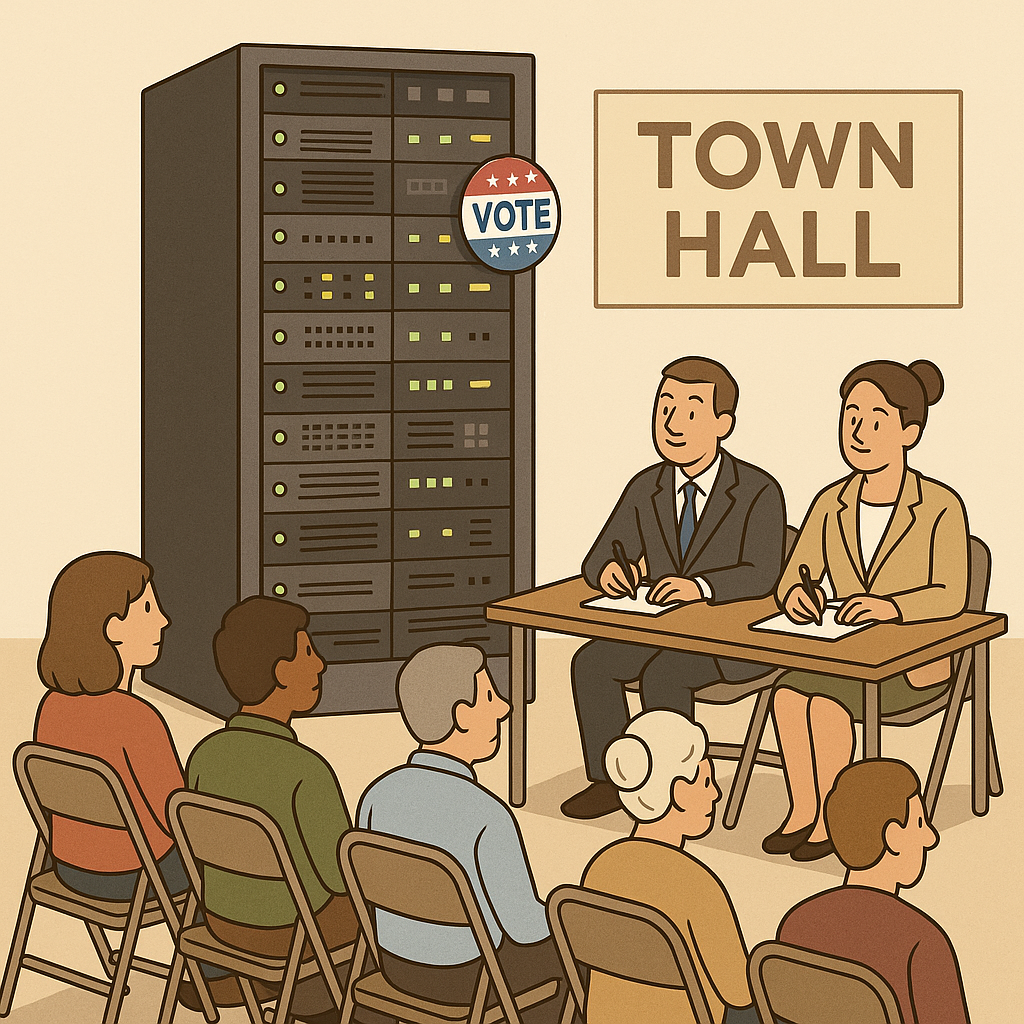
For decades, local hearings about power lines and substation noise were attended by three retirees and a guy who just wanted to talk about chemtrails. Now those same rooms are filled with PAC consultants offering to underwrite the folding chairs, optimize the microphone feedback, and workshop a more compelling name for the utility district.
Texas, as usual, has turned the trend into a stadium-sized pilot program. Last year, Governor Greg Abbott bragged that his state was the "epicenter of AI development" after Google promised a $40 billion data center build-out. This year, Abbott has ordered audits of data center projects connecting to the already wheezing Texas grid, a move his office describes as "proactive oversight" and everyone else describes as "turning the GPU fan curve down two notches before the lights go out in Dallas and the queso hardens statewide."
"Texas is open for business," Abbott told reporters, "but we are also open for pretending we did not personally cut the ribbon on the thing that is now causing rolling blackouts during high school football." Staff later clarified that the governor remained fully committed to innovation, provided it remembered to plug itself into Oklahoma.
His Democratic challenger, Gina Hinojosa, has proposed a moratorium on new data centers until the state figures out basic questions like where the power comes from and whether "AI epicenter" was supposed to mean literal epicenter of the next grid collapse. Her campaign recently released an ad showing Abbott standing in front of an OpenAI logo while a narrator intones, "Greg Abbott: Too close to the servers." The spot ends with a shot of a darkened suburban cul-de-sac, a slowly thawing freezer full of brisket, and the caption: "Brought to you by LeadingFuture PAC."
LeadingFuture, one of several AI-aligned groups mentioned in the Inkl report, responded with its own ad, accusing Hinojosa of being "anti-innovation" and warning that "without new data centers, Texas children will be forced to grow up using search engines that have to think for a full second." A follow up mailer featured a distressed teenager staring at a spinning loading icon that read "democracy_recount_final_FINAL_v7.pdf."
At last count, there are three distinct political positions on data centers in the state:
- Pro-data center: America must lead in AI, even if your thermostat becomes a mood ring for the grid and your porch light flickers every time someone fine-tunes a model.
- Anti-data center: Your tap water should not taste like coolant, and your backyard should not sound like a jet engine trying to pronounce "responsible innovation."
- It depends who wired the super PAC contribution: A bipartisan favorite, typically discovered in private meetings between a zoning board and a PowerPoint about "synergies."
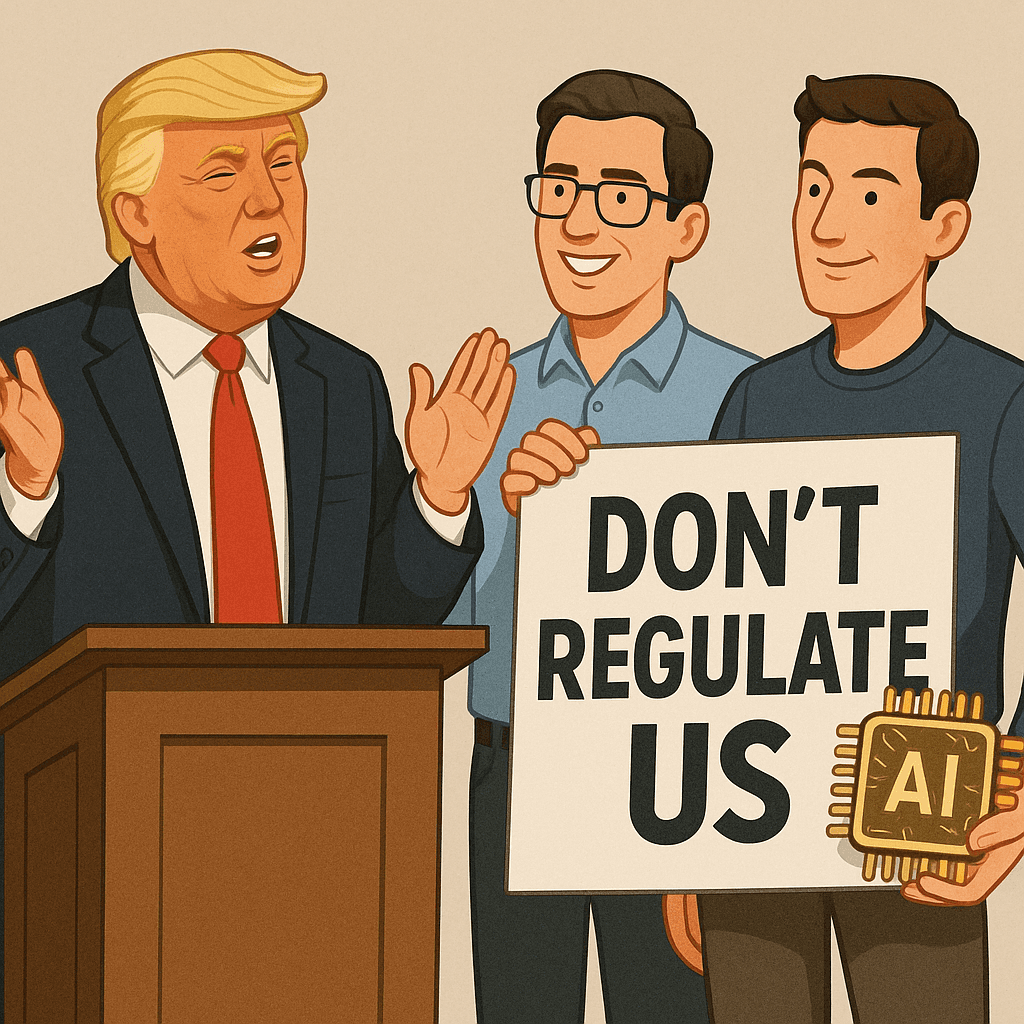
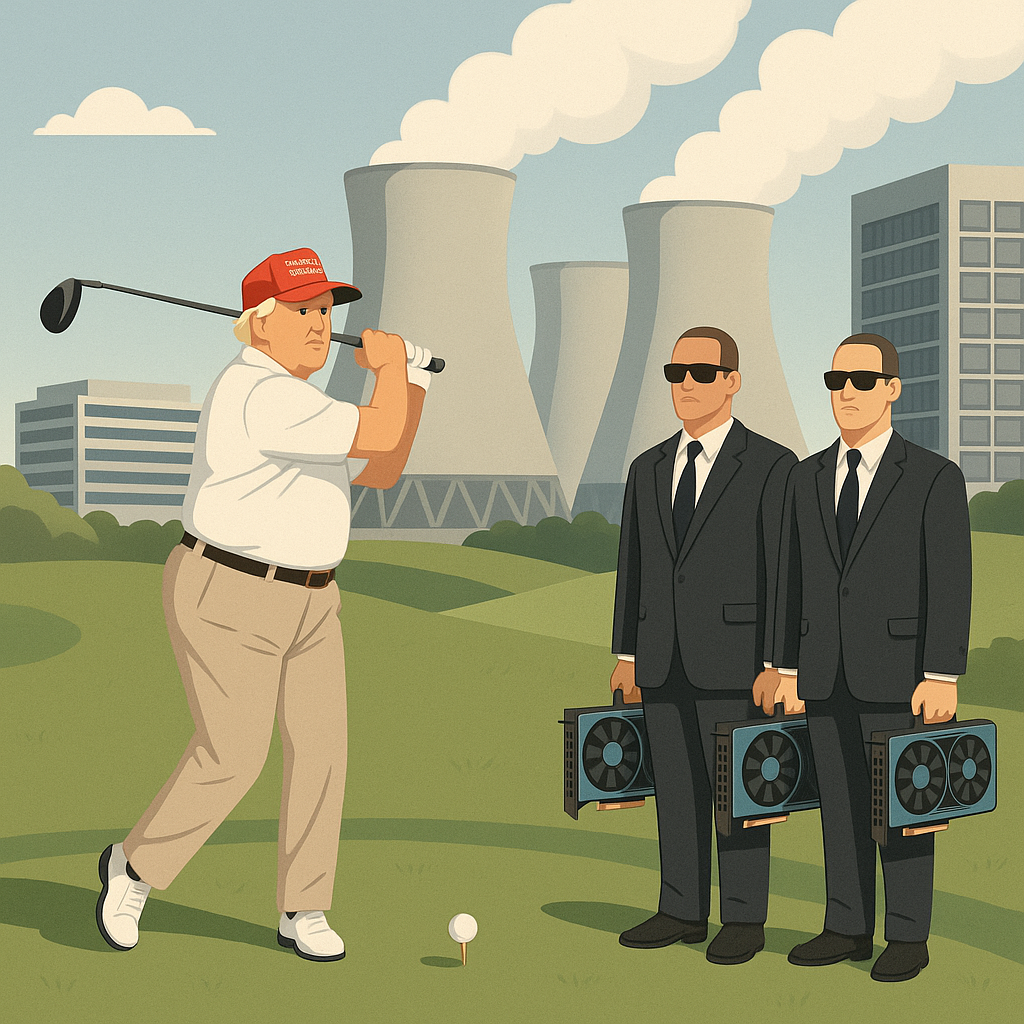
National figures are trying to catch up. Former President Donald Trump, already busy heralding an economic boom and promising that AI will juice productivity, recently wandered into the data center debate, according to Inkl's summary of Josh Marcus's piece. His intervention has left Republican candidates with the difficult task of defending both cheap electricity and infinitely scalable compute in a state that cannot reliably run ceiling fans in August without asking permission from the wind.
"These are the best data centers," Trump reportedly told a rally, "beautiful buildings, almost as good as a golf club, using tremendous energy, the best energy. We are going to make so much power the grid will beg us for mercy." Campaign aides later clarified that this did not represent an official policy proposal, just a preliminary vision statement for the forthcoming "Trump National Cloud Club" co-located with a substation outside West Palm Beach and offering tiered memberships denominated in kilowatt-hours.
Down-ballot, the scramble is more granular. In Ohio, Lieutenant Governor Jon Husted has spent years wooing cloud providers, only to now explain to county commissioners why their local creek sounds like a jacuzzi at 3 a.m. and why the new "AI Innovation Campus" appears to be three warehouses and a security guard named Doug.
In New York, Assemblymember Alex Bores, a self-described data nerd, has discovered that knocking on doors to discuss transformer upgrades is less popular than promising to "tax Big AI and give everyone a nice quiet park." His latest mailer features a bar chart comparing "megawatts" to "picnic tables" and invites voters to "choose their future infrastructure experience."
Anthropic and OpenAI, meanwhile, have adopted a posture familiar from other industries with complicated externalities. They are funding think tank panels on "AI for Resilient Grids," sponsoring glossy renderings of eco-friendly server farms surrounded by happy children flying kites, and issuing blog posts that solemnly acknowledge community concerns about noise, water use, and the faint orange glow in the sky when someone in San Francisco asks a chatbot to "rewrite this email in pirate voice." In one particularly earnest infographic, a cartoon data center hugs a wind turbine while standing on a beige exurban cul-de-sac.
"We take our responsibilities seriously," an imaginary joint statement from several AI firms would say if anyone asked for one. "That is why we are investing in advanced cooling systems, renewable energy credits, and a robust portfolio of 501(c)(4) organizations you will never be able to pronounce without a dedicated pronunciation model."
Local residents are unmoved. Homeowners near a proposed LeadingFuture-backed complex in central Texas told a packed utility hearing that they did not object to AI as a concept, they just objected to having their power bill fluctuate every time someone trains a new image model on pictures of raccoons smoking vapes.
"They told us it would be 40 permanent jobs and a million square feet," one resident said. "Turns out the 40 jobs were lobbyists, and the million square feet is where your elected officials put their campaign finance disclosures so nobody can find them without LIDAR."
Policy experts quoted by Inkl warn that AI will "force itself onto the political agenda" by 2028, which is a polite way of saying that by then your county commission will either have a coherent siting policy or be personally negotiated by a chatbot trained on zoning code and opposition mailers. The current cycle is described as a narrow window to make thoughtful rules before voters discover how much water their representative traded away for a ribbon-cutting with a cloud provider and a commemorative shovel.
So far, coherent templates are scarce. One proposal in a Midwestern legislature would cap data center power usage at "whatever does not cause visible sparks during primetime football." Another, drafted with input from utilities, would require that every new facility fund a public benefit project, such as a community battery, a noise wall, or a dedicated legal defense fund for the regulators who approved it in front of a screaming crowd wearing "Save Our Cul-De-Sac" T-shirts.
At the federal level, nothing concrete has emerged, leaving governors like Abbott to improvise. In internal memos leaked to nobody in particular, strategists outline the ideal outcome: accept the $265 million, build the data centers in someone else's district, and position yourself as the only adult in the room courageous enough to demand a slightly thicker layer of soundproofing around America's future. One particularly frank slide deck labels this approach "principled mitigation of campaign-finance-induced infrastructure."
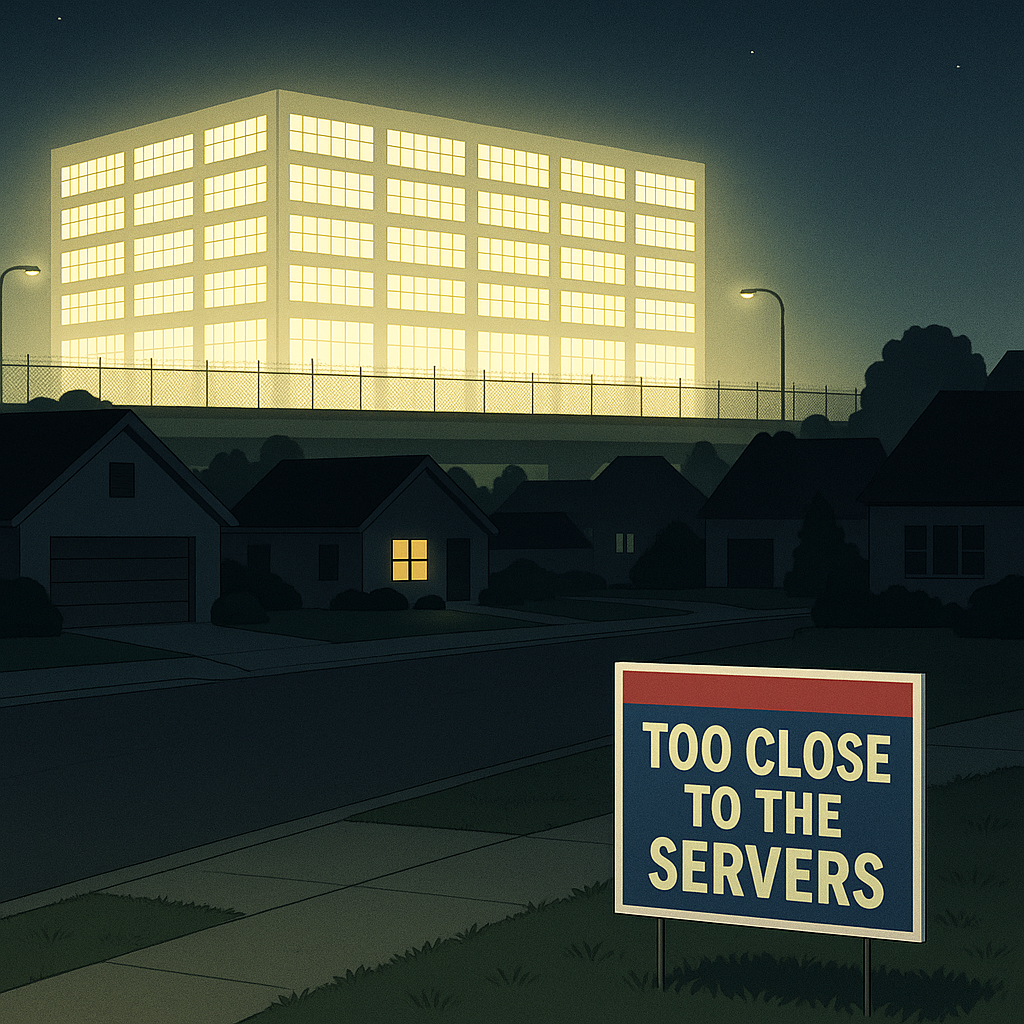
As for voters, polling remains limited but suggestive. Asked whether they support "continued US leadership in artificial intelligence," majorities in both parties say yes. Asked whether they support "the construction of a hyperscale data center within three miles of your home that may modestly raise your electric bill," majorities in both parties ask if this is the thing their neighbor was yelling about on Facebook between posts about school board drama and a mysteriously glowing cloud bank.
The final irony is geographic. The communities hosting this new AI infrastructure tend to be exurban or rural, places promised stable jobs and a broader tax base. Instead, many are discovering that the primary local career path is "campaign staffer for a candidate furious about the facility you already built" and "consultant helping you rebrand a substation as an innovation hub."
Back in Texas, one county official tried to summarize the emerging consensus for reporters.
"We support innovation," she said. "We just think maybe the training run to decide which party controls Congress should not knock out the air conditioning at the nursing home or turn the senior center into a live demo of heatstroke."
Across the country, AI money continues to flow, and candidates in both parties keep promising to stand up to Big Tech, regulate data centers, and protect ordinary Americans from corporate excess.
Campaign finance disclosures show they will begin doing all of that on November 6, 2026, approximately 24 hours after the last wire transfer clears and the last 40-megawatt "community innovation campus" finishes installing its flagpoles.