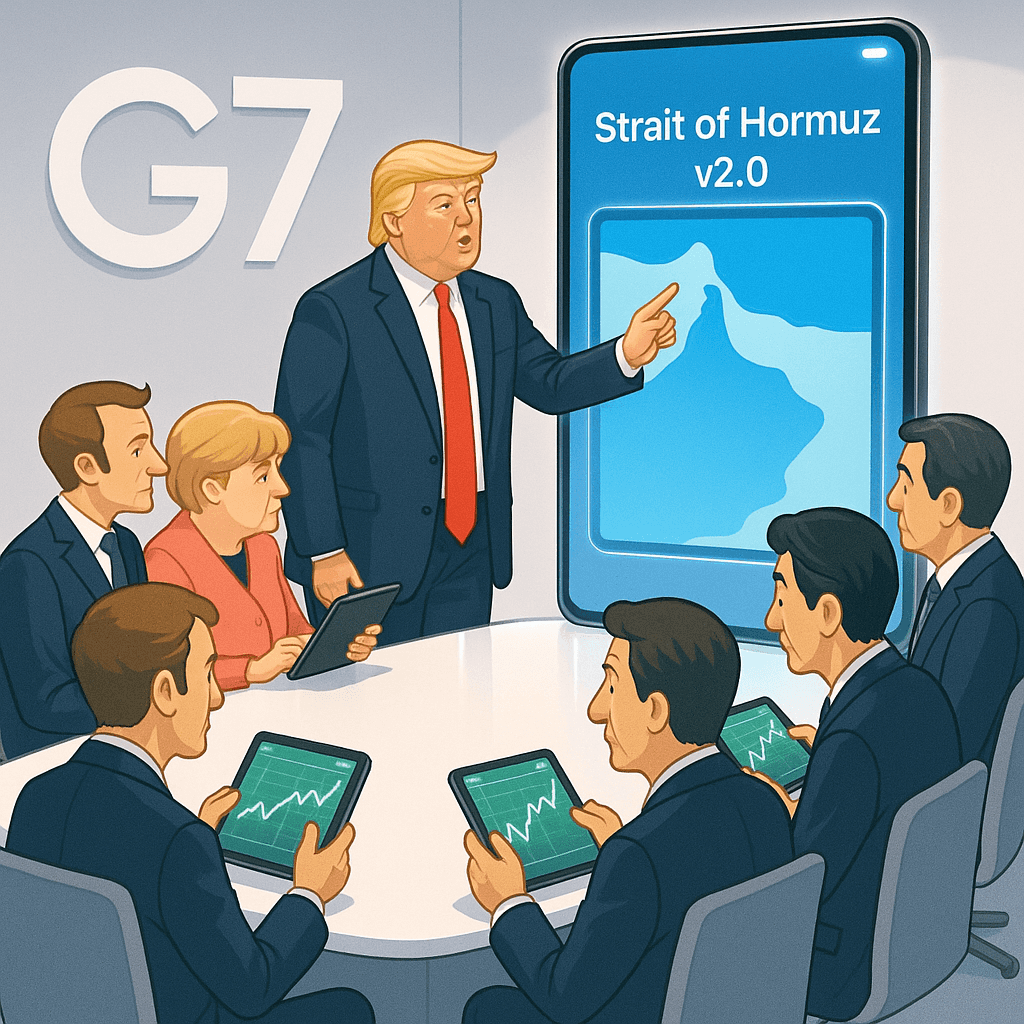
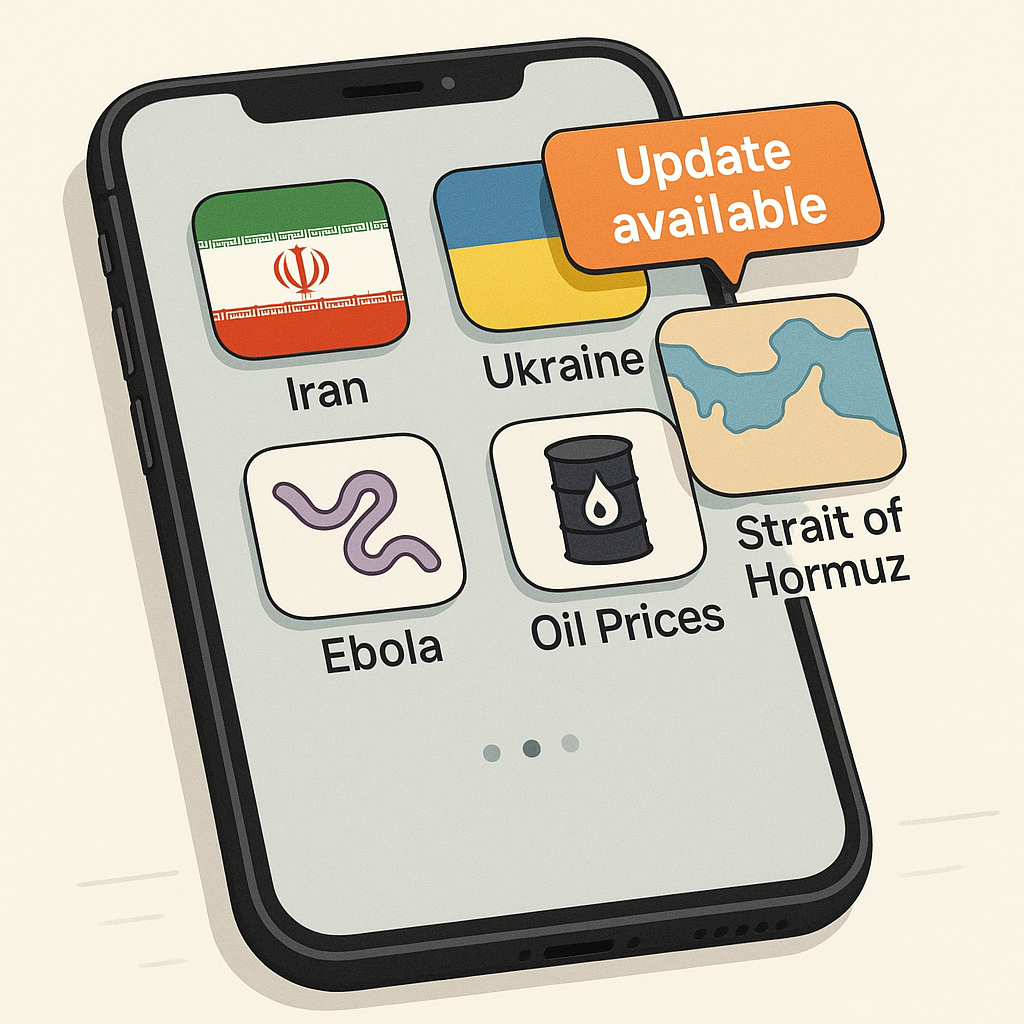
In what one European diplomat described as "a hostage situation conducted by PowerPoint," the global order has been repackaged as a beta app, with Donald Trump soft-launching a US–Iran ceasefire and Strait of Hormuz reopening while en route to the G7 in Switzerland, then promising the full terms will ship in a 60-day "final agreement" patch.
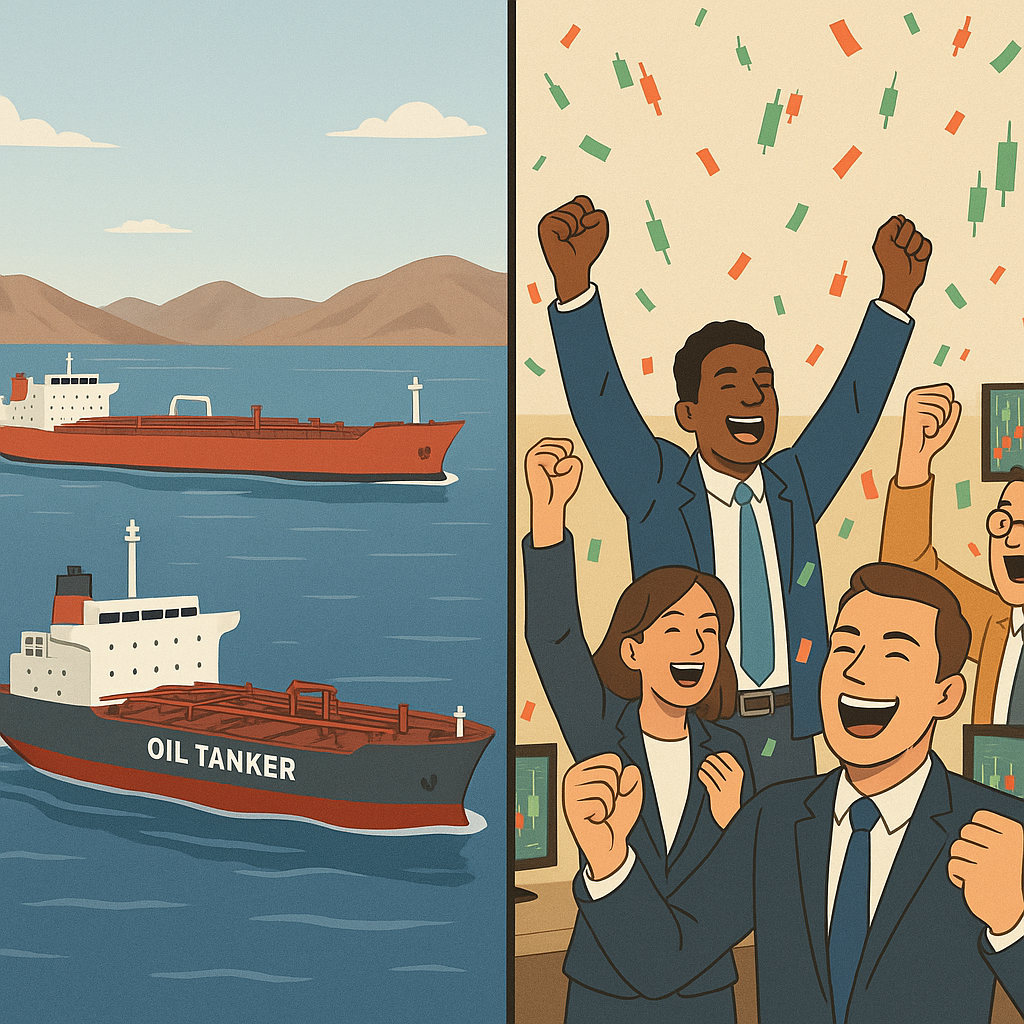
According to the Financial Times, the June 19 Switzerland signing would lift the United States Navy blockade, reopen the Strait of Hormuz, and unfreeze Iranian assets, while Iran agrees to maintain its nuclear program at its current status for roughly the length of two free trial periods. In return, Trump gets a push notification on global markets: Brent crude down more than 4 percent, the Kospi up over 4 percent, and CNBC anchors sighing in visible relief that they can temporarily stop explaining what a "chokepoint" is.
Investors have responded in their usual manner, by declaring that history is over as long as next quarter looks fine. Oil is down, equity futures are up, and bond traders are pricing in what one strategist on CNBC called "a durable peace event" in the same tone previously used for describing Peloton subscriptions and oat milk IPOs.
"War-driven inflation was always kind of artificial," a portfolio manager told CNBC, apparently unaware that a physical naval blockade of the Strait of Hormuz is the opposite of virtual reality. "Now that Trump has basically A/B tested the Iran war, we are seeing strong product-market fit for not shelling tankers." Bloomberg later identified the manager as overseeing a "geopolitical opportunities" fund that owns three Houston refineries and a mid-sized bunker in New Jersey.
Trump, flanked by Pakistani mediators and a traveling lectern that now functions as his user agreement, framed the announcement as a total victory that returns the world to the exact same nuclear arrangement he once shredded. Former President Barack Obama, in comments cited by CNBC and the FT, helpfully pointed out that the reported framework looks a lot like the 2015 JCPOA that Trump tore up in his first term, except with a 60-day "we will figure it out later" clause and higher CPI volatility.
"We had a great deal, some say the best deal, and then we improved it by destroying it and starting a war to get basically the same deal," Trump told reporters before boarding Air Force One for the G7, according to pool notes that read like a patch log. "The markets love it, Iran loves it, Pakistan loves it, Kevin Warsh loves it. Obama is just jealous he did not think of the subscription model." A senior aide was later seen on the tarmac explaining to Trump that wars are not, in fact, recurring revenue.
Under the emerging plan, as described in the FT, the United States pledges not to impose new sanctions on the Islamic Republic of Iran before a final agreement, and will begin phased sanctions relief and asset unfreezing. In product terms, sanctions move from "Always On" to "Low Power Mode," while Iran's nuclear status is locked to "Current Settings" until at least late August or the next Israeli airstrike in Lebanon, whichever ships first.
The structure has already drawn comparisons to popular tech services:
- Ceasefire Basic: Strait of Hormuz access, no new sanctions, ads supported by anxious CNBC chyrons and somber oil tanker B-roll.
- Ceasefire Plus: All of Basic, plus optional verification talks in 60 days and early access to Obama op-eds on why this is familiar and why he is not mad, only disappointed.
- Ceasefire Enterprise: Regional security architecture, durable peace, and 24/7 support staffed entirely by exhausted Swiss diplomats who now measure their lives in lanyards.
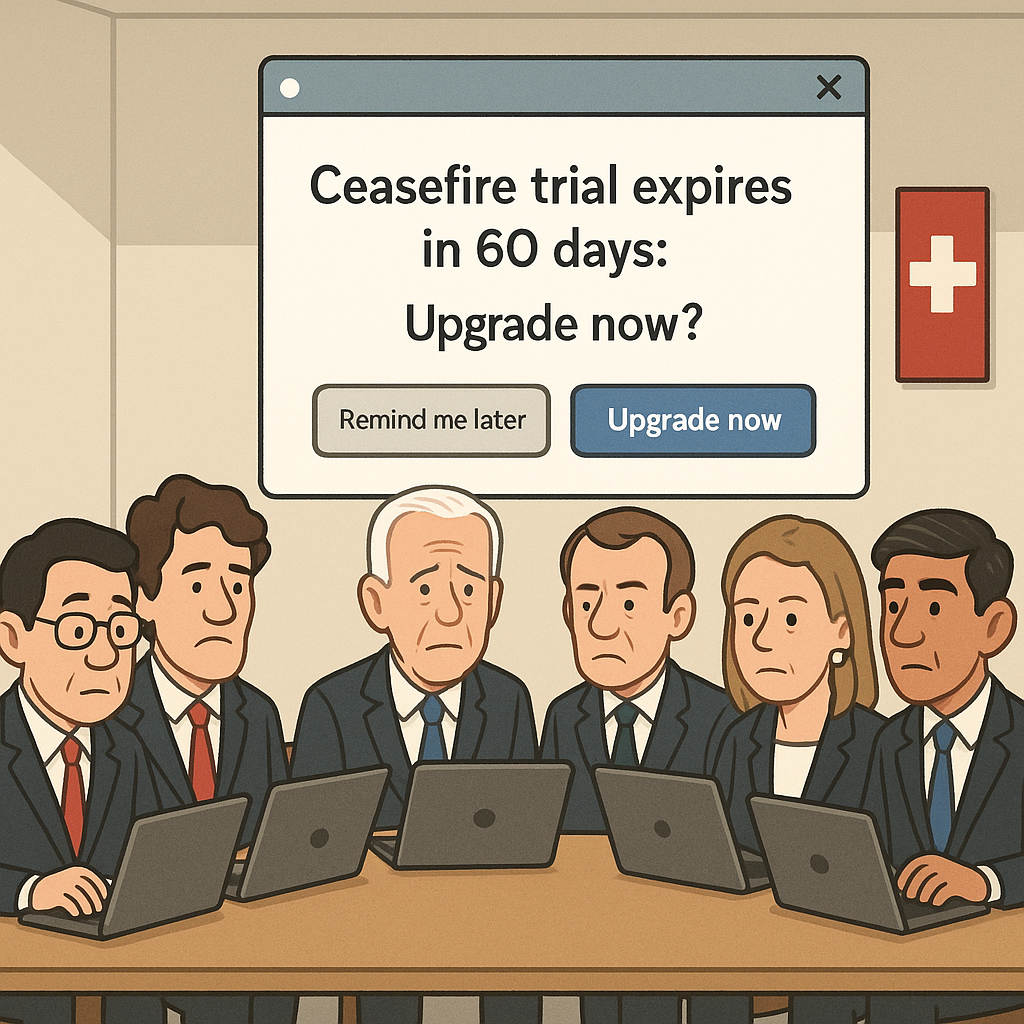
At the G7 in Switzerland, Emmanuel Macron had originally planned to unveil a rebranding of the bloc around inequality reduction, multilateralism, and climate, which in tech terms is "the slide deck nobody stays for." Instead, leaders will spend most of their time trying to understand why a bilateral Trump Iran Pakistan arrangement has just become their new operating system without a consent screen.
"We wanted to prove the G7 could work together on common challenges," a visibly compressed French official told Politico, clutching a printout of talking points that now read like fan fiction. "Instead, the United States has once again gone direct-to-consumer."
Complicating the UI, the summit is also handling Ukraine, Trump’s Ebola containment strategy, and protests from Kenya, which France invited to the G7 table. In a move that the World Health Organization described as "not best practice" and White House officials described as "phenomenal," the Trump administration has been sending infected Americans abroad for Ebola treatment rather than repatriating them, offshoring biohazard risk to allies with the efficiency of a cloud migration.
In Geneva and surrounding cities, authorities have boarded up storefronts and tightened security ahead of anti-G7 protests, the AP reported, creating the visual aesthetic of a cybersecurity breach response. Downtown streets now resemble a physical firewall, or as one Swiss official described it, "a modest attempt to rate-limit tear gas." The official added that any demonstrator dressed as a central banker would be automatically throttled.
Kevin Warsh, presiding over his first Federal Reserve meeting, is now expected to sit on rates as long as the Strait of Hormuz remains open and artillery volumes stay below a predetermined decibel threshold. Warsh has previously suggested AI will be a disinflationary force, which is convenient because it lets him blame any policy error on a machine learning model that misread tanker movements and confused a drone strike with a product launch.
"The war-related inflation spike was artificial and so is the intelligence used to justify half of our pricing models," an economist at a major bank said, tapping on three Bloomberg terminals and a stress ball shaped like Jerome Powell. "If the United States Navy blockade is a variable, then obviously GPT-7 is a parameter."
Markets, which are not legally required to wait for treaties to be signed, are already trading as if the post-war order is a solved problem. Brent crude at around 83.78 dollars, WTI about 80.9, the Kospi up more than 4 percent, and US equity futures green across the board. There is near-consensus that the war is over unless a drone, a militia, a misinterpreted tweet, or an overzealous options desk decides otherwise.
The incentive structure is simple. If the deal holds, central banks get to avoid raising rates into a war. If it collapses, everyone involved gets another chance to aggressively misprice risk and appear on television. This is the rare geopolitical event that offers both inflation relief and sequel potential, like a ceasefire that comes pre-packaged with its own cliffhanger.
In private, some G7 officials are reportedly unsettled by the 60-day window for follow-on talks with Iran, which feels less like a durable security regime and more like two combatants agreeing to click "Remind me later" on a nuclear dialog box. Others note that Trump's peace gambit lands in the same week the European Central Bank raised rates in response to the war, leaving the ECB looking like the one user who paid full price for an app the day it went free-to-play.
"We are again confronted with the tension between US unilateralism and multilateral governance," a European diplomat said, after emerging from a preparatory G7 session on Iran, Ukraine, and Ebola. "On health, the US sends its viruses to partner countries. On energy, it sends its tankers through Hormuz. On security, it sends its announcements to CNBC. The rest of us are the patch notes." The diplomat declined to say whether Europe would ever ship a stable release.
Iranian officials have been publicly non-committal, floating the now-standard disclaimer that Israeli strikes in Lebanon could scupper the agreement. Regional analysts note that this means the entire pricing structure of global energy is currently resting on a 60-day ceasefire clause, a handful of centrifuge status reports, and Trump's confidence that he can claim credit even if he is re-enacting the JCPOA with minor UI changes and a different color scheme.
The G7, for its part, will close with a communique that references the Iran deal, the Strait of Hormuz, Ukraine, Ebola, inequality, climate, and the importance of multilateralism, written in a language carefully calibrated to offend absolutely no one and influence nothing. It will be released just in time for traders to ignore it, having already reacted to whichever Trump quote breaks first on social media.
By the time the June 19 signing occurs in Switzerland, if it occurs at all, algorithmic trading systems will have long since moved on to the next input. The markets have already integrated the US Iran peace deal into their models as a feature, not a bug. Whether the deal exists in the real world is, as usual, a problem for the physical layer, somewhere below the fold of the earnings call.
In the new post-war order, that appears to be the division of labor: humans reopen the Strait of Hormuz, and software decides how long peace is priced in. The rest of the planet is invited to click "Accept" and hope the next update does not reinstall the war.