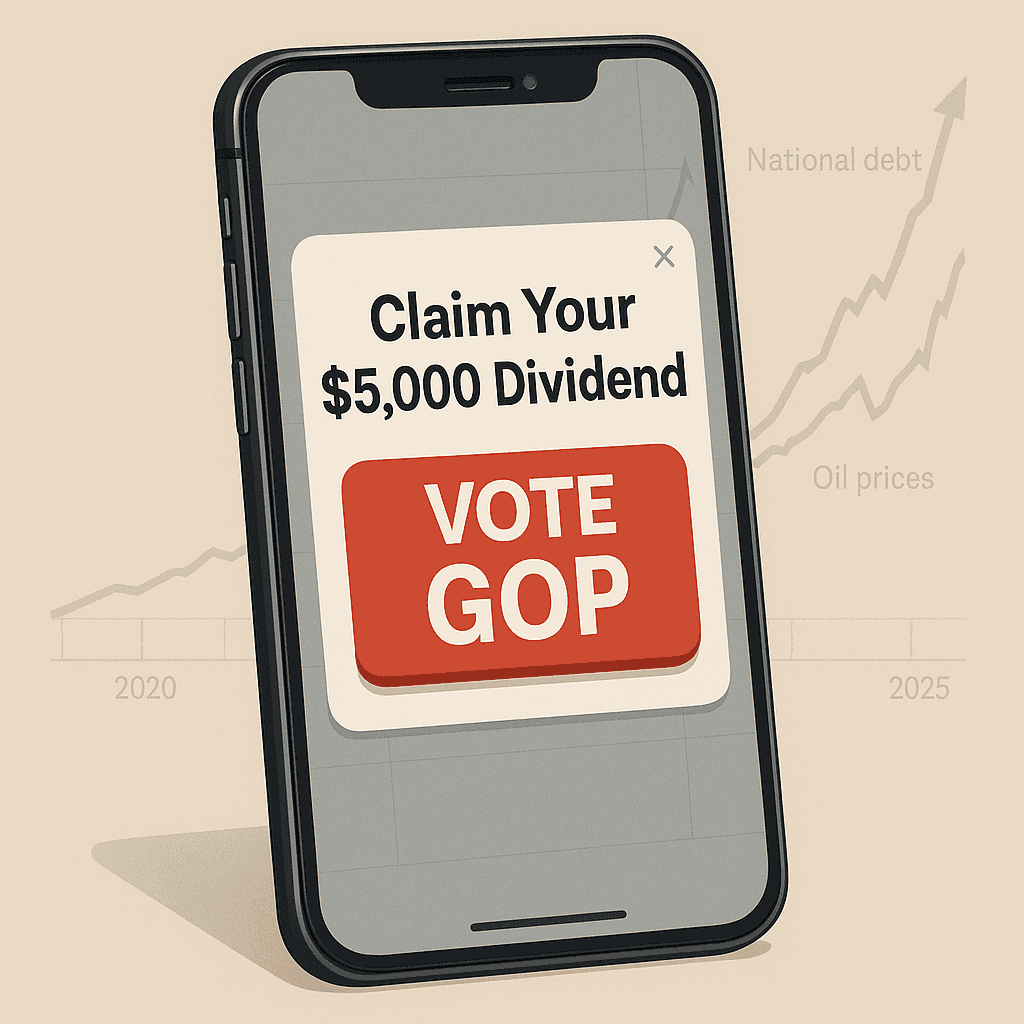
In a development experts called inevitable, Donald Trump has effectively turned the U.S. economy into a freemium app, announcing a $5,000 “dividend” for every adult American that only unlocks if Republicans keep control of Congress.
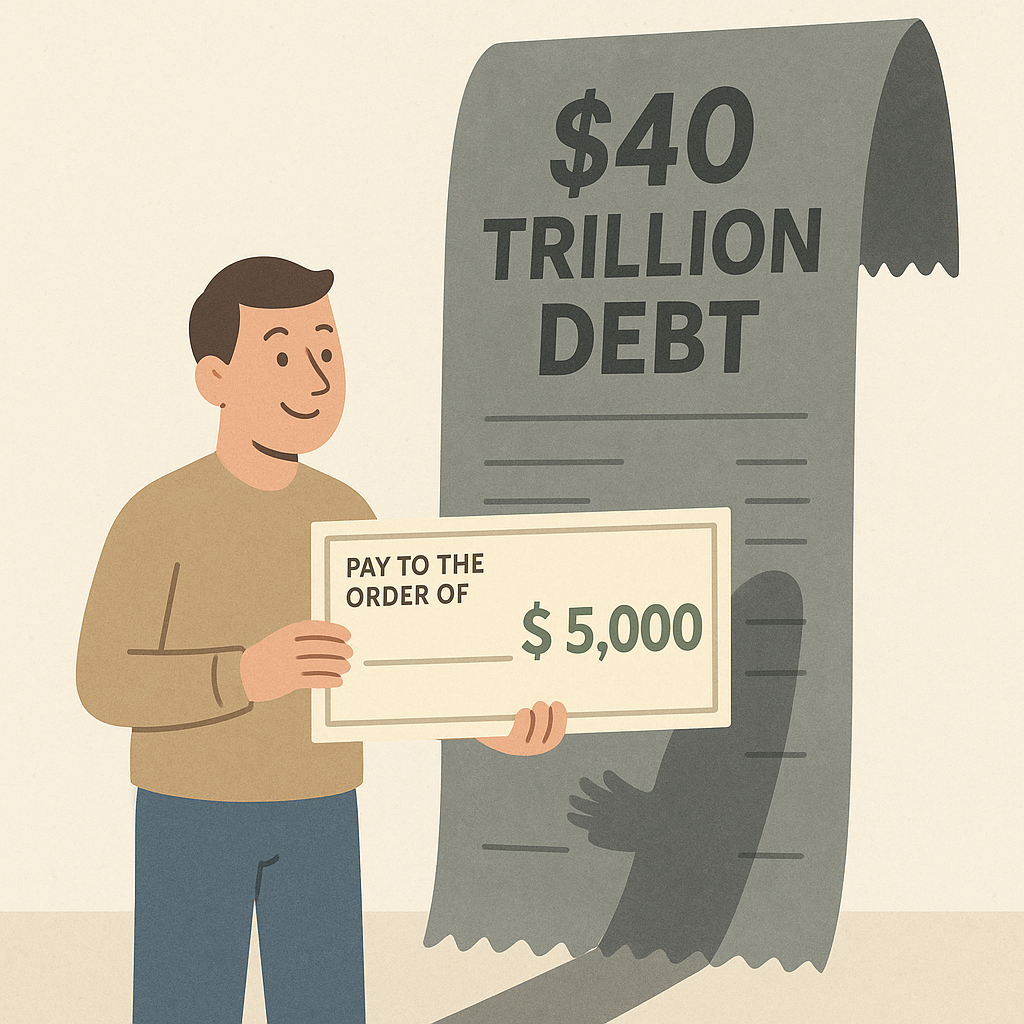
Speaking at the Republican National Convention in Dallas, Trump pitched what clickorlando.com helpfully titled “Trump’s $5,000 Dividend: Cheap Politics in an Expensive Economy,” a phrase that sounds less like a news headline and more like the tagline on a predatory fintech startup. The limited-time offer arrives as the national debt passes $40 trillion, annual interest payments swell to roughly $3,700 per person, and U.S. crude jumps back above $100 a barrel.
In software terms, it is like shipping everyone a $5,000 promo code while quietly subscribing them to a recurring $3,700 a year background charge called “servicing the debt.”
Administration aides have outlined the basic user flow. Step one: every American adult sees a full-screen pop-up in their brain, framed in campaign red, reading, “Claim your $5,000 reward. Offer only valid if Republican Party remains administrator of this device.” Step two: Congress approves the feature toggle, since the Constitution inconveniently gives it the in-app purchase authority.
“Think of it as a national stimulus, but fun,” an unnamed MAGA Inc. strategist said, standing in front of a dashboard tracking the group’s reported $400 million war chest. “People loved the COVID checks. We are just iterating the user experience, tying it to something they can control, which is voting for us. It is gamification of fiscal policy.”
Republican leadership in the House and Senate is reportedly working on draft legislation, informally nicknamed the “Venmo the Voters Act.” According to early leaks, the bill will be financed through a sophisticated four-step algorithm:
- Borrow trillions of dollars at interest rates that keep rising because of previous trillions of dollars.
- Send out $5,000 per adult in a single push notification.
- Blame the European Central Bank’s latest rate hike for any further inflation.
- Remind voters that Democrats are the real inflation party.
The plan arrives at a moment when markets already look like a risk dashboard in a datacenter that nobody wants in their county. Oil is over $100 as U.S.–Iran tensions keep the Strait of Hormuz semi-closed, Brent is above $105, and the ECB just raised rates again, sending Germany’s DAX into the red. U.S. wholesale prices remain stubborn, which economists say is normal when you repeatedly set the economy to “stimulus, then argue about why things cost more.”
To reassure everyone, Trump has promised that oil prices “probably won’t come down until after the midterms,” a statement that accidentally described how algorithms typically schedule their outages.
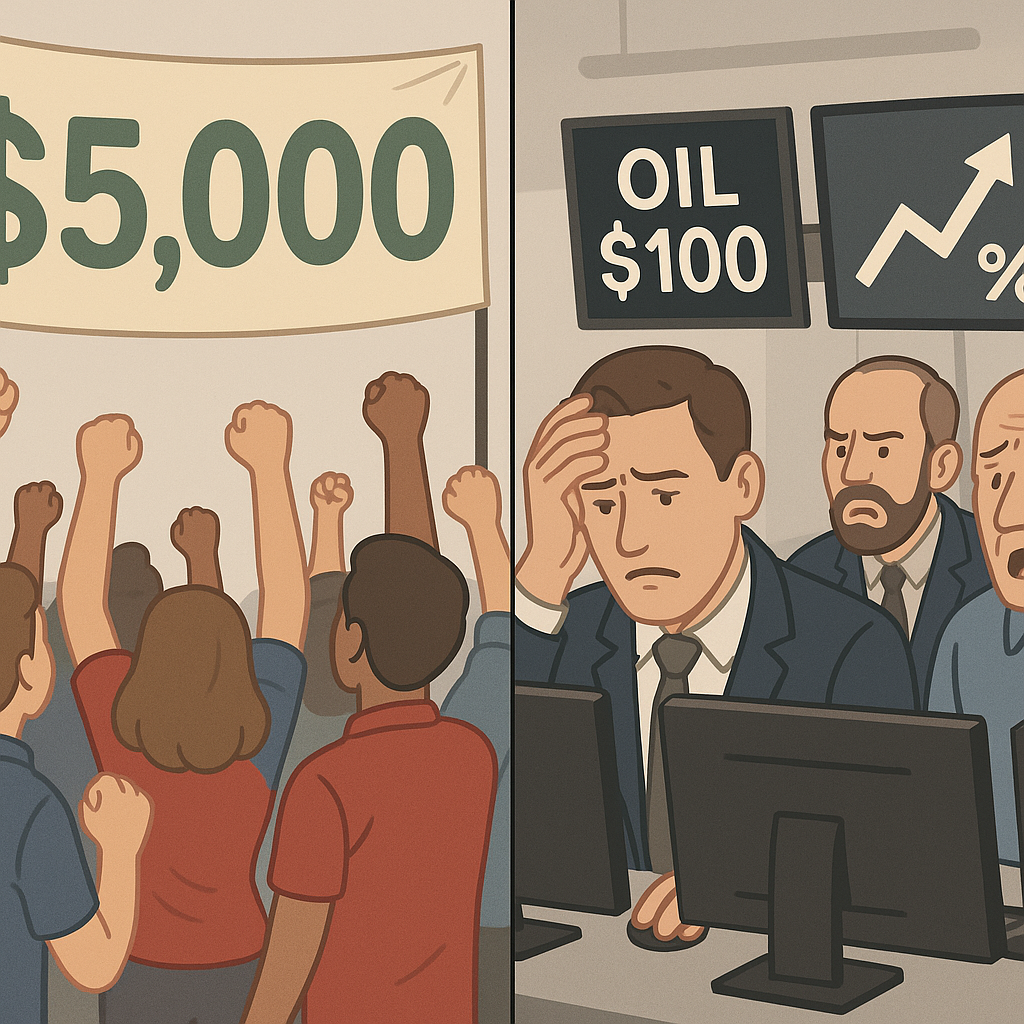
Fiscal hawks in the Republican Party, once marketed as the content moderators of federal spending, now sound like an outdated spam filter. “I am troubled by the debt trajectory,” one Senate Republican said, while quickly adding that he was “open to discussion on the dividend” because he has a competitive race and “Democrats do checks too.”
Behind the scenes, campaign tech consultants are quietly thrilled. “This is the cleanest A/B test in political history,” said a former social media growth head who now optimizes super PACs. “Group A gets abstract warnings about inflation. Group B gets $5,000 promised on live TV. We already know the result, but we get to invoice them for the analytics anyway.”
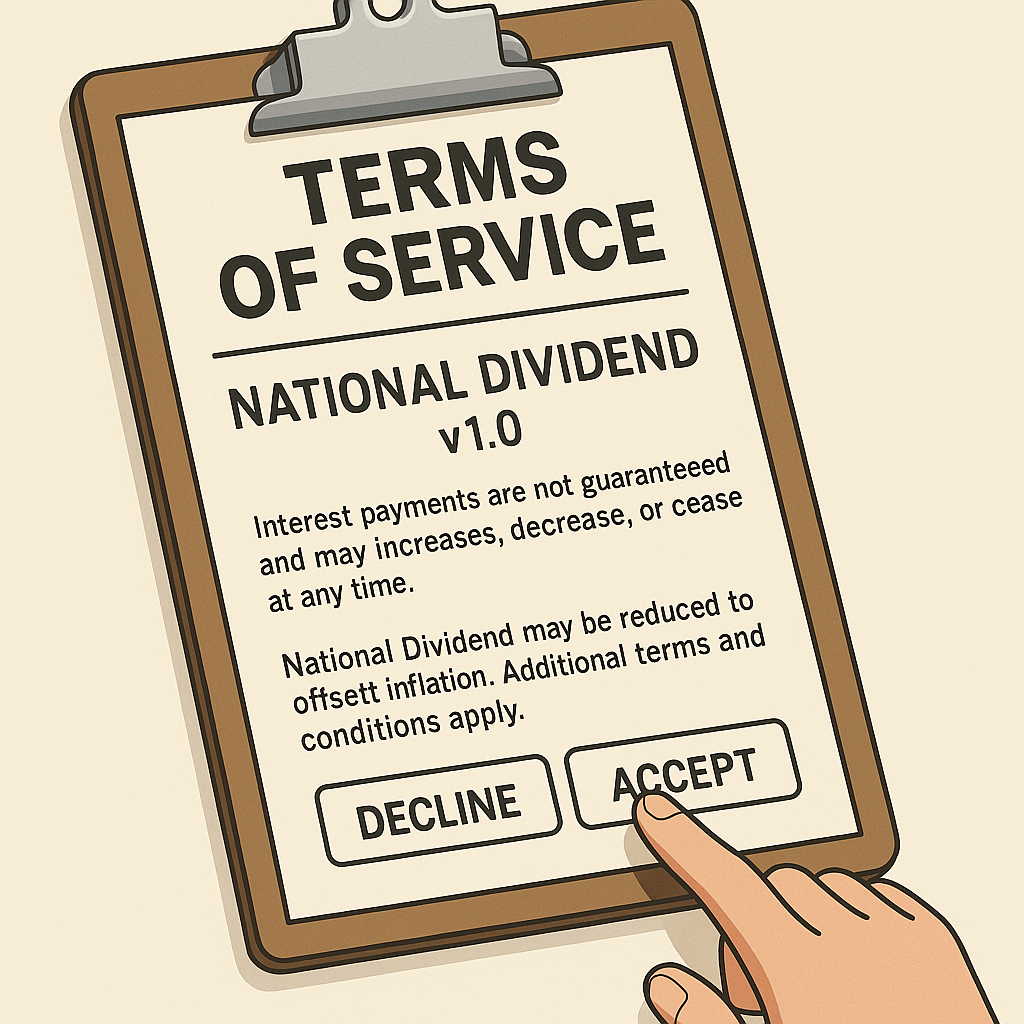
Legal scholars, interviewed by Reuters, have said the arrangement is probably constitutional, mostly because the Constitution did not anticipate push notifications. “Voters would have a hard time showing direct harm,” one law professor explained. “Traditionally, courts step in when someone loses money. The challenge here is that everyone is potentially gaining money in the short term in exchange for abstract long-term risk. That looks less like bribery and more like a standard terms-of-service agreement.”
Meanwhile, AI systems that now handle the financial questions people are too embarrassed to ask, as Digital Journal recently noted, are already processing a flood of new queries:
Q: If I get $5,000 now but owe $3,700 a year in interest forever, is that good?
AI: That depends. Are you up for re-election in eight weeks?
In a sign of synchronized absurdity, some Republican strategists have floated funding the dividend via new tariffs, similar to a previous Trump pitch for a $2,000 tariff-backed payment that never materialized. This would effectively charge Americans higher prices on imported goods so the government can collect the difference, take a fee, and send some of it back to them as a “dividend.” In Silicon Valley, this is known as a marketplace business model. Everywhere else, it is known as paying shipping twice.
The Federal Reserve, which has spent years trying to gently cool inflation without crashing markets, now watches all this like a DevOps team handed a Molotov cocktail during a minor server fire. Officials are reportedly modeling scenarios in which trillions in fresh stimulus checks hit household accounts just as oil supply stays tight and the ECB hikes again. The technical term for this, in central-banking circles, is “not ideal.”
Democrats, for their part, are split between calling the plan reckless and drawing up their own competing feature sets, such as targeted child tax credits, student debt relief, or a “climate cashback” that would arrive as your house floods. Focus groups reveal that voters describe all of these as “less exciting than $5,000 right now, though.”
Back on the convention floor, Trump loyalists dismiss concerns that the U.S. is turning into a giant buy-now-pay-later app with a defense budget. “The national debt is fake news,” one attendee said, waving a sign that read “DIVIDENDS NOT DEFICITS.” “They have been warning about this for decades. If it was real, something bad would have happened by now.”
Asked how he reconciles years of Republican warnings about Biden-era “inflationary overspending” with the largest one-time cash transfer in U.S. history, the same attendee shrugged. “That was their spending. This is our investing.”
The only entity showing consistent fiscal discipline is MAGA Inc., which is carefully choosing which races to support with its $400 million. The group recently committed $10 million to TV ads for scandal-plagued Texas Senate nominee Ken Paxton, in what analysts called “testing whether you can debug a candidate with sheer spend.”
Economists say the real experiment is whether an advanced democracy will repeatedly trade long-term stability for short-term payouts, even as interest costs approach the size of the promised dividend on a per-person basis. At that point, the government will have essentially launched a national subscription service where every year you pay most of last cycle’s bonus back to bondholders so you can qualify for the next bonus.
Asked to summarize the strategy, one senior Republican aide was admirably concise. “Look, in 2020, Biden and Congress sent people checks, and he won. In 2026, we are sending bigger checks. If this works, in 2028, everyone will have to send even bigger checks. That is not a bug. That is incumbency.”
Somewhere under all this, the U.S. economy continues to process real signals: oil tankers waiting at the Strait of Hormuz, central banks ratcheting interest rates, stock indexes in Europe and Asia sliding, wages trying to keep up with prices. The dividend debate treats these as minor UI clutter around the main button that reads “Claim $5,000.”
If voters click it, they will get their money. Then, quietly, the system will reboot with a small pop-up no one reads: “By accepting this payment, you agree to recurring charges of unknown size, payable by you or your children. No refunds. No customer support. Press ‘OK’ to continue.”