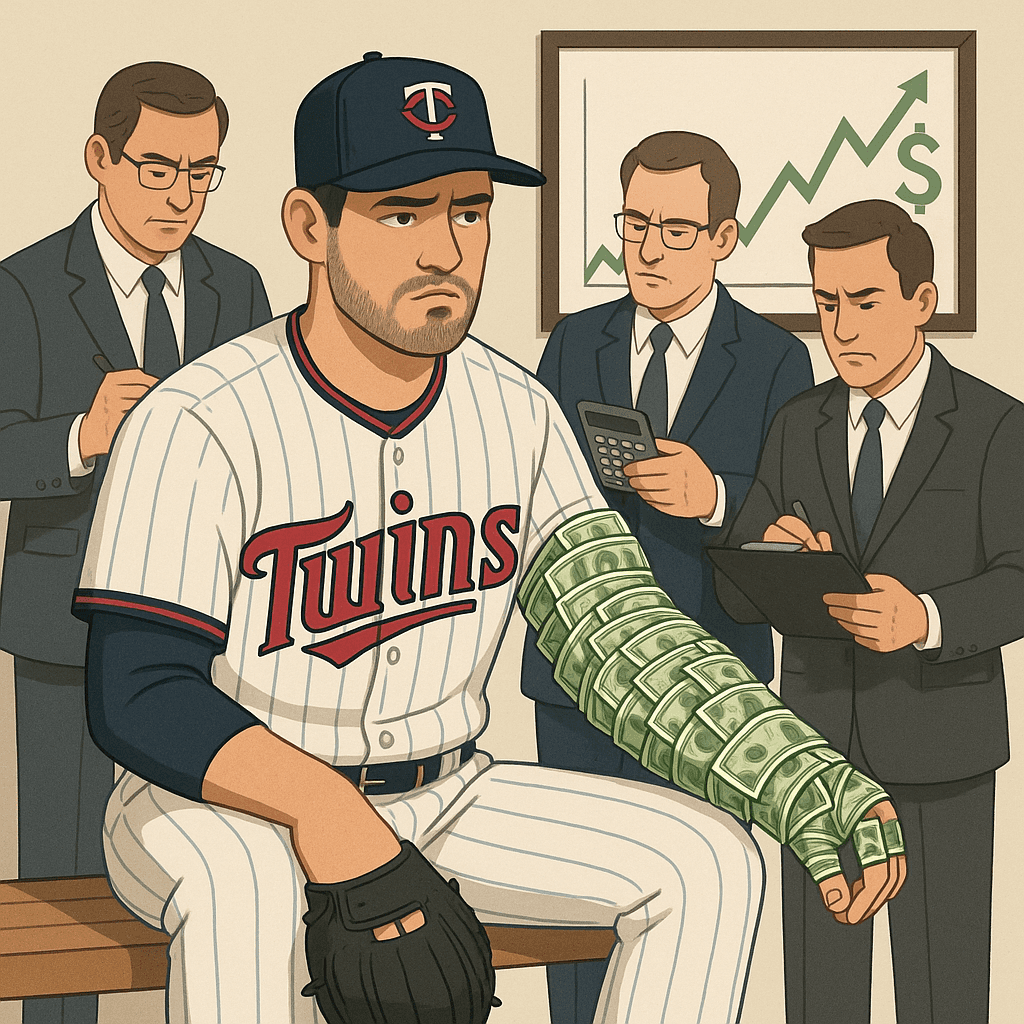
MINNEAPOLIS — When Minnesota Twins ace Pablo López shredded his ulnar collateral ligament, most fans worried about wins, losses, and whether this meant another year of daytime baseball-induced seasonal depression. The Twins front office, however, mainly worried about one thing: the business case for paying eight figures to a man whose elbow now resembles a dollar-store bungee cord.
The injury — a “significant UCL tear” likely shelving López for the season, according to the Twins GM (AP, Feb 2026) — has accidentally exposed Major League Baseball’s favorite hidden stat: Return on Ligament (ROL). Somewhere between WAR, FIP, and whatever Excel war crime is happening in the analytics department, the Twins have been quietly turning elbows into line items.
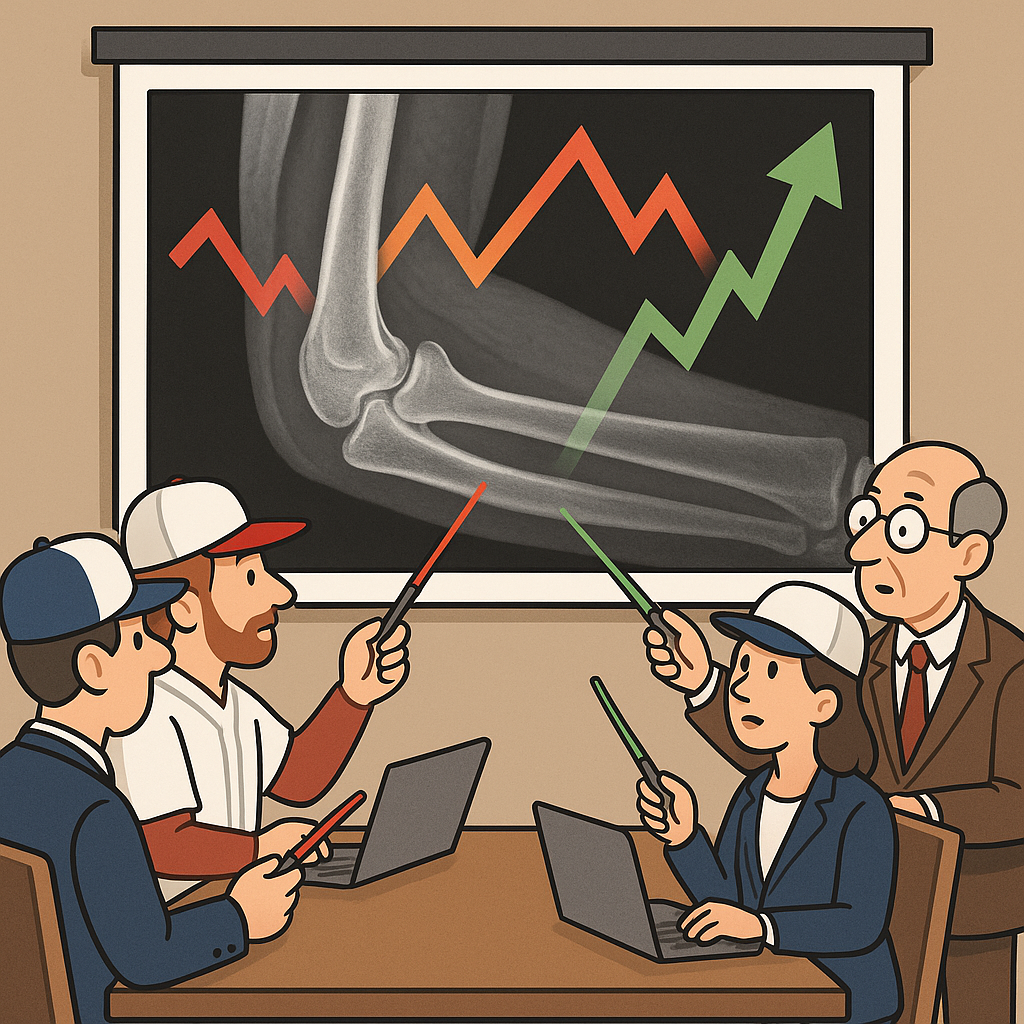
“From a baseball perspective, it’s unfortunate,” the Twins GM reportedly said, staring at an MRI like it was a quarterly earnings slide. “But from a portfolio perspective, we’ve never been more diversified. We’ve got Pablo’s contract, three layers of injury insurance, and a derivative Swaps On Projected Strikeouts instrument that pays out if he can’t lift a fork.”
Financial analysts, rarely invited to speak about ulnar collateral ligaments unless they own a fantasy team, suddenly found themselves in high demand. One Minneapolis-based sports economist, wearing a tie shaped like a baseball bat, explained the new logic of the game:
“Teams don’t sign pitchers for innings anymore. They sign them for content, cap gymnastics, and balance-sheet theatre. Pablo López’s elbow is less a joint and more a structured financial product. The tear just accelerated maturation.”
Across the river, die-hard Twins fans processed the news the old-fashioned way: arguing about capitalism on talk radio. Callers alternated between lamenting López’s lost season and demanding to see the insurance contract like it was a Freedom of Information Act request.
“So let me get this straight,” one caller complained, “we pay twenty bucks for a beer, forty for parking, and a hundred to sit behind a pole, but the real winner tonight is Lloyd’s of London because Pablo’s elbow detonated in April?”
Economically, though, the math is darkly elegant. The Twins still sell jerseys with LÓPEZ 49 on the back. The regional sports network, hungry for content, will now air three different specials: “The Anatomy of a Pitcher’s Elbow,” “The Business of Rehab,” and “Can AI Replace a Starting Rotation?” sponsored by an insurance company, a hospital, and some cloud firm that has never seen a fastball in its life.
The headline practically wrote itself across half a dozen outlets — Postregister, West Plains Daily Quill, Rutland Herald, and more all ran their versions of the same gloomy note about Pablo López’s season imploding. But the quiet subhead, if you look closely, might as well read: “Asset Reclassified: Now Yielding Insurance Payouts Rather Than Innings Pitched.”
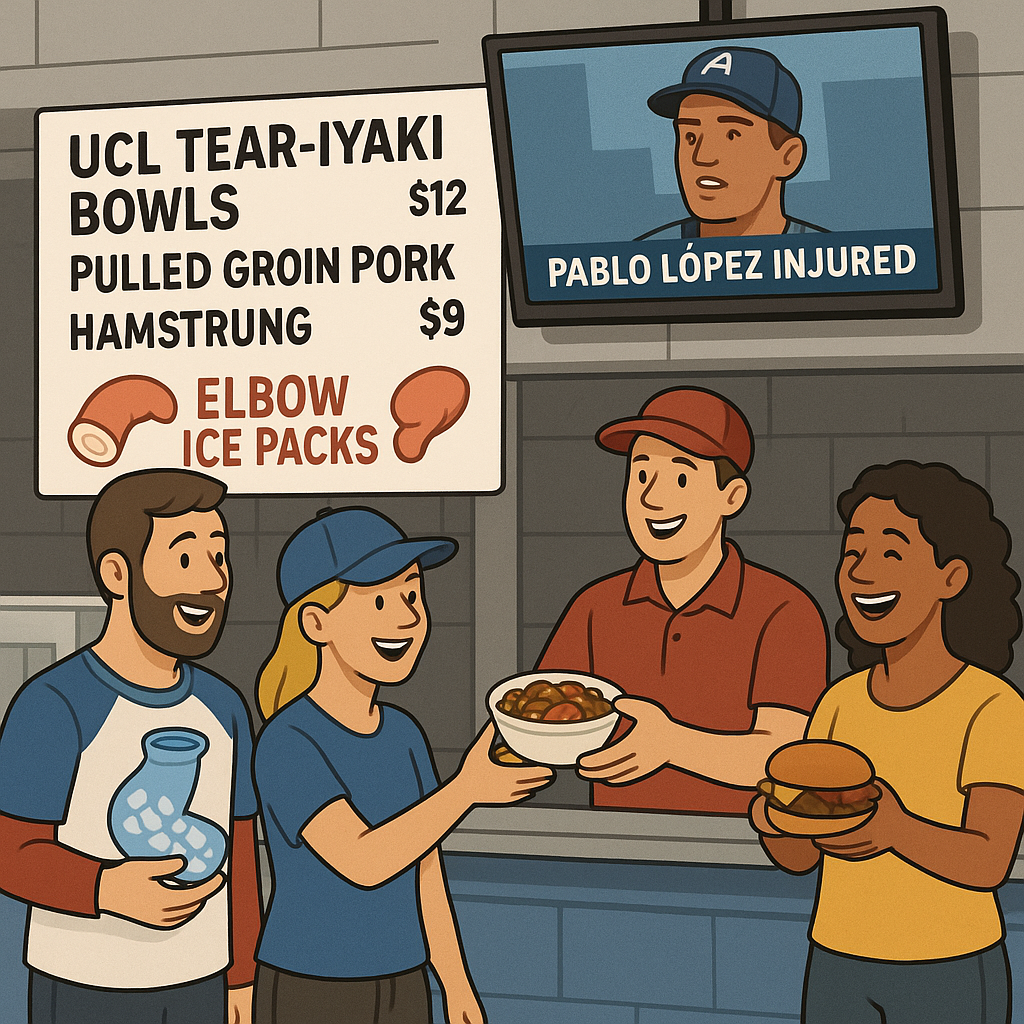
On Wall Street, baseball injury alerts have become a thinly disguised asset class. The moment AP News pushed its notification that Pablo López’s elbow could sideline him for the season, a cluster of monitors lit up in a Manhattan office. An algorithm triggered a series of trades in the North American Pitcher Health Index ETF, a niche product tracking teams whose playoff hopes are held together with sutures and prayer.
“We used to track macro indicators like oil prices and interest rates,” said one hedge fund manager. “Now we track UCLs, oblique strains, and how many times a GM says ‘day-to-day’ when they really mean ‘it’s over.’ Pablo’s MRI is now a material event in our risk model.”
Back inside Target Field, the business opportunities are just beginning. With their nominal ace sidelined, the Twins unveiled a new premium seating experience: the Orthopedic Suite. For an additional $300 per ticket, fans can watch the game in a high-backed recliner, with an in-seat physical therapist and a souvenir ice pack shaped like an elbow.
- “Tommy John Tuesdays” featuring discounted surgery-themed merch
- “MRI Cam” on the jumbotron, overlaying grainy scan images on opposing pitchers
- Sponsored in-game segment: “Pitch Count or Payout?” guessing when the insurance clause kicks in
Even the concession stands are in on it, testing a new menu item called the UCL Tear-iyaki Bowl: incredibly overworked, undercooked, and guaranteed to fail before September.
López himself, by all accounts, would prefer to be throwing baseballs rather than becoming a walking case study in the financialization of sports injuries. But business doesn’t run on preference; it runs on leverage. And at the moment, his elbow is more valuable as a cautionary tale than as a delivery system for sliders.
“It’s surreal,” said a fan outside the stadium, holding a freshly purchased Pablo López bobblehead whose arm is, ominously, spring-loaded. “He’s on the injured list, but he’s also on three promotional posters, two video ads, and my fantasy team’s ‘out for season’ slot. I feel like I own a tiny bond in his elbow.”
The Twins, meanwhile, insist they’re committed to López’s long-term future. In the same breath, they also confirm they are “exploring innovative financial strategies around player health risk,” which is corporate-speak for slapping QR codes on MRIs and selling them as NFTs the next time crypto briefly reanimates.
Teams around the league are taking notes. If a Twins GM can turn an UCL tear into a balance-sheet event, imagine what the New York Yankees could do with a full rotation headed for surgery. Baseball’s next expansion, it seems, won’t be into new cities — it’ll be into new financial products.
By the time Pablo López returns, some future broadcast might introduce him like this:
“On the mound tonight, making his long-awaited comeback after reconstructive surgery and a highly successful bond issuance… right-hander Pablo López, the only pitcher in MLB history to lead his team in both strikeouts and insurance revenue.”
In the meantime, his elbow will spend the season doing what every modern asset does best: sitting quietly while other people try to figure out how to squeeze one more dollar out of it.