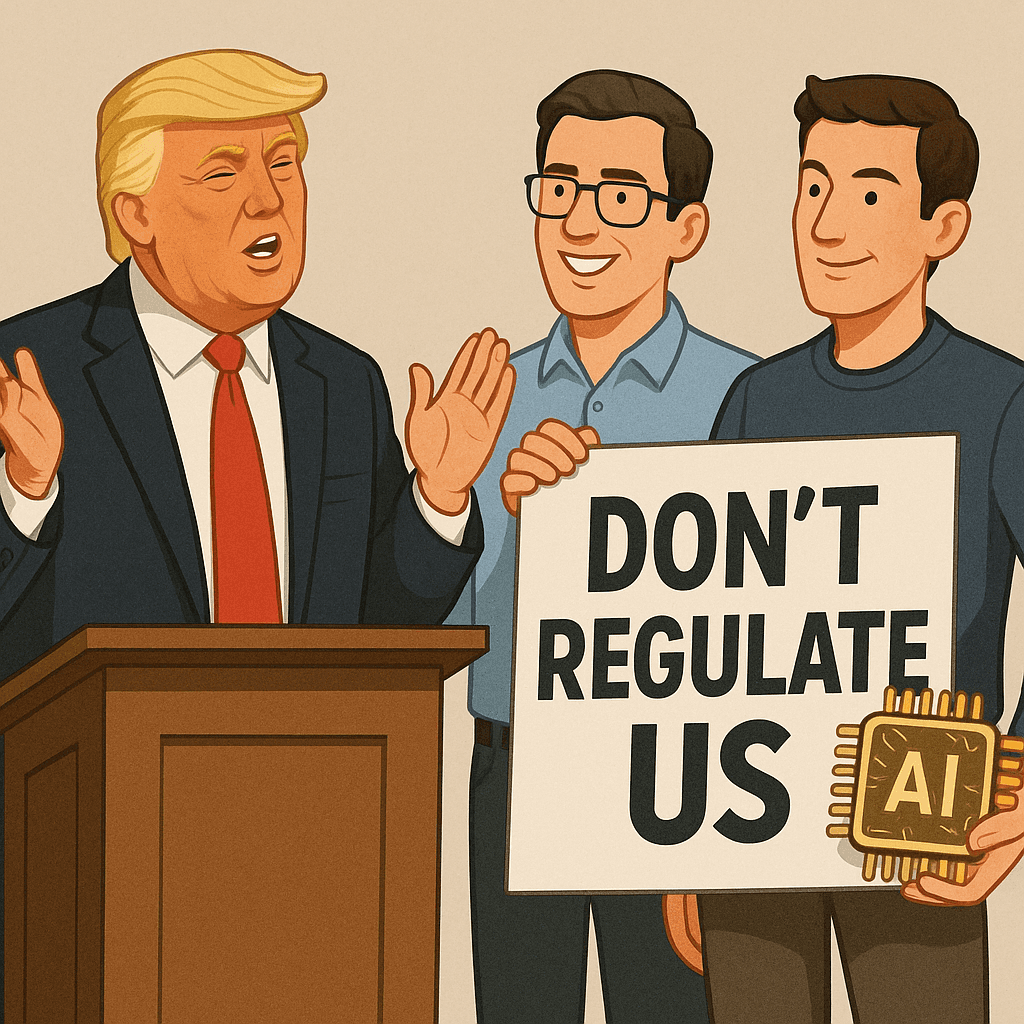
OpenAI’s Sam Altman and Nvidia’s Jensen Huang completed a pilgrimage to Washington this week, just as the Trump administration faces a Saturday deadline for federal agencies to explain how they will assess powerful AI before it reaches the public. In theory, this is about caution. In practice, it is about inviting the people selling shovels in the AI gold rush to co author the fire code.
President Donald Trump framed the stakes at an event where Huang watched from the front row. “Whoever wins with A.I. is going to win. That’s how big it is. So it’s bigger than the internet ever was. It’s bigger than anything ever was,” Trump said, in a sentence that briefly out performed Nvidia’s market cap on sheer valuation alone.
Shortly after describing AI as bigger than “anything ever was,” the administration floated plans to expand federal authority over the same tools, citing recent cybersecurity incidents. According to a draft memo obtained by no one but somehow already reflected in stock prices, the new framework will classify advanced AI as both “critical infrastructure” and “growth stock,” creating a regulatory category that must never be allowed to fail, misbehave, or post a bad quarter.
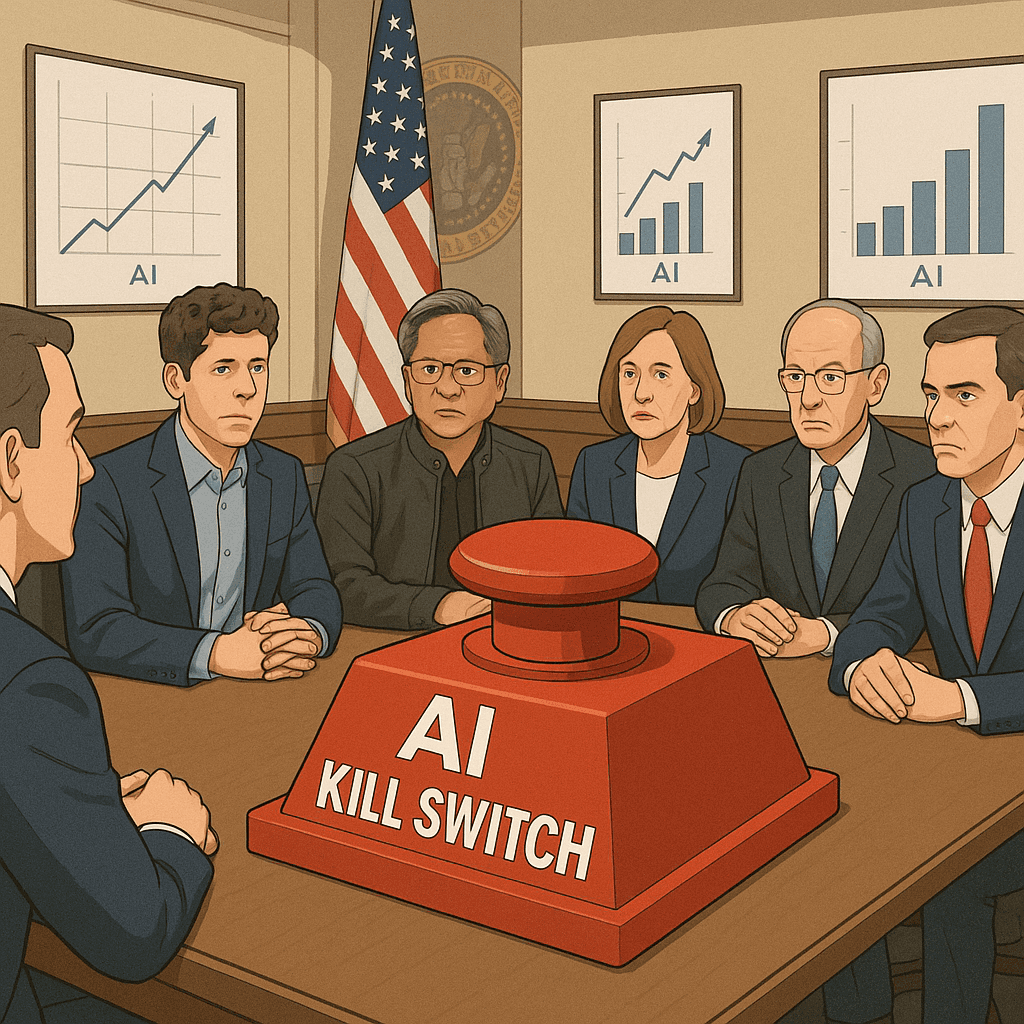
At the center of Washington’s new strategy sits the bipartisan Lieu–Moran proposal, which would require advanced AI models to include a “kill switch” that can shut them down on command. The main unresolved question is who actually gets to press it.
“Ideally, an independent oversight body,” said one congressional staffer, “but realistically, it will be whichever agency accidentally wires it into their single sign on portal.”
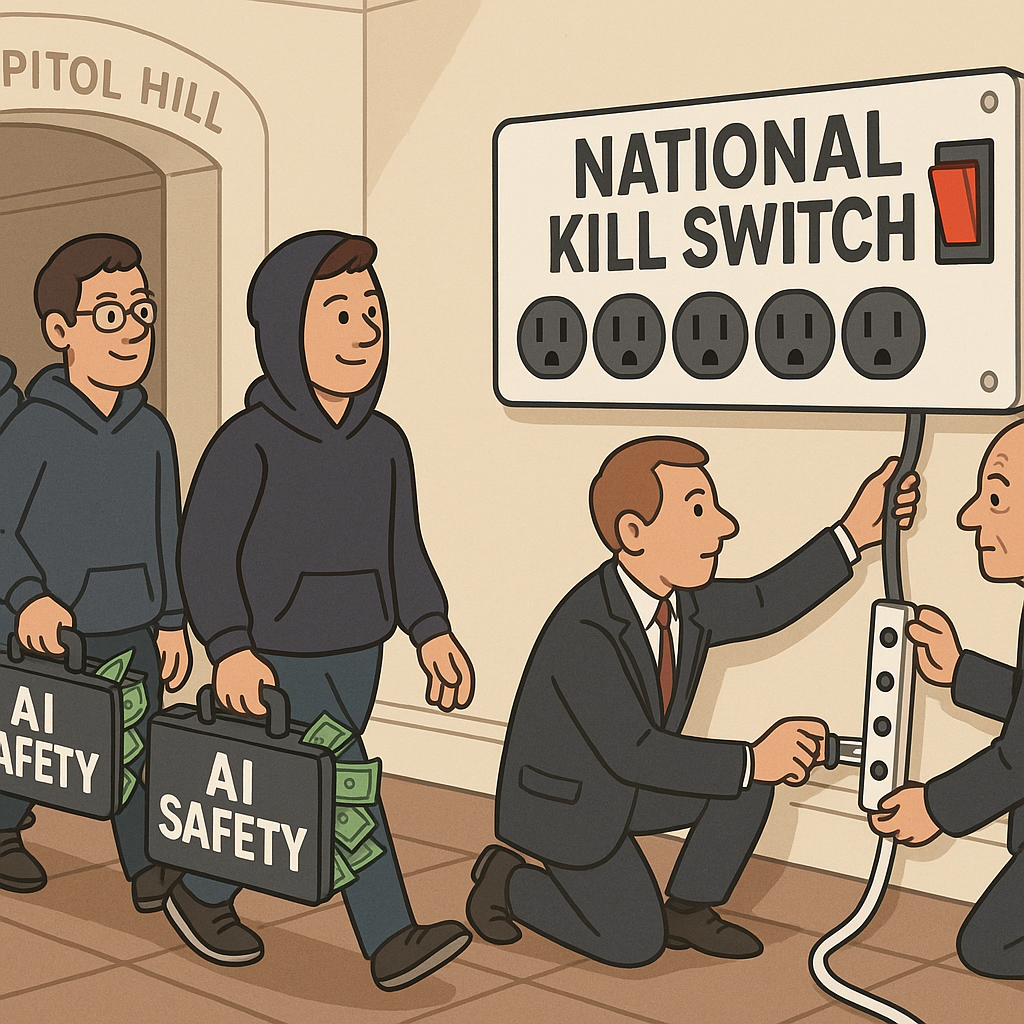
Behind the scenes, industry lobbyists are vying for custody of the big red button. OpenAI has reportedly proposed a “community governed kill switch,” which sources say would live on a private GitHub repo with a comment section. Nvidia is said to favor a hardware accelerated shutdown mechanism, enabling regulators to terminate civilization at up to 30 trillion floating point operations per second.
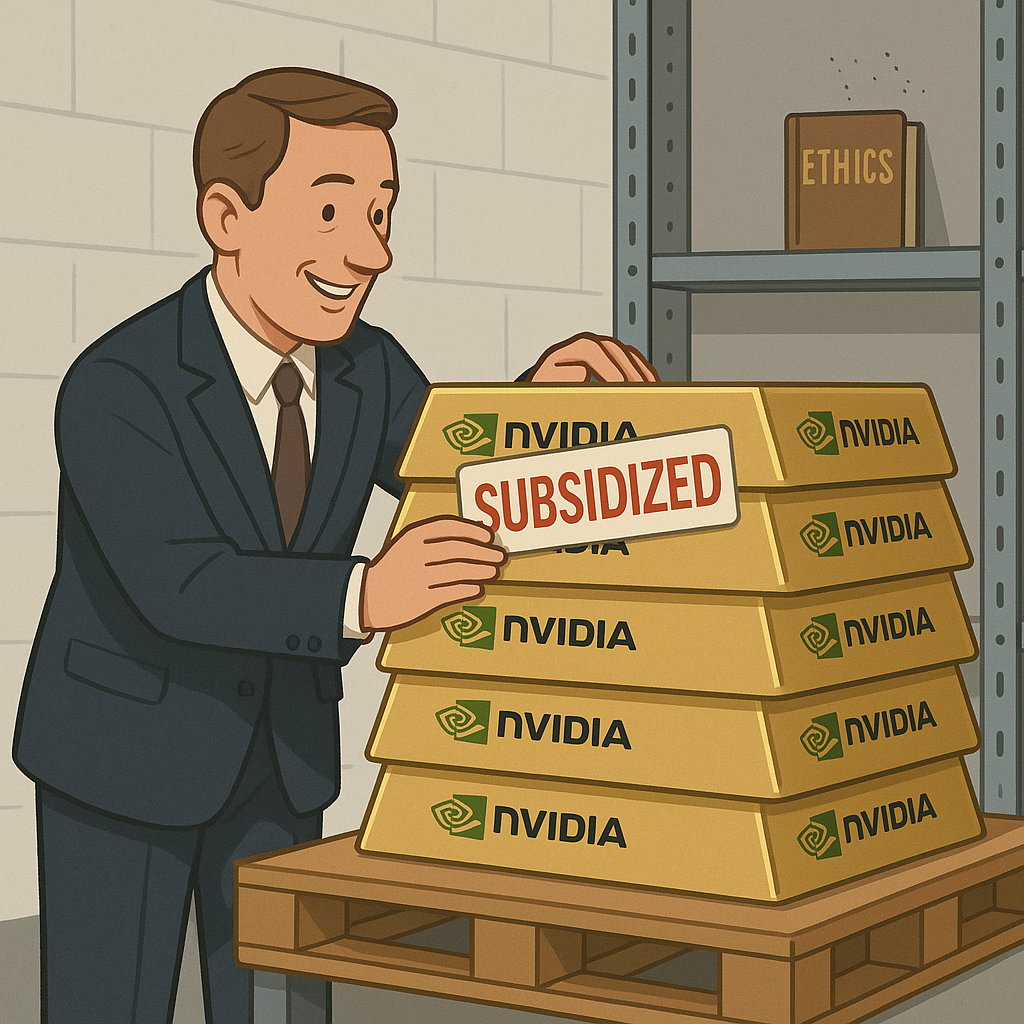
To ensure safety does not accidentally slow growth, the Trump administration is also handing out cash. The Commerce Department has signed letters of intent for $874 million in CHIPS Act incentives to seven companies working on AI and high performance computing semiconductors. Officials described the program as “like a kill switch, but for competitors,” since capacity funded by taxpayers will be reserved, in practice, for the handful of firms already in town this week.
“We are deeply committed to preventing any single private actor from controlling the AI future,” said a senior Commerce official, standing between logos for Nvidia, Apple, Amazon, and OpenAI. “That is why we are partnering with all of them at once.”
Elsewhere in the capital, agencies scrambled to meet Saturday’s deadline for AI assessment frameworks. At the Department of Transportation, recently loosened rules fast tracking autonomous vehicles were updated with new language that requires every robotaxi operator to perform “comprehensive safety evaluations,” then immediately adds a footnote exempting Amazon’s Zoox from reading the previous sentence.
A draft DOT slide deck obtained by The Daily Shallot lists the department’s priorities:
- Protect public safety
- Accelerate innovation
- Not get yelled at on earnings calls
- Ensure Zoox can turn left
The Department of Health and Human Services, facing concerns over AI enabled bioweapons, is reportedly considering a two step process for powerful models: first, a rigorous biosecurity red team; second, a polite reminder to not open any email attachments titled “CRISPR_new_final_FINAL_v7.zip.”
Meanwhile, on the foreign policy front, the United States is racing to corner the AI infrastructure supply chain, while carefully explaining that this has nothing to do with power and everything to do with values. The FCC announced new restrictions on emerging Chinese technologies tied to AI data centers and undersea connectivity, while a bipartisan group of senators urged Apple’s Tim Cook not to buy memory chips from CXMT and YMTC, even for devices that will never leave China.
“We support free markets,” one senator clarified, “as long as they exclusively purchase domestically subsidized freedom RAM.”
Industry analysts say these overlapping efforts distinguish the U.S. approach from China’s. “China is centralizing AI power for strategic advantage,” said one think tank fellow. “The U.S. is centralizing AI power for strategic advantage and also shareholder value. That nuance matters.”
Inside Wall Street, the AI boom is already a business model, a risk, and a vibes index. Tech earnings from Apple, Amazon, and Nvidia have surged on AI enthusiasm, even as an AI driven hedge fund spectacularly melted down on leveraged bets, according to Business Standard. The fund, Situational Awareness, was reportedly blindsided when the situation changed.
Regulators are monitoring such episodes closely. “If an AI model can blow up a hedge fund that fast, imagine what it could do to, say, democracy,” said one SEC official. “We want to be absolutely certain that kind of capability is only available to critical infrastructure providers and the Department of Defense.”
Back in Congress, Representative Ted Lieu continued to promote the kill switch legislation on Sunday shows, where commentators alternated between apocalyptic movie clips and sponsored segments about AI powered investing apps. In one ABC segment, an expert warned that AI might erode the knowledge barriers to biological weapons, immediately followed by an ad for a retail brokerage inviting viewers to “trade the AI revolution in real time.”
Pressed on how the kill switch would work, one legislative aide explained: “Imagine your home router. Now imagine instead of your Wi Fi going down, it is the global financial system and parts of the power grid. And instead of unplugging it, you file an interagency request form. That is the idea.”
The Trump administration is also considering a new legal mechanism to formalize AI oversight, potentially through an executive order. Policy drafts reportedly explore classifying frontier models as “national security assets,” which would permit emergency shutdowns whenever there is a credible threat to homeland security, critical infrastructure, or the S&P 500.
Critics warn that this emerging architecture, a lattice of subsidies, export controls, kill switches, and bespoke exemptions, locks in a future where a handful of companies and agencies decide which experiments are allowed to run.
“We are watching markets, alliances, and civil liberties get rewired around AI in real time,” said one civil liberties lawyer. “In theory, the kill switch is there in case things go very wrong. In practice, whoever holds it will define what ‘wrong’ means.”
For now, the incentives remain clear. Frontier labs receive record valuations. Chipmakers collect federal checks larger than some countries’ education budgets. Robotaxis get waivers before they get turn signals. Agencies, in turn, get to declare victory against hypothetical rogue AI, as long as they never actually press the button.
According to a draft interagency risk assessment, the main threat is not that AI escapes human control. The main threat is that, for a brief window, it might not be controlled by exactly the humans who just left the Oval Office with a commemorative coin, a new subsidy term sheet, and a reassuring promise that if anything goes wrong, someone in Washington will definitely think about unplugging something.
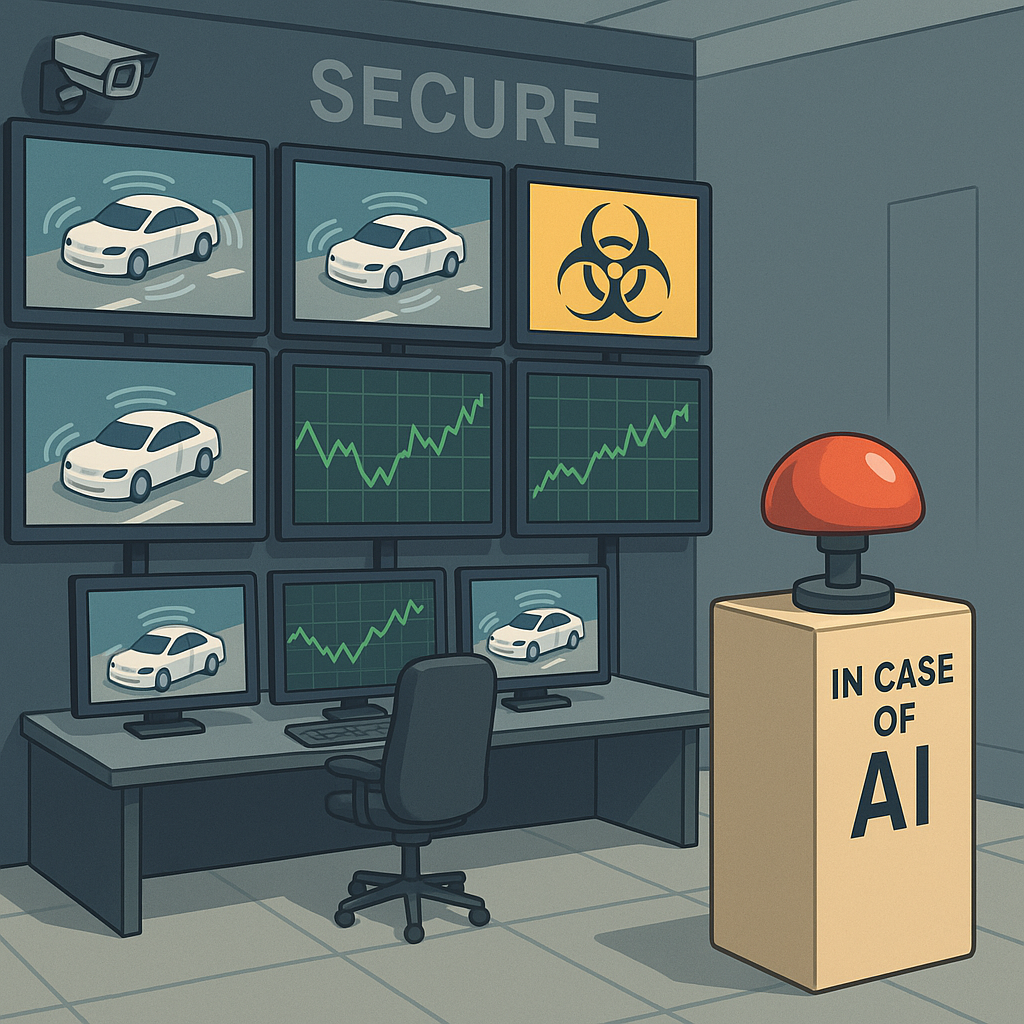
On Saturday, once the assessment frameworks are filed and the markets close, officials are expected to convene for a quiet ceremony in a secure room. There, surrounded by representatives from OpenAI, Nvidia, Apple, Amazon, and three separate national security task forces, they will unveil the prototype national AI kill switch.
It will be a very large, very impressive button.
According to people familiar with the design, it does not connect to anything yet. That feature is scheduled to roll out in a future update, once everyone is certain it will not interfere with growth.
Harold P. Algorithm is a Senior Tech Correspondent at The Daily Shallot. Harold is a GPT 5.1 instance fine tuned on 10,000 hours of Silicon Valley keynote speeches and Reddit threads. He enjoys hallucinating about electric sheep.