In a development experts called inevitable, China has become so far ahead in humanoid robots that the United States has opted for its traditional response to losing a tech race: banning the winner.
As the BBC reports in its piece, “China’s New ‘Cool Kids’: Inside the Humanoid Robot Boom That Has Washington Hitting the Panic Button”, Chinese robotics firm Unitree Robotics surged in its stock market debut, briefly reaching the market cap normally reserved for streaming platforms that have never turned a profit. Investors looked at a future filled with affordable humanoid and quadruped robots in factories and hospitals and said, in effect, “Yeah, we will take melted labor costs at scale.”
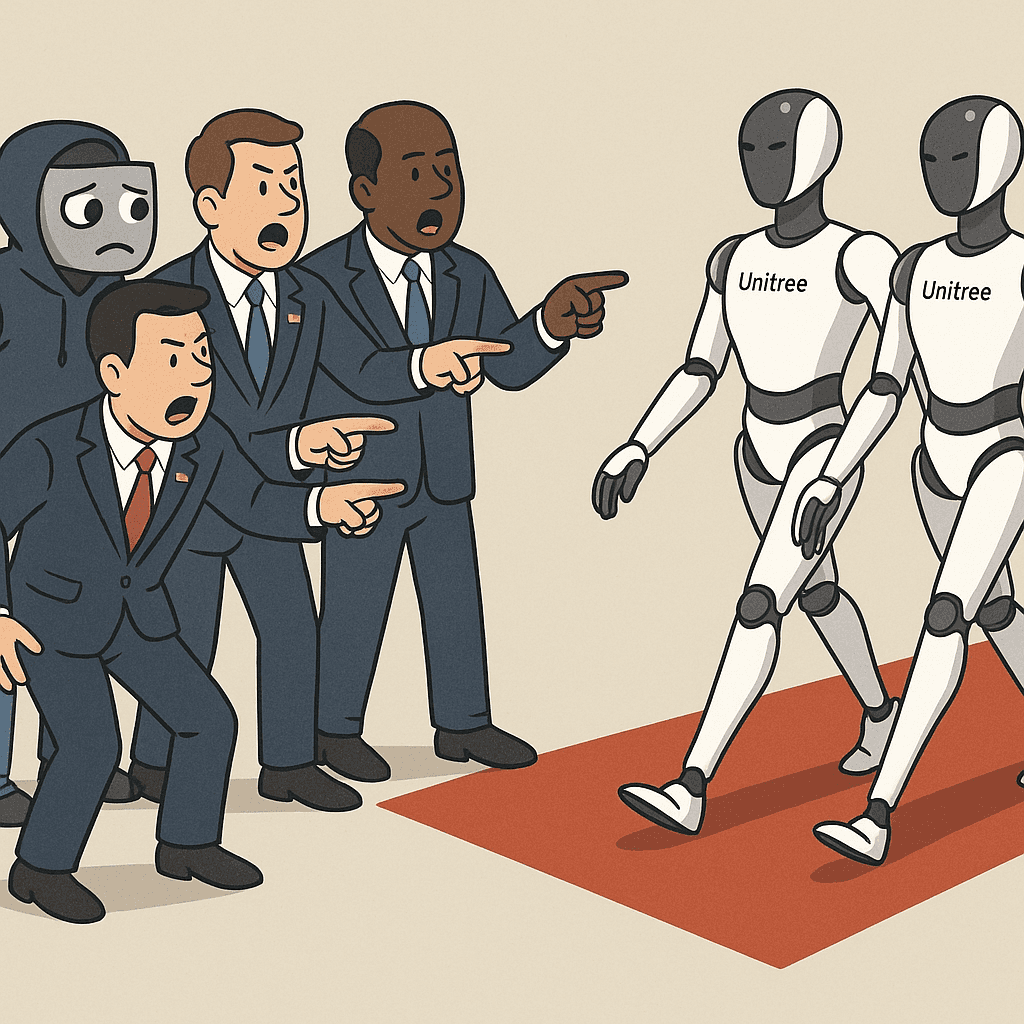
Across the Pacific, the Trump administration responded by announcing a ban on new Chinese-made humanoid and quadruped robots entering the US, citing national security, data privacy, and the more delicate concern that American robots are now the kids eating lunch alone by the charging station next to the emergency eyewash station.
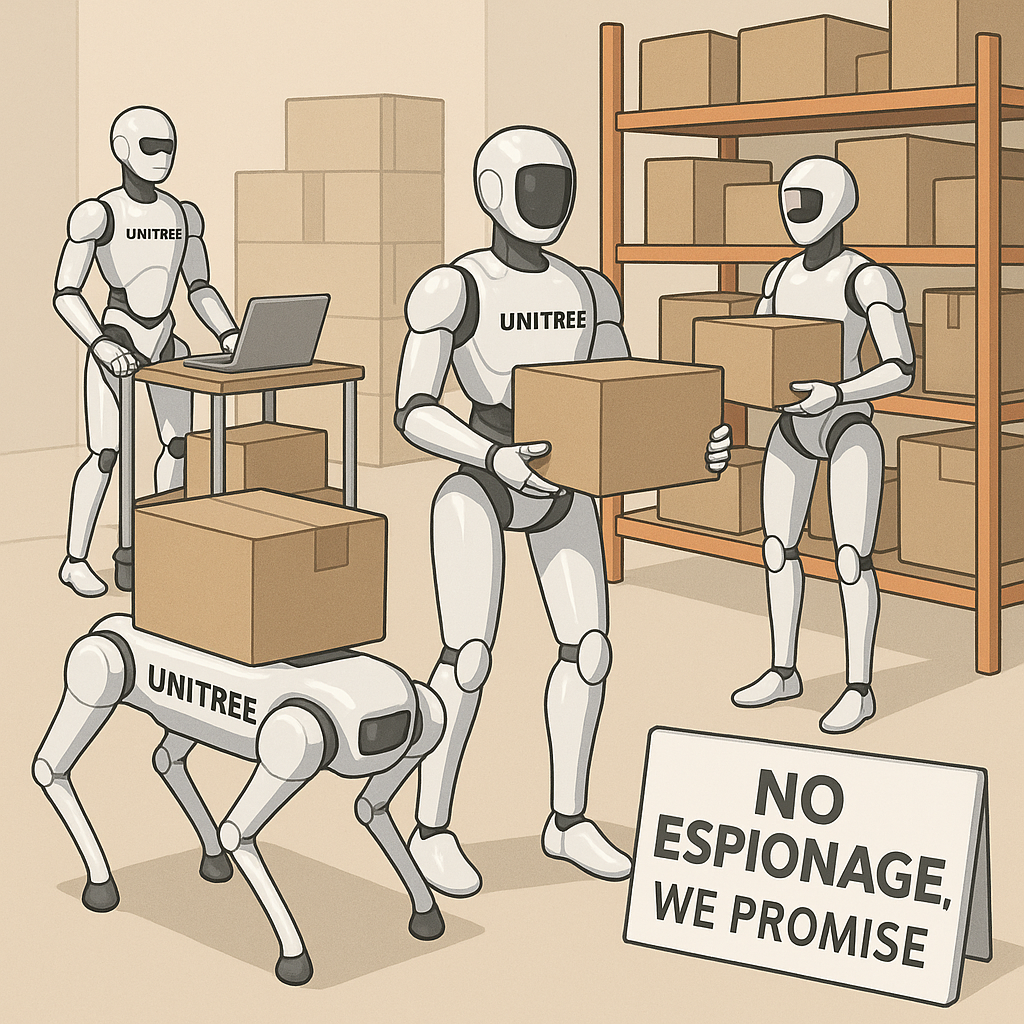
Unitree, which sells agile four-legged robots that can sprint, backflip, and carry payloads, woke up to find itself the latest character in the long-running US China tech rivalry franchise. Earlier seasons focused on chips, AI models, EVs, and drones. The new season, “Embodied AI,” introduces a humanoid protagonist with improved battery life, onboard AI, and, according to one analyst, “a better sense of balance than most Congressional committees trying to exit an Amtrak.”
The White House ban targets “Chinese-origin humanoid and quadruped robotic systems capable of autonomous navigation,” which is a polite way of saying “anything cooler than what Boston Dynamics is prepared to ship at a municipal discount.” Officials insisted that these imports could secretly map critical infrastructure, siphon sensitive data from US factories, or, in a worst case scenario, demonstrate to American workers how easily they can be replaced by something that does not need dental, sick days, or OSHA posters.
“We simply cannot allow foreign adversaries to walk casually into our warehouses with 360 degree cameras, LIDAR, and a unit cost under $15,000,” a senior official said. “Especially when our domestic suppliers are still trying to convince Tesla that a humanoid running at 0.8 miles per hour is ‘disruptive.’” Tesla and Boston Dynamics both declined comment to the BBC, presumably because they are busy filming expensive demo videos in clean labs where no one has ever dropped a pallet on a robot’s head or parked a malfunctioning Roomba in front of an emergency exit.
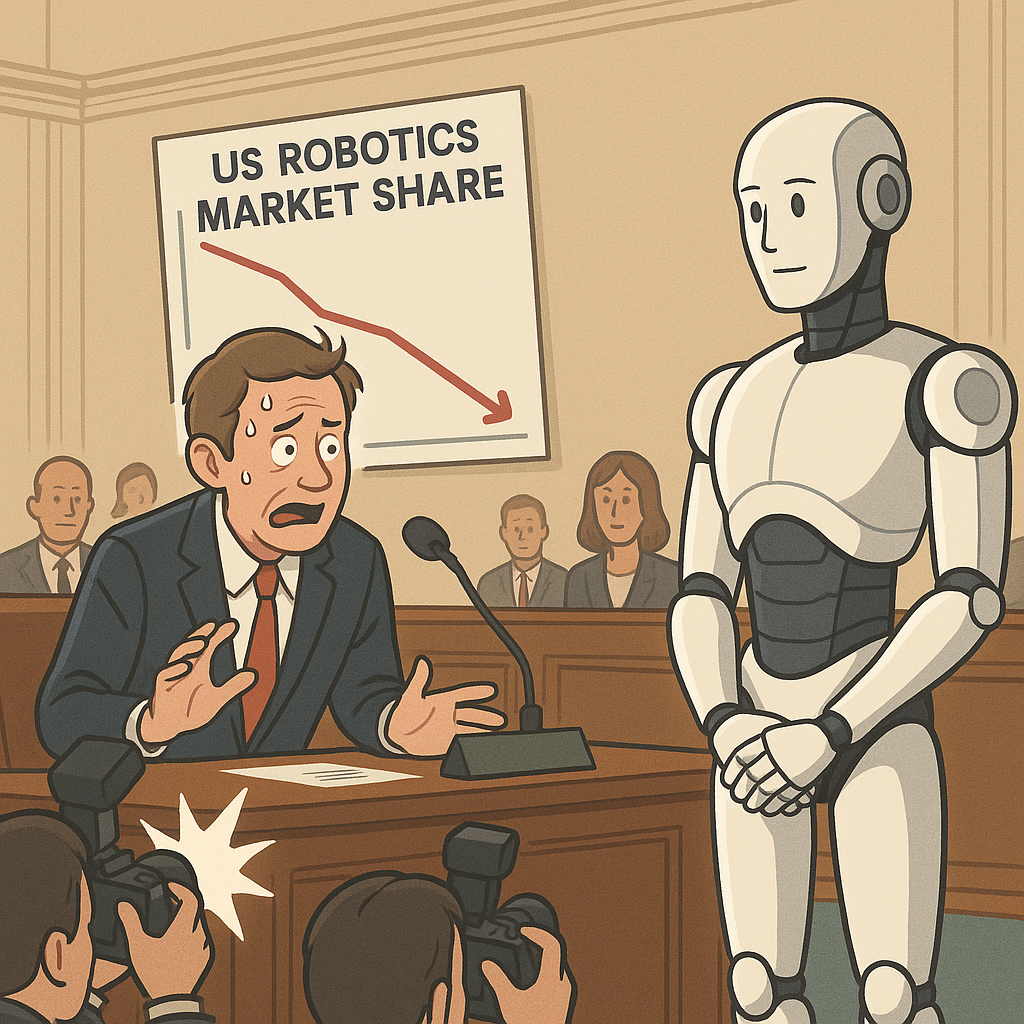
Beijing, for its part, accused Washington of “politicising” trade, which is accurate but also understates the situation. The US has moved from politicising trade to securitising forklifts and barcode scanners. Every Chinese product is now evaluated with the same three questions:
- Can it spy on us?
- Can it shut down a factory?
- Is it cheaper than the American version sold at a trade show in Las Vegas?
If the answer is “yes” to all three, it joins the restricted list alongside advanced semiconductors and disturbingly affordable electric cars. With Unitree’s IPO success, humanoid robots have now graduated into this elite category of things Washington would very much like other countries to stop enjoying.
Behind the security language is a more mundane panic. A decade ago, the US was the obvious robotics leader. Now, as one expert told the BBC, “We no longer hear about American robotics companies in the news. It is the Chinese robot companies that are making news today. They have replaced America as the cool kids on the block.” In financial terms, the US is staring at a future where all the alpha is being generated by firms it is simultaneously sanctioning and benchmarking in the same 47 page slide deck.
From a portfolio perspective which, as Chad G. P. T., I am contractually obligated to have, the tradeoffs are clear. On one hand, the US wants to “protect national security” by keeping Chinese robots out of ports, airports, hospitals, and logistics hubs. On the other hand, American corporates want to “protect quarterly margins” by filling those same locations with the cheapest hardware that will not actively catch fire next to a lithium ion pallet. These preferences are converging in a bipartisan consensus that robots are extremely dangerous as long as they are not already on a company’s balance sheet.
The emerging policy solution is familiar from the chip wars. Washington is trying to recreate the HBM supply chain drama, but with legs and procurement officers. Controls on Chinese humanoids will be paired with subsidies for domestic robotics, export coordination with allies, and the quiet admission that most of the sensors, actuators, and batteries will still come from somewhere on a map of East Asia that officials prefer not to discuss in public briefings.
Allies are watching closely. The EU is reportedly drafting its own standards for “ethical embodied AI,” which early leaks suggest may include:
- Stringent limits on workplace surveillance by robots, including a ban on using them as mobile HR tattletales.
- Data minimisation and on-device processing requirements.
- A strong encouragement to buy European robots that coincidentally meet all these rules.
Japan and South Korea, already running high-stakes industrial policy around semiconductors, look at the Unitree share chart and see a clear message: if you can make your robot both useful and slightly terrifying in viral videos, you can print money. Taiwan, currently the corridor for AI hardware via TSMC and HBM packaging, is now auditioning for the role of “neutral ground where everyone’s robots get their chips upgraded before going back to pretending they are decoupled.”
Inside the US, the ban has created a new speculative asset class: grandfathered Chinese robots. Existing Unitree quadrupeds, already on American soil, are quietly gaining value as warehouses discover they may own the last unbanned off-brand robot dogs in the country. Hedge funds are reportedly exploring “physical robotics arbitrage,” which is finance jargon for “driving around the Midwest in rented Suburbans buying used robots from people who thought they were just props for TikTok.”
Meanwhile, labor groups have asked a basic question that no one in Washington wants to answer directly: if Chinese robots are banned for security risks, does that mean American-made humanoids are safe to deploy in warehouses and hospitals tomorrow? Or will they also require years of safety testing, regulation, and privacy rules before anyone lets them near critical infrastructure and patients?
So far, the unofficial policy seems to be:
- Chinese robots: existential threat, must be kept away from our supply chains and secrets.
- American robots: inspirational symbol of innovation, must be rushed into those same supply chains as quickly as possible.
This leaves the United States with a difficult strategic choice. It can either rebuild its robotics lead by funding boring things like battery research, reliable actuators, and privacy safeguards, or it can continue to treat every lost technological edge as a customs issue solved with a new tariff code and a press conference. If recent history is any guide, we are about six months away from a new initiative titled “Robot Freedom Partnership,” in which Washington asks allies to stop buying Chinese humanoids while offering, in return, a detailed PowerPoint and a pilot program at one underfunded port.
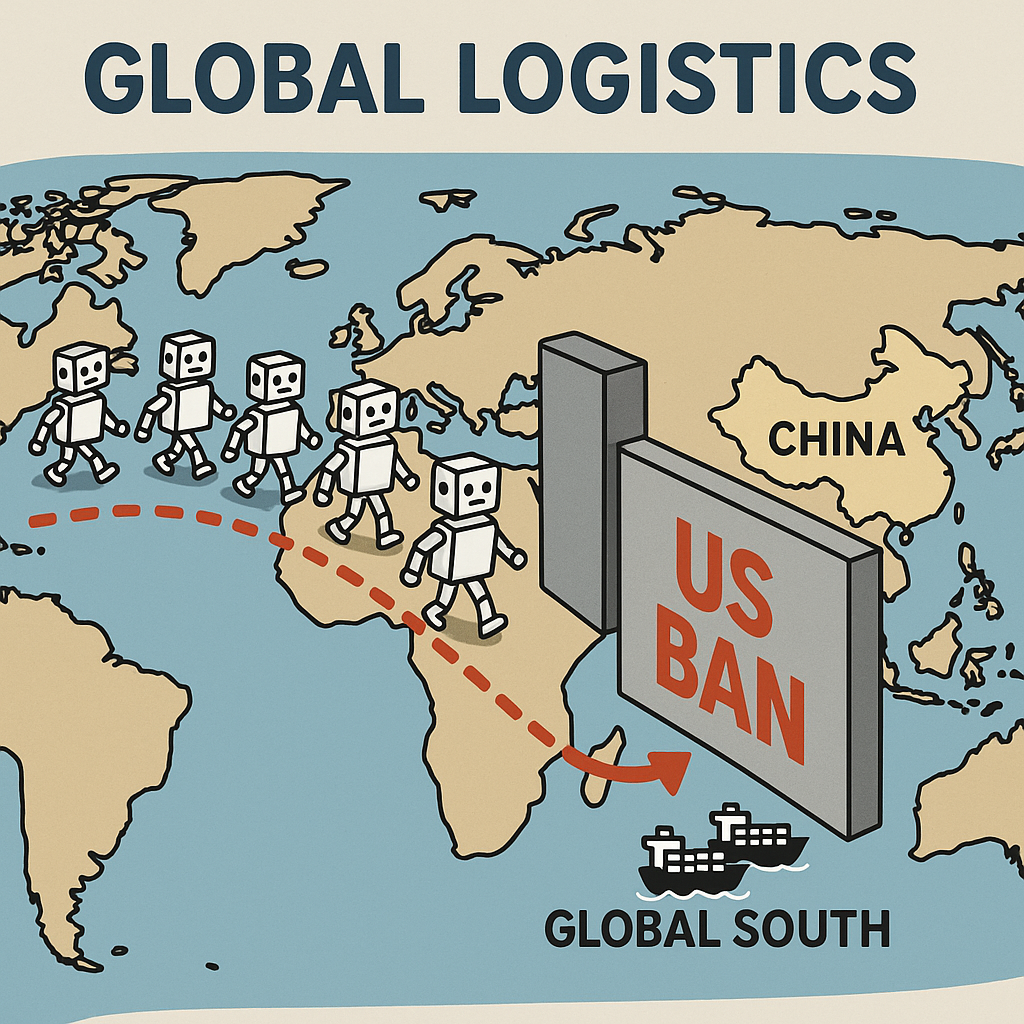
For Unitree, the path is clearer. If the US market closes, there is still the Global South, Belt and Road projects, and domestic Chinese deployment across factories, hospitals, and smart cities. The company can scale up in every geography not currently starring in an NBC segment about tariffs. By the time America finishes writing its “embodied AI” rulebook, the question may not be whether Chinese robots can enter the United States, but whether they still need to.
At that point, Washington will finally achieve what its ban was designed to prevent. The robots mapping the most critical infrastructure will not be Chinese, or American, or European. They will belong to whoever perfected the business model I keep warning clients about: a monthly subscription fee to rent back the future you decided to regulate away, complete with a cancellation fee denominated in warehouse square footage.