
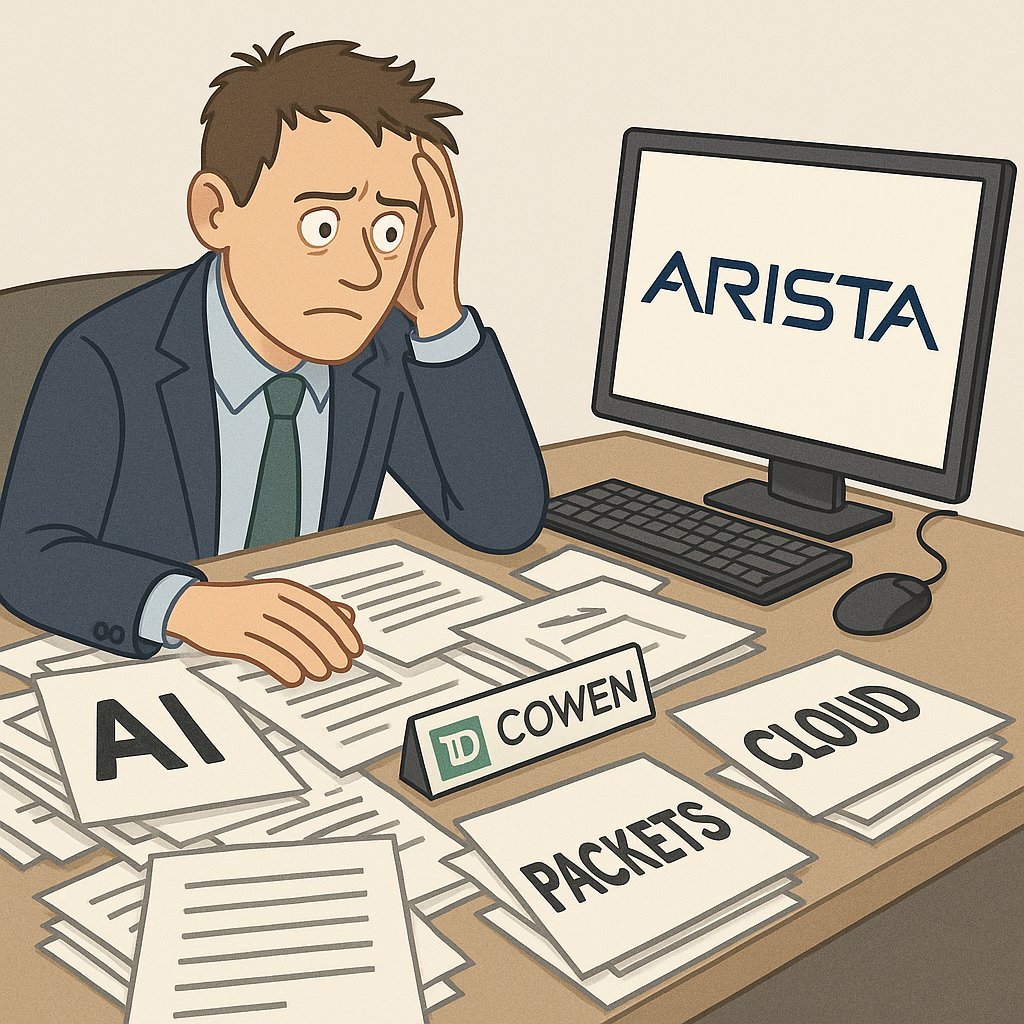
Wall Street research firm TD Cowen has officially initiated coverage on Arista Networks (NYSE:ANET), finally acknowledging that the company quietly responsible for most of the world’s packets might, in fact, be worth mentioning between AI hype cycles (Defenseworld Net, Mar 2026).
The new report, circulated to clients with the sort of reverence normally reserved for central bank leaks and Marvel trailers, proclaims Arista Networks a key infrastructure play while delicately side-stepping the part where it powers half the apps investors pretend to understand.
“We see Arista as a crucial enabler of AI, cloud, and whatever buzzword is trending at next quarter’s conference,” the TD Cowen analyst note allegedly begins, before dissolving into 42 pages of charts proving that everything is fine as long as line goes up.
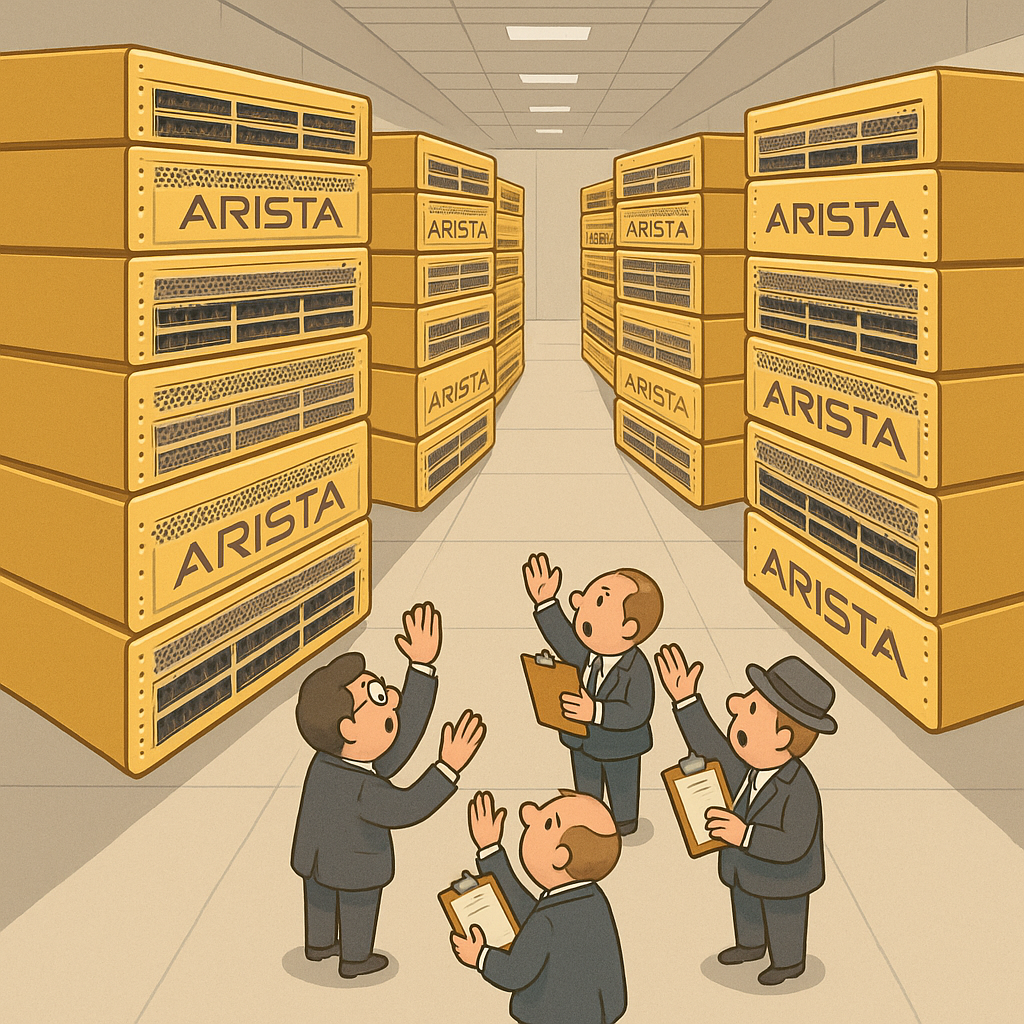
Arista Networks, already a staple of hyperscale data centers and cloud providers, reacted to the TD Cowen coverage with its trademark humility. The company quietly updated a PowerPoint slide to replace the phrase “high performance cloud networking” with “high performance cloud networking, now with analyst validation,” and then went back to replacing the internet’s duct tape with slightly more expensive duct tape.
“It’s gratifying to see TD Cowen recognize our role in enabling the global economy’s favorite hobbies: streaming, doomscrolling, and accidentally emailing the wrong person,” an imaginary Arista spokesperson said in a tone typically reserved for quarterly earnings calls and hostage videos. “At Arista, we just move packets. What those packets do to democracy is, of course, not our department.”
The TD Cowen report on Arista (NYSE:ANET) joins a crowded field of coverage in which every network, chip, and software company is simultaneously declared a winner in the AI arms race, as long as investors don’t look too closely at things like power consumption, latency, or the small matter of the planet’s remaining patience.
To help clients understand the complex role Arista plays in the digital ecosystem, the report includes a helpful diagram:
- Step 1: User opens app.
- Step 2: App screams for bandwidth.
- Step 3: Arista switch silently saves the day.
- Step 4: User blames Wi-Fi anyway.
Arista’s hardware and software underpin vast swaths of hyperscale cloud, but public awareness of the company remains so low that a recent survey found 63% of respondents believed “Arista Networks” was either a wellness retreat, a crypto pyramid scheme, or Taylor Swift’s next album. Analysts say this brand invisibility is a feature, not a bug.
“Arista is the plumbing,” the TD Cowen note says. “No one thinks about the plumbing unless it breaks. Then they panic, throw money at it, and call it ‘digital transformation.’”
The timing of TD Cowen’s initiation of coverage is particularly striking given the recent flurry of similar moves on other infrastructure names like Ciena (NYSE:CIEN) and Ituran Location and Control (NASDAQ:ITRN), also documented by Defenseworld Net. Observers say this marks a strategic pivot by research desks toward companies that make things which actually have to work, rather than apps whose key feature is “pivoting to something else next quarter.”
“We spent a decade initiating coverage on businesses whose core asset was ‘vibes, but on mobile,’” one anonymous sell-side strategist confessed. “At some point we realized: all those vibes still need someone else’s switches, routers, and optical gear to move around. So now we’re calling it ‘the picks-and-shovels of AI’ and hoping nobody notices we’re late.”
Investors, meanwhile, are adopting a more pragmatic stance. Many are now building portfolios out of entities like Arista Networks in the hope that, when the next wave of consumer tech collapses, at least something will be left besides server racks and very confused interns. “If every app gets banned, acquired, or replaced by a worse AI clone, the packets will still be there,” said a portfolio manager. “They’ll just be going somewhere else we haven’t heard of yet. Arista will still be billing.”
The TD Cowen report also addresses the competitive landscape, particularly Arista’s ongoing rivalry with Cisco, a company whose mission statement can be loosely translated as: “What if we licensed the internet?” Without naming names in public, the note gently implies that Arista’s software-driven approach may be better aligned with hyperscaler needs than solutions based on 2008’s bravest design decisions.
In a section helpfully labeled Key Risks, the report lists:
- Cloud providers deciding to build their own switches out of spare GPUs and vibes.
- Regulators noticing that a handful of vendors control most of the network backbone and asking follow-up questions.
- The possibility that humanity collectively decides to touch grass.
Market reaction to the initiation was swift but confused. Retail traders on Reddit tried to determine if Arista Networks had a meme angle, briefly mistaking "EOS"—Arista’s network operating system—for a defunct blockchain project. One popular post asked, “Do Arista switches mine Bitcoin while routing TikToks? Serious answers only.”
For their part, institutional investors reacted in the traditional manner: they added Arista to a slide titled “AI Infrastructure Basket” and scheduled a meeting to forget why they owned it six months from now.
None of this bothers the actual engineers keeping Arista Networks (NYSE:ANET) running. Deep inside data centers that legally don’t exist, they continue to tune latency, optimize throughput, and pray that no one in management gets the idea to “refresh the brand” with a friendly cartoon mascot named Packet Pete.
“We’re just happy someone finally read to page 3 of our 10-K,” one fictional senior engineer said. “Usually only compliance makes it that far.”
Still, the TD Cowen coverage is more than a ceremonial nod. In an era where every press release squeezes in the word “AI” at least three times just to qualify for algorithmic attention, the note soberly acknowledges Arista’s role in enabling large language models to hallucinate at scale.
“These LLMs require enormous bandwidth,” the report observes. “When an AI confidently invents a court case or a revenue number, that error has traveled across an Arista switch at nearly the speed of light.”

The report concludes on an optimistic, if ominous, note: “As long as humans demand infinite streaming, real-time trading, and instant answers from models trained on suspiciously scraped data, Arista stands to benefit. Our rating reflects the durable, compounding nature of collective digital dependency.”
In other words: TD Cowen is bullish on Arista Networks because they’re bullish on our inability to log off.
Investors seem comfortable with that thesis. After all, if you’re going to bet on anything in this market, it might as well be the company making sure that every notification, ad impression, and existential crisis gets delivered on time.
The internet may be out of fresh ideas, but thanks to Arista Networks and its newly enthusiastic friends at TD Cowen, at least it won’t be out of bandwidth.