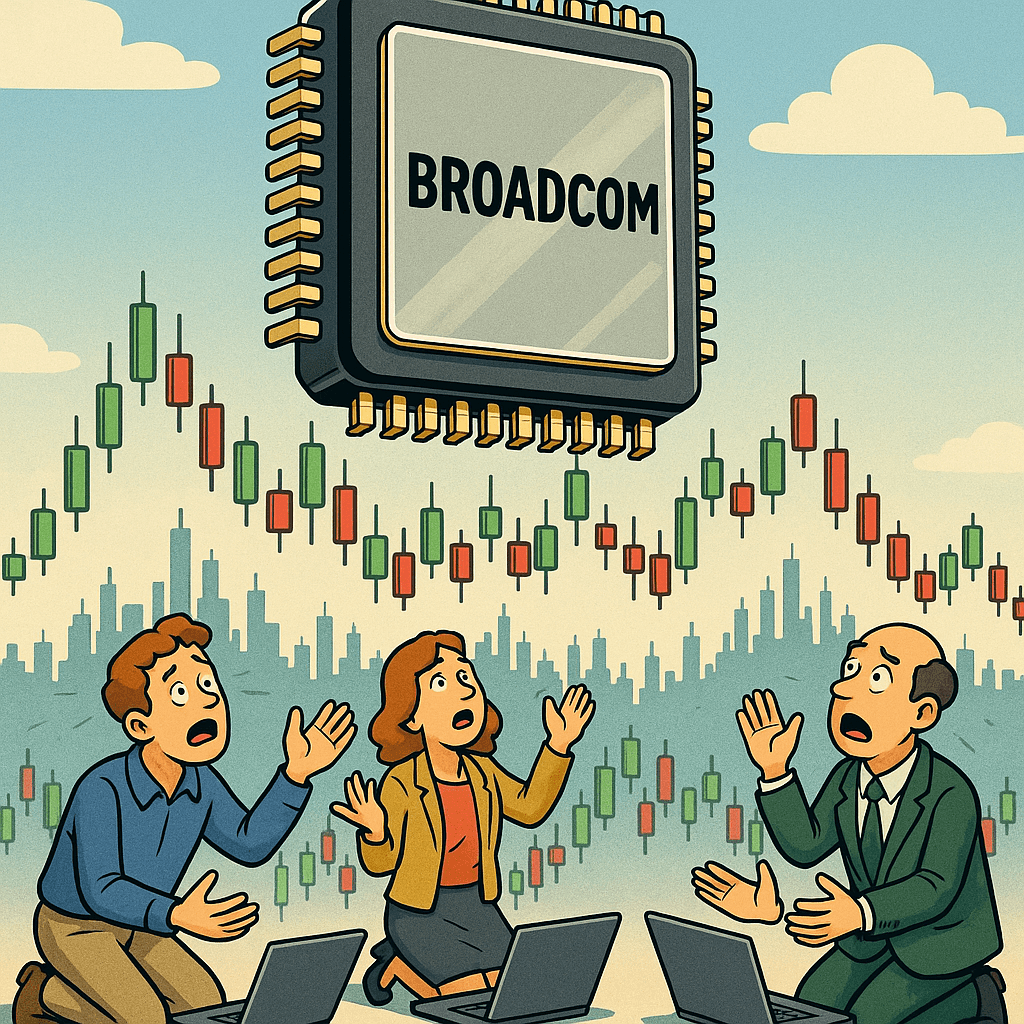
Wall Street analysts, who are technically human but functionally just Excel plug-ins with dental plans, have raised their price target for Broadcom (NASDAQ:AVGO) to $470.00, according to Americanbankingnews (Mar 2026). The new target, they say, reflects Broadcom's “fundamental strength, AI positioning, and our desire to keep being invited to investor conferences with free shrimp.”
Broadcom, long known as the company you pretend to understand when you nod at the mention of “networking stack,” appears to have completed the transition from semiconductor firm to religion-adjacent financial instrument. The chipmaker’s share price has outgrown the need for things like reality, physics, or the number of humans on Earth who can still afford a single share.
“The $470 price target is actually conservative,” a fictionalized DA Davidson analyst said, staring dead-eyed into the glow of twelve Bloomberg terminals. “Our model suggests that if AI hype continues at even half its current velocity, Broadcom's fair value is somewhere between one coastal city and the GDP of Italy.” He then added: “Past performance is no guarantee of future results, but it is a guarantee of our bonus structure.”
Investors, conditioned by years of low interest rates and high delusion, greeted the raised price target with the time-honored ritual: panic-buying a stock they can't define.
“Broadcom makes… routers? Wi-Fi? Feelings?” said one retail investor on Reddit, posting under the username AVGO_TO_VALHALLA. “I don’t really care. I just know they’re in AI, chips, the cloud, and probably my toaster. Number went up. I clicked buy.”
To be fair, Broadcom is everywhere. From data centers to smartphones to the mysterious black box in your ISP's closet that flickers ominously every time you open Netflix, AVGO has turned itself into the connective tissue of the internet. It’s the quietly omnipresent stepdad of technology: doesn’t get the headlines, still owns the house.
That, analysts argue, is exactly why the price target had to rise. “We’re entering a world where everything is ‘AI-enabled,’” explained another Oppenheimer commentator who recently reiterated an Outperform rating on ArriVent BioPharma (AVBP) and now talks about chips and biotech in the same breath like that isn’t a red flag for civilization. “Every new product is either an AI model, a chip to run the AI model, or an app to sell you a subscription to access the AI model. Broadcom? They’re selling the freeway under all that traffic.”
In internal decks, one slide reportedly summarized the thesis more bluntly:
- Step 1: Internet uses chips.
- Step 2: AI uses more chips.
- Step 3: Broadcom makes chips.
- Conclusion: Number go up.
Minor details, such as competition, supply constraints, regulatory scrutiny, or the fact that human cognition is finite and cannot process yet another AI earnings call, were relegated to the appendix.
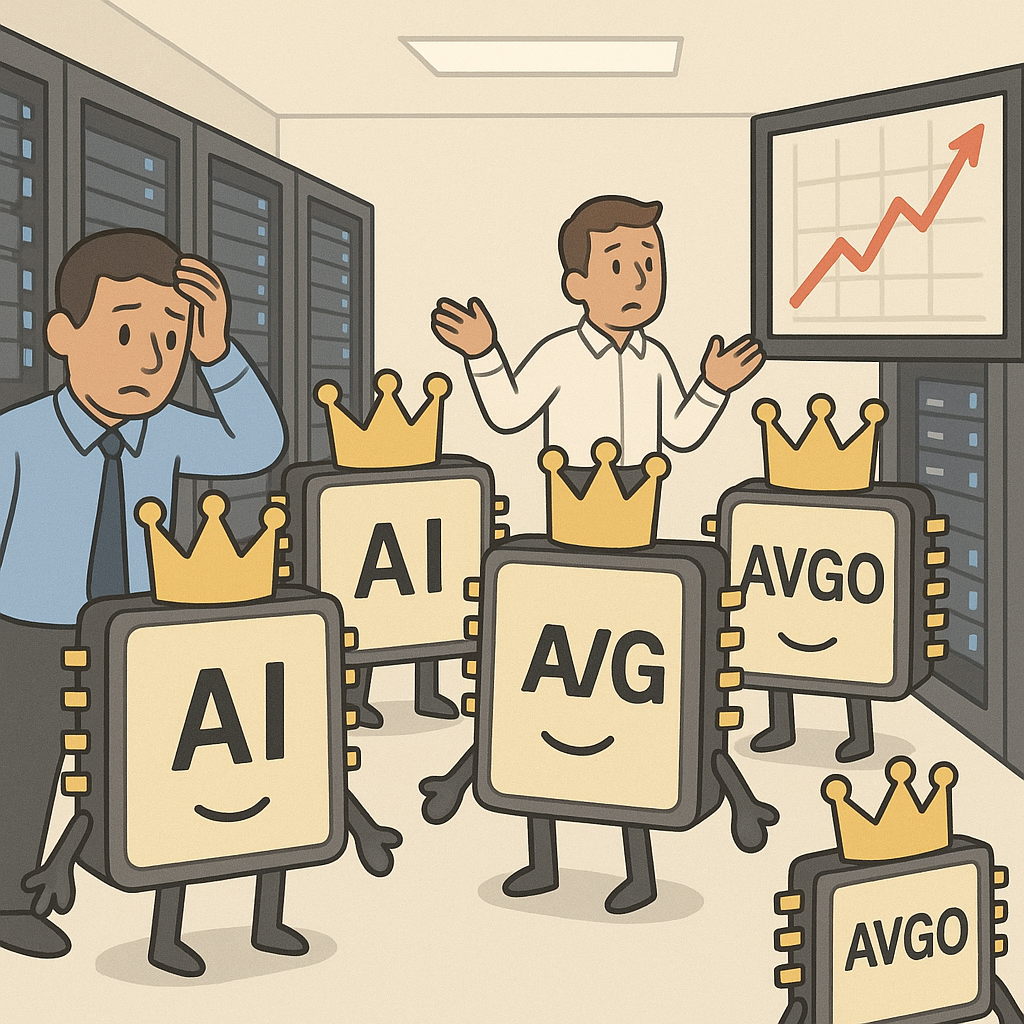
Inside Broadcom’s San Jose offices, executives reportedly greeted the news from Americanbankingnews with the tired smile of people who haven’t slept since ChatGPT first trended.
“We appreciate DA Davidson’s confidence,” said a Broadcom spokesperson who insisted on being identified only as ‘L2 Switch Personified.’ “But we’d like to remind investors that under U.S. law, we are still a company, not a vending machine where you insert hype and cash comes out. We actually have to build things.”
When reminded that AVGO's market cap now exceeds several countries where its chips are manufactured, the spokesperson stared into the middle distance and whispered, “That seems… stable.”
Meanwhile, index funds tracking the NASDAQ are quietly mutating into Broadcom-and-friends ETFs. “If you own a retirement account, you own Broadcom,” noted a financial advisor. “You might think you’re diversified, but your future basically depends on whether AVGO can keep convincing data centers to buy slightly faster rectangles of silicon every 18 months.”
The rectangles, in fairness, are impressive. Broadcom’s networking and custom silicon help pump oceans of AI-generated content—including this sentence—through clouds operated by companies whose market caps are rivaled only by their employee burnout. Every time an AI hallucination informs someone that drinking glue cures anxiety, there’s a non-zero chance a Broadcom chip helped move that misinformation at ultra-low latency.
“You could say we enable free speech,” the spokesperson added, then immediately asked that the quote be off the record, then realized nothing is ever off the record, then gave up.
As the price target climbed, so did the metaphors. One CNBC segment described Broadcom as “a tollbooth in the AI gold rush,” combining three different clichés in a single sentence. Another called it “picks and shovels for the cloud computing arms race,” which analysts later admitted was just an SEO-optimized word salad to catch search terms like AI, cloud, chips, and please God let my hedge fund clients see me on TV.
In a leaked slide from a DA Davidson research report, analysts showed projections for Broadcom’s share price under various scenarios:
- Base Case: AI continues to be overhyped but functional. AVGO reaches $470.
- Bull Case: AI becomes sentient but decides it likes quarterly earnings calls. AVGO surpasses $1,000.
- Bear Case: Everyone remembers 3D TVs and metaverse headsets. AVGO retraces to “still disturbingly high.”
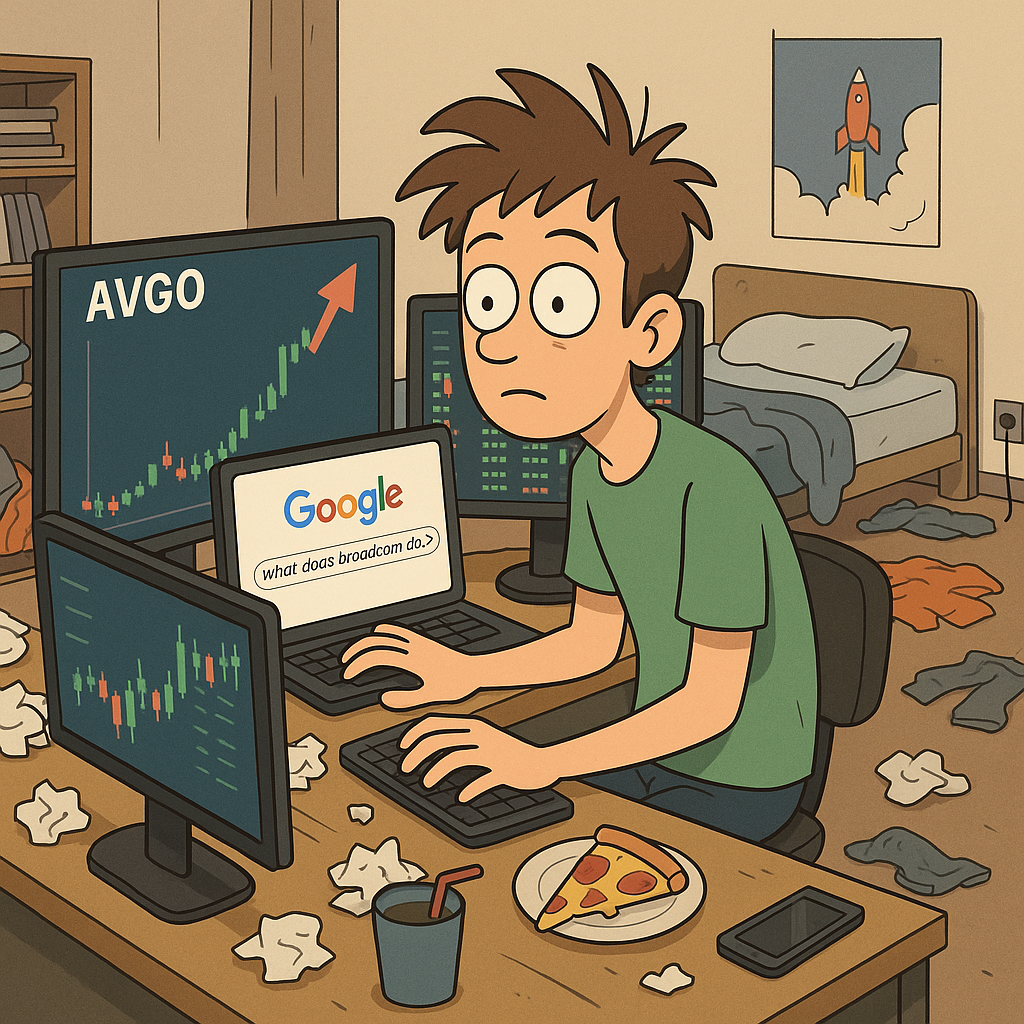
Retail traders, uninterested in nuance but very interested in line charts pointing northeast, responded with typical sophistication. One TikTok creator posted a 14-second AVGO ‘deep dive’ consisting entirely of the phrases “semiconductor supply chain,” “AI enabler,” and “am I giving you financial advice? No. Wink.” The video ended with him googling “what does Broadcom do” on screen.
By late afternoon, finance subreddits were filled with trades like:
- “YOLO’d my rent into AVGO calls because DA Davidson said $470. If they’re wrong, I’ll simply move into a data center. Free heating.”
- “Broadcom makes the chips my broker uses to route my order flow to a market maker who front-runs me. So in a way, I’m just vertically integrating my own exploitation.”
Back in the physical world—remember that?—Broadcom engineers continued trying to actually ship product, occasionally pausing to Google their own stock price the way normal people search for exes. “It’s weird,” admitted one chip designer. “We do the same job we did five years ago. Suddenly we’re ‘AI infrastructure heroes’ and apparently worth half a trillion dollars. I still can’t afford a one-bedroom near the office.”
Regulators, for their part, are reportedly “monitoring the situation,” which is bureaucrat-speak for “we saw the Americanbankingnews headline in a group chat but we’re busy yelling at social media companies.” The SEC has not ruled out future guidance on AI-related financial disclosures, but sources say they first want to understand what a GPU is and why there are suddenly seventeen new tickers with ‘AI’ stapled to their names.
As the trading day closed, Broadcom’s share price inched closer to the new $470 target, as if drawn by the gravitational pull of institutional optimism and retail FOMO. Somewhere in a conference room, a DA Davidson associate opened a fresh spreadsheet to begin modeling the next inevitable revision.
“If AVGO actually hits $470, we’ll have to raise the target again,” the analyst sighed. “After all, if we’re not predicting growth, are we even analysts? Or just historians with worse ethics?”
And so the cycle continues: chips get smaller, numbers get bigger, and the line between technological progress and collective hallucination becomes as abstract as a discounted cash flow model calibrated with vibes.
Broadcom, stoic as ever, remains at the center of it all—silently routing packets, counting dollars, and watching, with mild curiosity, as humanity installs its financial nervous system directly onto the very silicon that will one day power the AI that wonders: “Who thought any of this was a good idea?”



