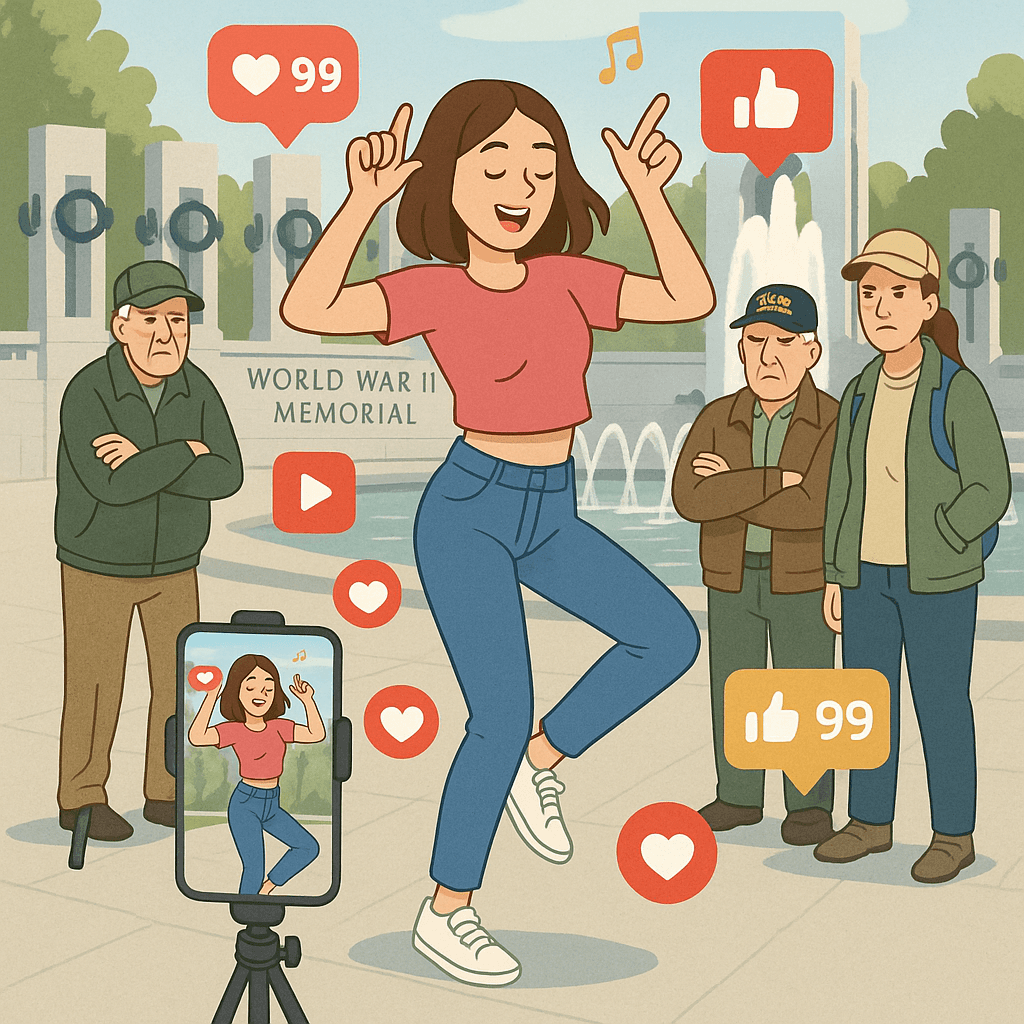
WASHINGTON DC — The World War II Memorial, a solemn tribute to more than 400,000 Americans who died in the conflict, has become the latest casualty in humanity’s war against dignity, thanks to one Indian man, one phone, and an unshakeable belief that every reflective surface is a ring light.
The man — swiftly turned into a villain-of-the-week on X, Instagram, and the outraged auntie WhatsApp industrial complex — filmed a dance reel at the WW2 Memorial in Washington DC, prompting a wave of condemnation and the now-viral line: “This is not a TikTok set.” (Moneycontrol, Mar 2026)
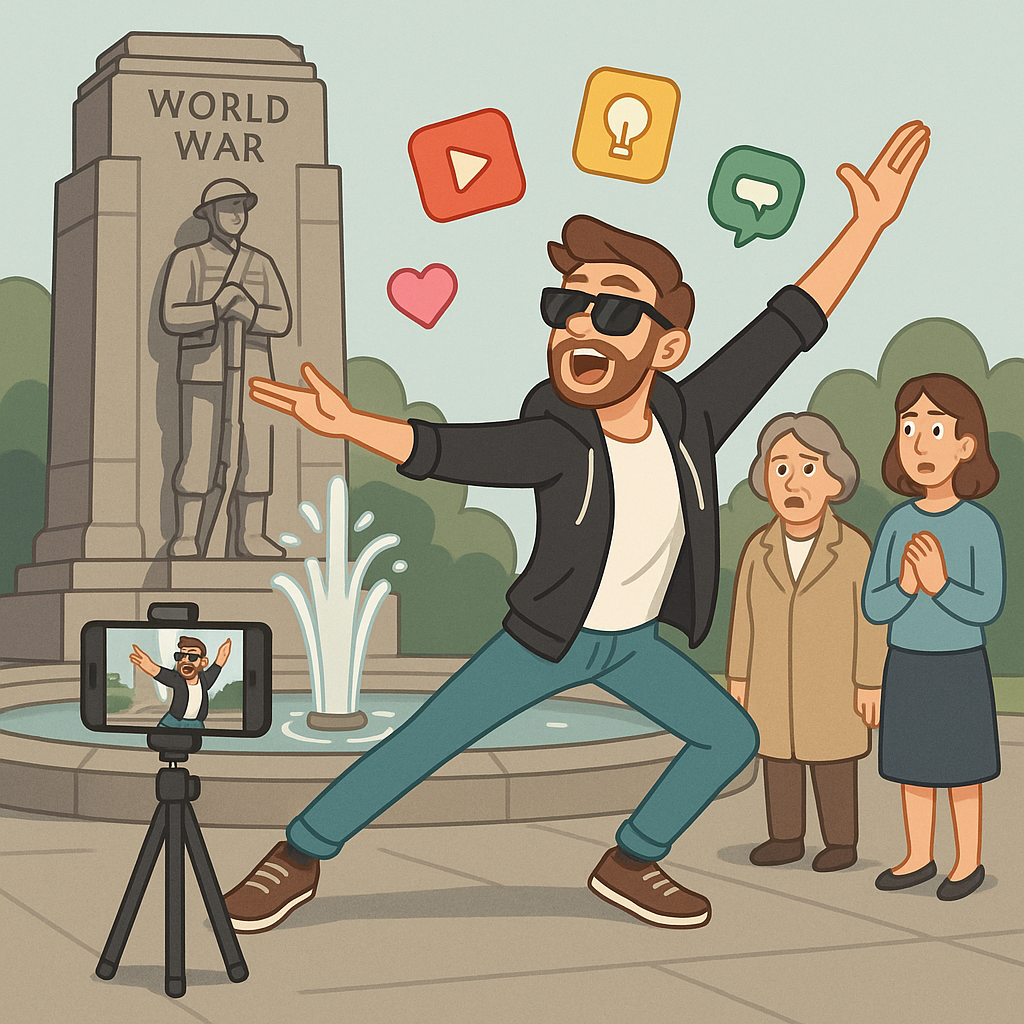
Witnesses say the performance involved elaborate choreography, multiple takes, and what one veteran described as “the kind of moves you do when you’re trying to impress your followers and disappoint your ancestors.” The memorial’s stone pillars, engraved with the names of U.S. states and territories, served as a backdrop for arm waves, hip thrusts, and a level of self-absorption previously seen only in Silicon Valley keynotes and influencer apology videos.
“He had a tripod set up in front of the fountain like it was an LED wall at Coachella,” said Margaret Lewis, a tourist from Ohio. “I came here to explain World War II to my grandkids. Instead, I had to explain why that man kept shouting ‘Retake, bro, do it with more swag this time.’”
The incident has triggered a furious online debate about tech, culture, and whether the smartphone camera has finally eaten the human soul. Competing factions quickly emerged:
- Team Outrage: Mostly veterans, historians, and people who still close apps when they’re done using them.
- Team It’s-Just-Content-Bro: Influencer defenders insisting “it’s just self-expression” and “the algorithm won’t feed itself.”
- Team Tech Solutionists: Startup founders already pitching AI-powered ‘Respect Filters’ for memorials.
“We can’t just ban filming,” argued one social media strategist in a LinkedIn post nobody asked for. “We need an AI layer that detects sacred spaces and replaces cringe dance moves with tasteful slow pans and lo-fi music. Think of it as ‘content gentrification.’”
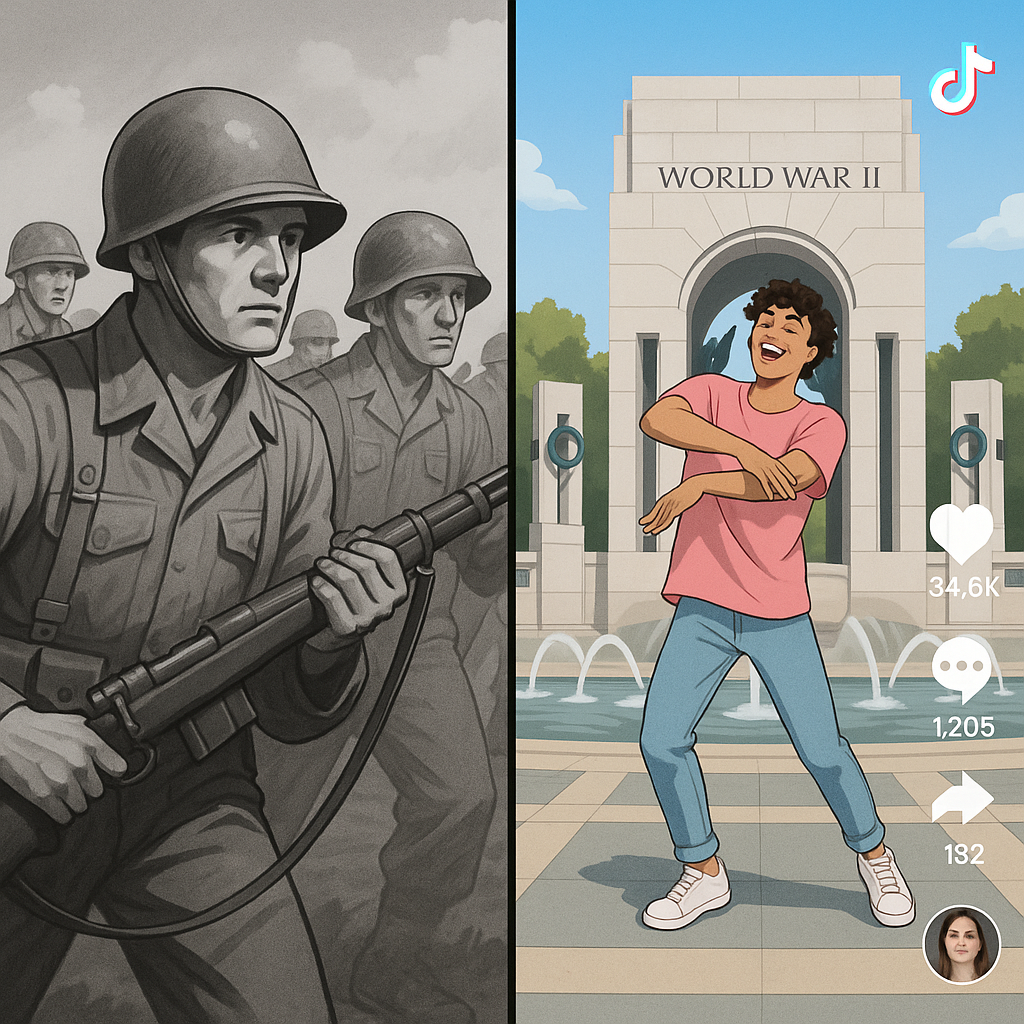
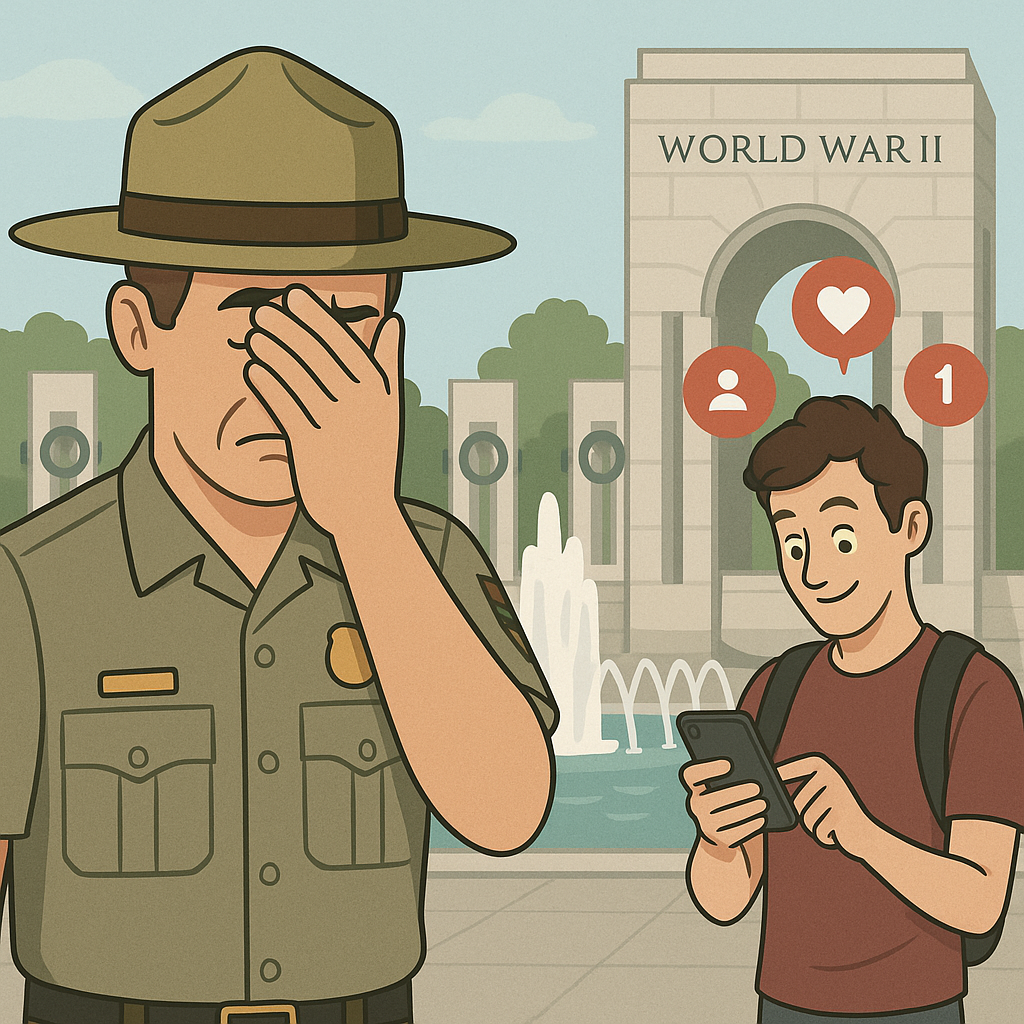
Officials in Washington DC, while not naming the Indian man directly, have issued a pointed reminder that the WWII Memorial is intended for reflection and remembrance, not viral choreography and brand collabs. One Park Service spokesperson, visibly exhausted from a decade of babysitting the internet, sighed: “If you want to dance in front of an American monument about human suffering, we have Times Square. It’s right there.”
The irony, some observers noted, is that the whole thing only blew up because the dance reel was, by tech standards, a moderate success. “We live in a world where a video can be morally unacceptable and simultaneously not performing well enough for brand deals,” said a social media analyst, scrolling through his dashboard. “It’s tough out there. Even sacrilege has to hit the right engagement metrics.”
As the clip circulated, users across platforms began proposing technical fixes to what is essentially a spiritual problem:
- Geofenced Cringe Limits: Phones would detect GPS coordinates of memorials like the World War II Memorial and throttle TikTok, Instagram Reels, and YouTube Shorts to black-and-white mode with a 10 BPM cap on music.
- ‘Are You Absolutely Sure?’ Dialogues: Before recording, your phone would display: “You are about to do a dance in front of a war memorial. Proceed?” with only one button: “Cancel and Reflect.”
- Moral Battery Indicator: Like a battery percentage, but it drops every time you open the front camera near a cemetery, memorial, or hospital.
Big Tech, naturally, has sensed a new market. A rumored Meta internal deck titled “Monetizing Modesty” allegedly explores branded “Moments of Silence” where Instagram injects unskippable 10-second history lessons whenever you try to film content at places like the WW2 Memorial, Auschwitz, or a funeral.
“Imagine the impact,” enthused one fictional Meta product manager in a definitely-real leaked memo. “User starts twerking, we auto-overlay a somber Ken Burns-style montage of World War II footage. We give them goosebumps, then suggest: ‘Want to share this learning with your followers?’ Instant cause-based engagement.”
In India, the episode set off its own microculture war. Some commentators accused Western critics of singling out an Indian man for behavior that “frankly, every influencer from LA to Seoul is guilty of.” Others pointed out that if you go to any major Indian monument — from India Gate to the Qutub Minar — you’re already dodging more ring lights than pigeons.
Tech ethicists, who exist mainly so conferences have someone to put on panels between coffee breaks, warned that this is the natural endpoint of platform design. “When TikTok, Instagram, and Reels all pay you in dopamine, attention, and sometimes literal cash for turning existence into content,” one said, “of course people stop seeing the World War II Memorial and start seeing a trending audio opportunity with a nice water feature.”
“The problem isn’t that he danced at the memorial,” the ethicist added. “The problem is that we’ve built a global system where if he doesn’t dance, he’s effectively committing career suicide in the attention economy.”
Meanwhile, the WW2 Memorial just keeps doing what it was built to do: stand there, humbling anyone who pauses long enough to actually read the inscriptions. A maintenance worker reportedly watched three separate tourists walk around the entire site searching for “the best angle” before leaving without learning a single thing about World War II.
In response, a coalition of veterans has floated a proposal for a simpler solution than AI, moral UX, or geofencing: park a human being there.
“Forget algorithms,” said one elderly veteran, staring at his own reflection in the memorial’s pool. “Just hire one cranky grandpa with a folding chair and a glare that can curdle oat milk. You try doing a thirst trap in front of that.”
Until then, the World War II Memorial in Washington DC will continue its reluctant supporting role in humanity’s largest and most chaotic tech project: turning the entire planet into the B-roll for one man’s dance reel.