In a bold experiment in behavioral economics, Nvidia has decided that maybe—just maybe—its billionaire co-founder and CEO Jensen Huang should get a bit more financial encouragement to keep accidentally speedrunning the global AI arms race.
According to The Business Times, the chipmaker’s fiscal 2027 compensation plan sets a US$4 million target cash bonus for Huang, a man whose net worth already requires its own data center and three layers of rate limiting (The Business Times, Mar 2026). Wall Street reacted positively, on the theory that if you’re going to worship a leather-jacketed demigod, you might as well tip him.

The structure is simple: if Nvidia continues to print money, Huang gets an extra small hill of it. If Nvidia somehow implodes, he merely retreats to his emergency stash of high-bandwidth memory and private islands. This, human resources experts explain, is known as “aligning incentives,” a process by which a board of directors pretends the CEO might quit and become a yoga influencer if not properly motivated.
Nvidia framed the bonus as part of a broader fiscal 2027 plan meant to keep the company competitive as AI demand surges, GPUs remain sold out until the heat death of the universe, and data centers in places like Silicon Valley and Singapore draw enough power to dim entire constellations. Shareholders mostly nodded along, busy calculating how many H100s you can buy for $4 million and whether they could just give those to Huang instead as a sort of emotional support cluster.
"We strongly believe this pay package reflects Nvidia’s performance-driven culture," one theoretical compensation committee member might say, if they ever spoke in public without a lawyer. "Also, have you seen what Sam Altman would pay this man if we fumbled?"
Industry observers note that $4 million is, in Nvidia terms, the moral equivalent of free conference Wi-Fi: technically valuable, but mostly symbolic. The company added over a trillion dollars in market cap in the time it took you to read this sentence. Jensen Huang’s keynote leather jacket alone now has a higher implied market value than most national airlines. Giving him a $4 million target bonus is like tipping the pilot for not crashing the moon.
Still, symbolism matters. The fiscal 2027 plan is widely seen as Nvidia’s way of saying, "Please don’t retire to a volcano lair just yet." With AI accelerators like the H100 and upcoming B100 effectively functioning as worldwide GPU-based taxation, the board’s main risk is that Huang decides he’s bored and goes off to disrupt, say, gravity.
On tech Twitter—still called Twitter by people who refuse to accept any further UX regressions—reaction was mixed:
- VCs: "This is modest. Frankly insultingly modest. Is he okay? Blink twice if you need more stock options."
- Startup founders: "$4 million? That’s like three rounds of seed funding and a mid-tier YC flex."
- Developers: "Cool, can I have a GPU that costs less than a used Tesla, or is that not in the comp plan?"
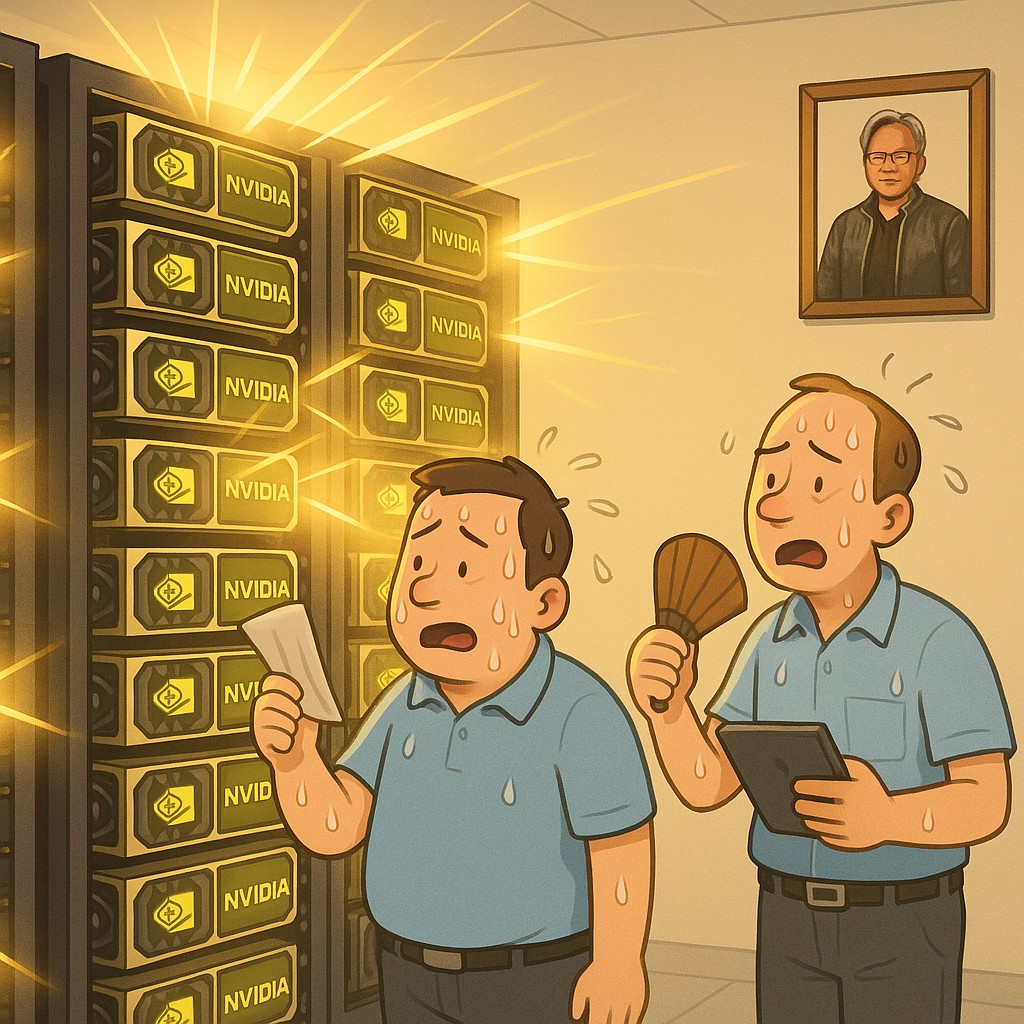
Meanwhile, in data centers from Oregon to Osaka, system admins stared at the news and then at their overheating racks and wondered whether there might be, say, $40 of bonus money available for better air conditioning. So far, the answer appears to be no, but they have been encouraged to “do more with less,” a phrase that now legally counts as a workplace horror genre.
Corporate governance experts point out that Huang’s $4 million target cash bonus is just one piece of a much larger compensation puzzle, most of which is denominated in Nvidia stock, performance shares, and what analysts delicately refer to as “vibes-based valuation.” If the company hits its fiscal 2027 goals, Huang’s total haul could be comfortably north of "don’t worry about the check" levels.
"This kind of package is meant to drive long-term value creation," an imaginary governance consultant explained while toggling between PowerPoint slides and Nvidia’s stock chart. "Of course, in Nvidia’s case, ‘long-term’ now means about 18 weeks, or roughly the time between AI hype cycles."
Some critics have argued that executive pay at companies like Nvidia and its Silicon Valley neighbors increasingly resembles an AI training loop: each quarter, boards feed in more compensation, observe stock price reactions, and tune the learning rate until everyone is too rich to notice the climate collapsing. "We are essentially running reinforcement learning on a single agent: Jensen Huang," one analyst quipped. "Reward policy: if market cap go up, give treat."
The comparison isn’t entirely unfair. As AI workloads explode, hyperscalers like Microsoft, Google, Amazon and Meta have become functionally dependent on Nvidia silicon to keep their own hallucinating models online. Governments from Washington to Brussels to Beijing are now treating GPUs as a strategic resource right behind oil and slightly ahead of rare earth memes.
In that context, the fiscal 2027 bonus plan feels less like executive pampering and more like national security theater. There are probably classified strategy memos in multiple capitals that read, "Step 1: Keep Jensen happy. Step 2: Hope AI doesn’t kill us." The $4 million, then, might be best understood as a line item in the global "Please, For The Love Of God, Don’t Slow Down The Chips" budget.
Not everyone is convinced. Labor activists note that while Huang gets a nice new performance carrot, the average engineer is being compensated in pizza and the honor of debugging LLM inference kernels at 3 a.m. "We’re told this is a performance culture," one anonymous employee said. "So how come the performance review form has only one question—‘Are you Jensen Huang?’—and there’s only one acceptable answer?"

Still, it’s hard to argue with results. Nvidia has become the de facto shovel merchant in a gold rush where the gold is mediocre AI-generated slide decks and suspiciously cheery chatbots. Every time a cloud provider promises "AI for everyone," somewhere a procurement team adds another five-figure GPU to a spreadsheet and quietly cries.
By fiscal 2027, when this shiny new bonus structure fully kicks in, we may be living in a world where Nvidia GPUs power not just data centers, but cars, toasters, factory robots, and at least one ill-advised AI therapist app named something like "TruFeelz." If that future arrives on schedule, Jensen Huang’s $4 million will look quaint—a rounding error in the ledger of a civilization that decided its entire digital infrastructure should be bottlenecked on a man in a leather jacket.
Until then, the message from Nvidia’s board is clear:
Dear Jensen,
Thank you for turning graphics cards into the new global reserve currency. Please accept this small bonus as a sign of our appreciation, and please do not defect to a rival AI empire. Love, Your Very Nervous Directors.
And somewhere in a basement, a gamer still refreshing checkout pages for a reasonably priced GPU looks at the news and whispers: "Sir, if it helps, you can have my $4 million. Just, like, save me one RTX."