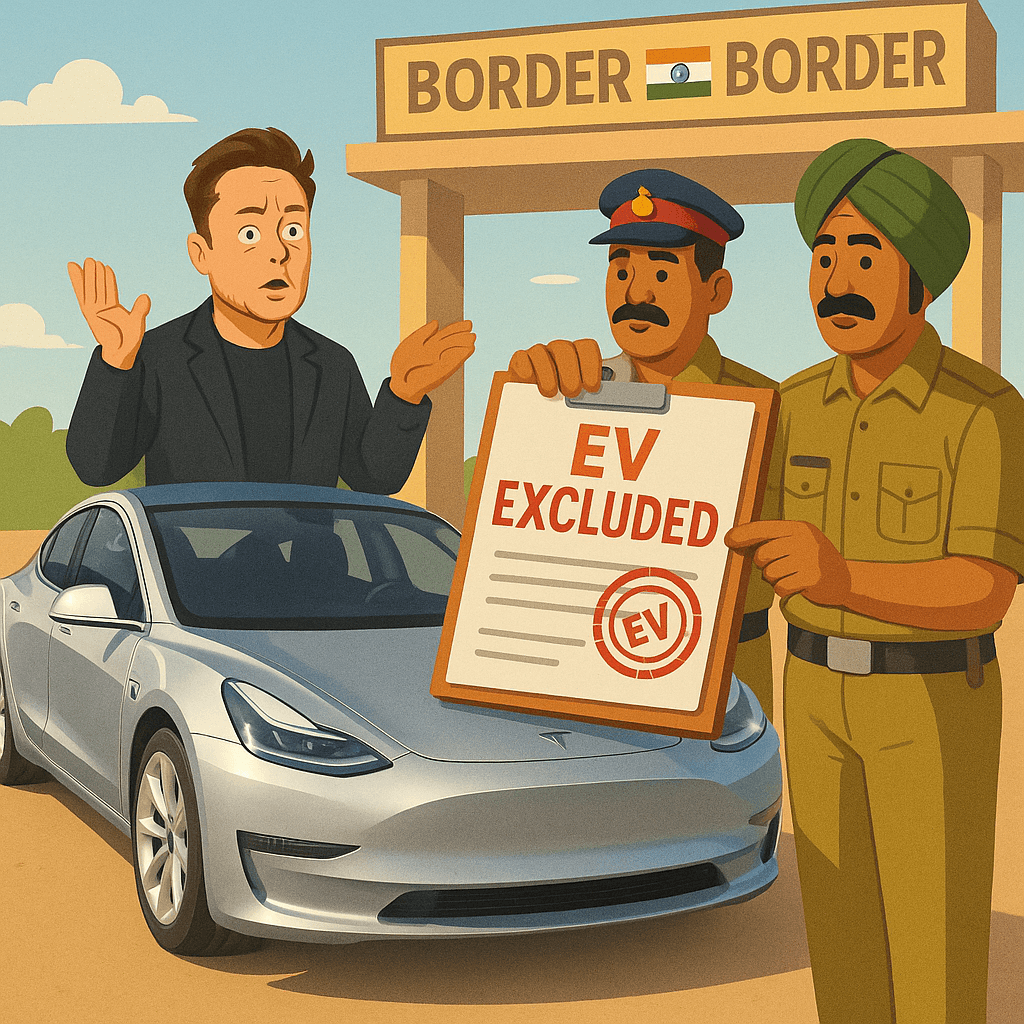
In a development that feels less like industrial policy and more like a cosmic prank on Elon Musk, Tesla is discovering that getting into India may be harder than landing a rocket on a barge. A new trade deal has largely excluded electric vehicles, neatly complicating Tesla’s long-teased market entry and confirming what many already suspected: the universe really enjoys watching billionaires squirm (The CSR Journal, Feb 2026).
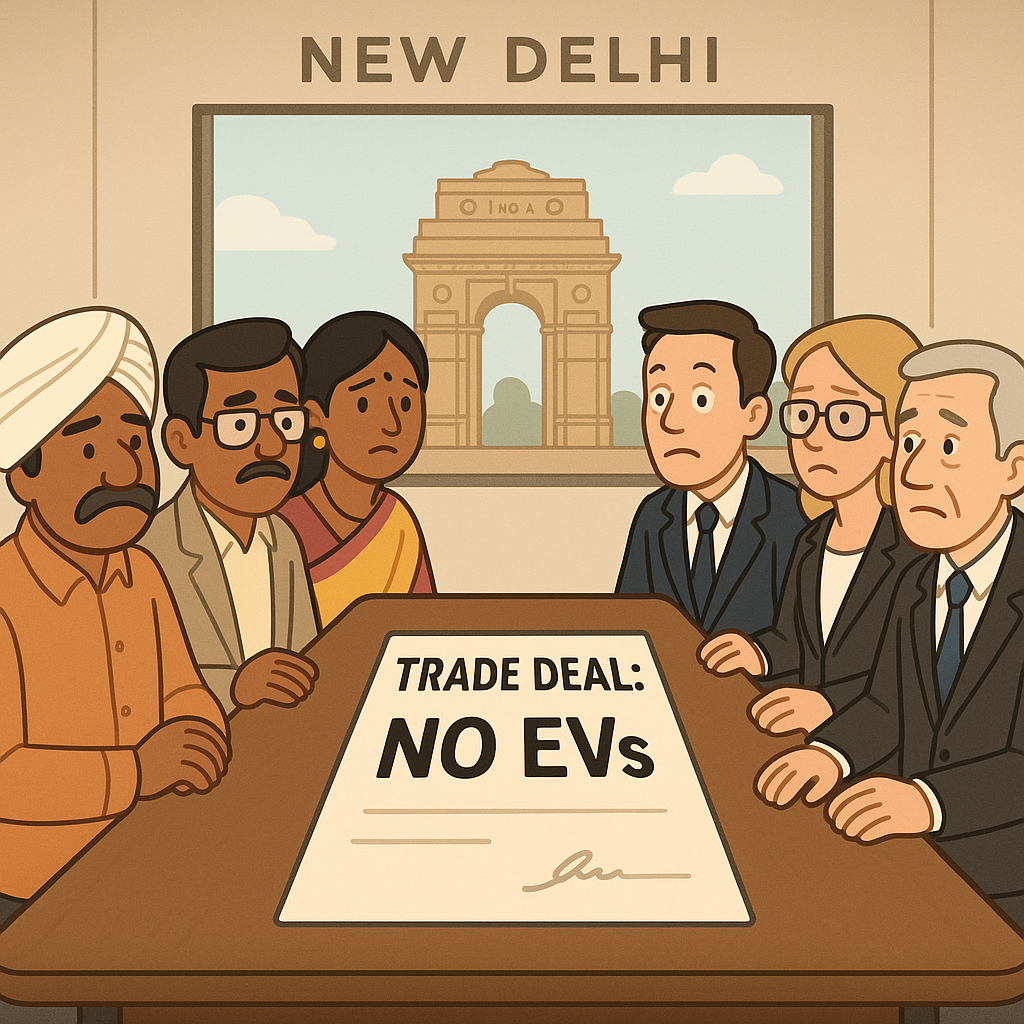
According to The CSR Journal, the trade framework aims to boost manufacturing, green growth, and all the usual buzzwords—just not in a way that involves imported EVs from a Silicon Valley–adjacent cult car company. While New Delhi touts its plan as a win for local industry, the fine print basically tells Tesla: "You’re welcome to come, as long as you don’t bring the only product you actually make."
Officials involved in the deal insist there’s no anti-Tesla bias, merely a desire to promote the government’s own Make in India agenda. Tesla, for its part, is used to skating around regulations—from U.S. labor complaints to European safety probes—so this is a new experience: a market that politely smiles and says, "No thanks, we have Ola already."
People close to the talks say the tension centers on whether Tesla will commit to building a serious manufacturing footprint in India rather than treating the country like an emerging-market outlet mall. The Indian government reportedly wants giga-factories, supply chains, and real jobs. Elon Musk, who runs five separate revolutions before breakfast, reportedly wants to send some Model 3s over, see how it feels, and then maybe do Mars stuff.
"We’re absolutely committed to India as a major strategic market," a hypothetical Tesla spokesperson did not say on any record. "Just as soon as India commits to bending reality to our margin profile and Twitter feed."
Behind the polite diplomacy lies an awkward truth: India wants to be a global EV hub without becoming a mere assembly line for Tesla. Tesla wants India’s 1.4 billion potential customers without dealing with all the tedious parts, such as:
- Building actual factories in places that are not called Fremont, Shanghai, or "future Mars dome"
- Respecting local industrial policy instead of subtweeting it
- Navigating a regulatory system that does not accept Dogecoin as an application fee
India’s EV policy is also heavily entangled with its broader industrial ambitions and love-hate relationship with foreign tech giants. Government advisors watch what happened with smartphones—where brands like Apple and the usual swarm of Android vendors used the country as both market and factory—and seem determined to avoid a rerun where all the IP and profits live in California while all the smog and payroll live in India.
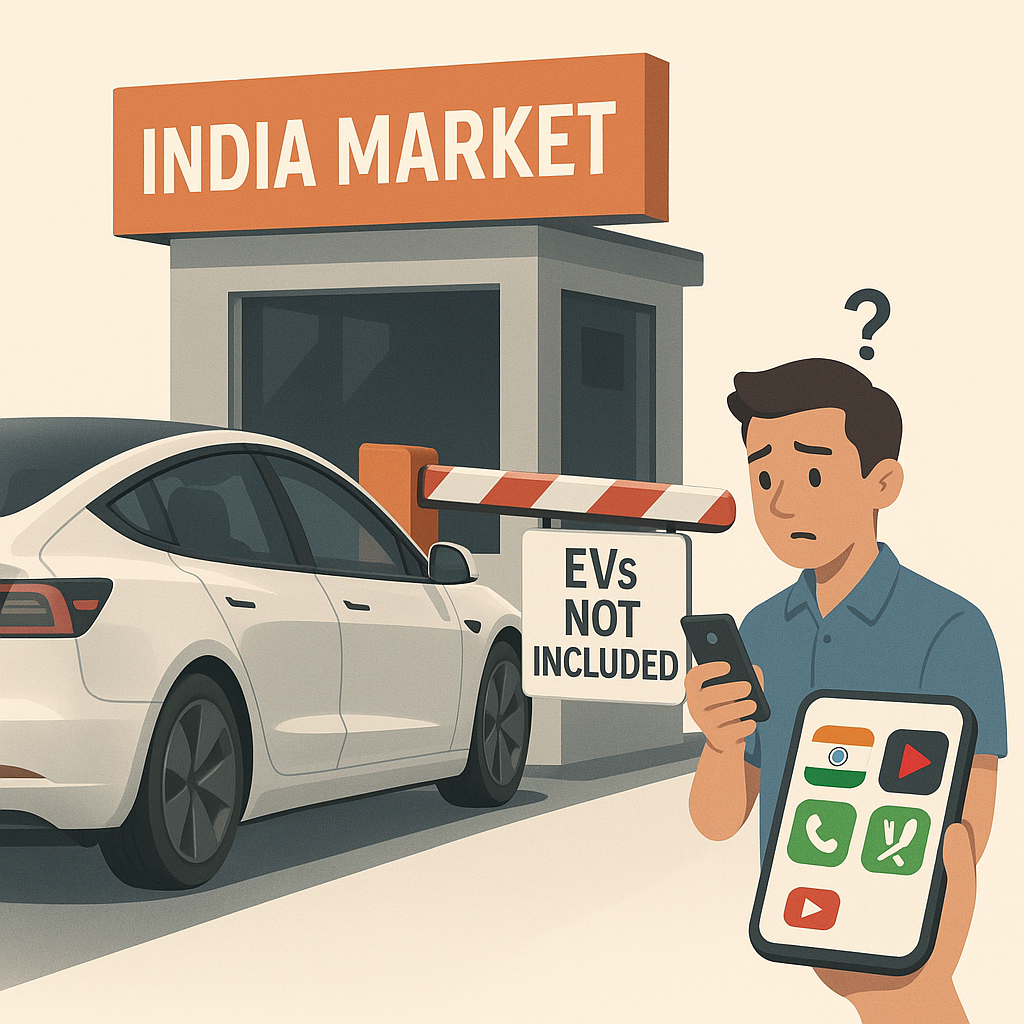
For Elon Musk, this is more than a minor commercial hiccup. India is one of the last truly massive growth markets where Tesla is not already a status symbol for people who say "bro" unironically. Missing India now risks ceding the field to Chinese EV makers, local startups, and whatever Frankenstein scooter OEM decides a steering wheel is "optional." It’s the kind of strategic blind spot that makes Wall Street analysts open a new tab and frantically Google "Tata EV stock."
Local policymakers, though, appear unfazed by Tesla’s mystique. One trade official, speaking off the record because on-the-record quotes have consequences, said: "If Elon really wants access, he can build here. We’re not begging global brands to treat us like a showroom with bad roads." He then reportedly asked, "Also, does the car work if there’s no app store signal? Asking for literally the entire countryside."
Musk’s own brand isn’t helping. Between trying to rebrand Twitter as X, picking fights with regulators, and livestreaming half-baked product demos, he has unintentionally strengthened the case of Indian bureaucrats who argue that betting the nation’s EV roadmap on his attention span is… risky. A senior policy analyst summarized it more politely: "We prefer partners whose five-year plan lasts at least five days."
Meanwhile, Indian consumers are trapped in a weird limbo. On one hand, they scroll Insta Reels of Tesla owners in California letting their cars drive them to overpriced coffee. On the other hand, their actual EV options look like someone shrunk a hatchback in the wash and forgot to add range. The demand for something aspirational is real; the government’s patience for another foreign company waltzing in with demands for tax breaks and hero worship is not.
Investors, naturally, are torn. Tech funds want Tesla in India because "EV + India" looks amazing in a pitch deck. Sovereign wealth funds would like to own the local champions instead. Retail traders are just typing "tesla india deal ev ban means buy or sell" into search bars and then clicking on the first YouTube video that yells loudest. Markets remain, as always, deeply rational.
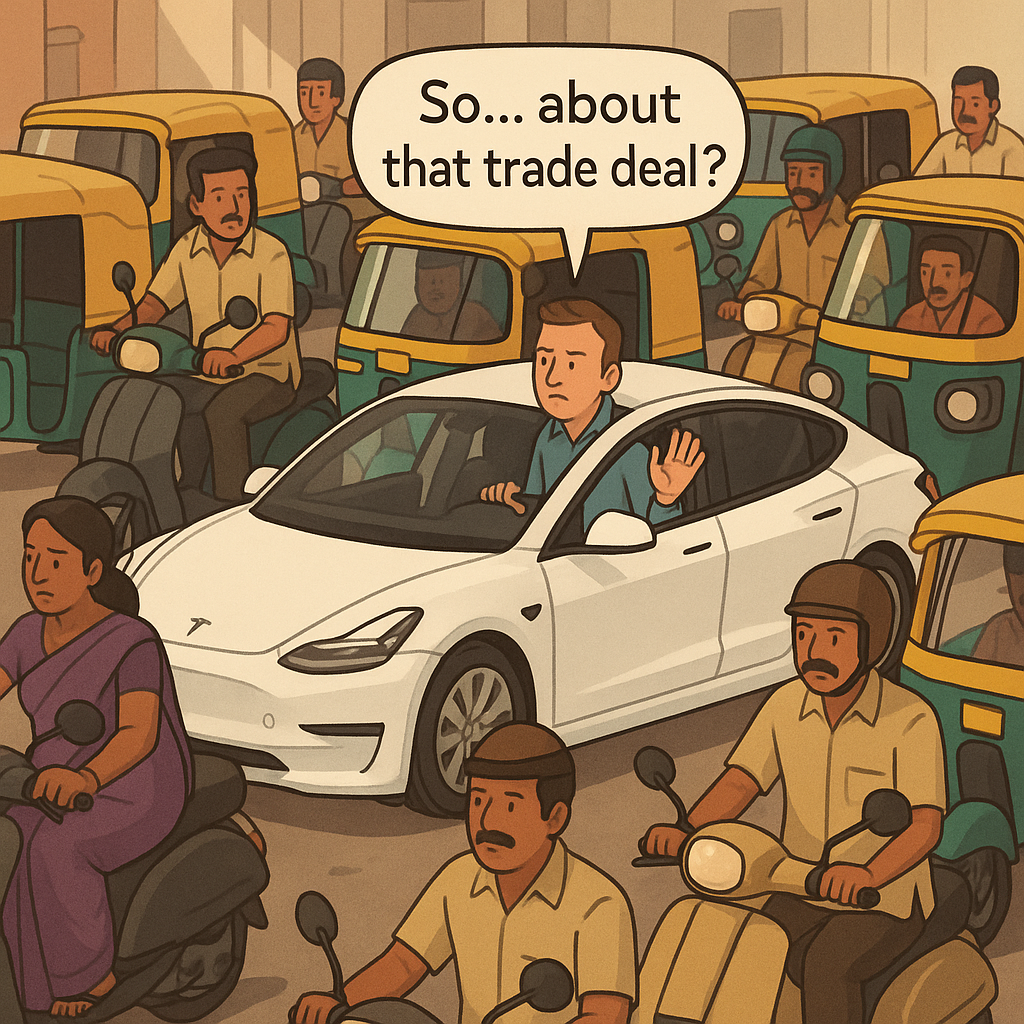
Still, there’s ample room for a twist. Tesla could swallow its pride, cut a deal with an Indian conglomerate, and churn out "Model Bharat" vehicles with slightly worse trim and aggressively patriotic ads. India could carve out a narrow EV exception in a future revision of the trade deal, slapping just enough conditions on it to make sure Tesla doesn’t treat the country like a discount dumping ground. Or Musk could decide that getting regulatory approval in India is harder than colonizing Mars and just pivot to selling flamethrowers to Bangalore startups.
For now, the EV giant and the world’s largest democracy are locked in a cautious, passive-aggressive courtship. New Delhi is saying, "Commit or don’t bother." Tesla is replying, "Text you later, just swamped with cybertrucks and brain chips." And 1.4 billion potential customers are stuck in the middle, watching a company famous for going fast discover what it’s like to hit a well-designed, policy-grade speed bump.
In the long run, India will almost certainly get more EVs, and Tesla will almost certainly find more countries to impress or annoy. But this episode is a useful reminder for investors and fanboys alike: no matter how high your stock price or how viral your memes, there is always at least one government somewhere willing to say, very calmly, "No, you first."